In the bustling, narrow lanes of Hyderabad's historic Dhoolpet area, long famed as the birthplace of the city's exquisite handmade paper kites, a quiet revolution is being acknowledged. For generations, the narrative of this vibrant trade has been dominated by the men who own the shops and front the businesses. However, as the Sankranti festival rush builds, a closer look reveals the true, often invisible, architects of this craft: the women.
The Silent Hands Behind the Soaring Kites
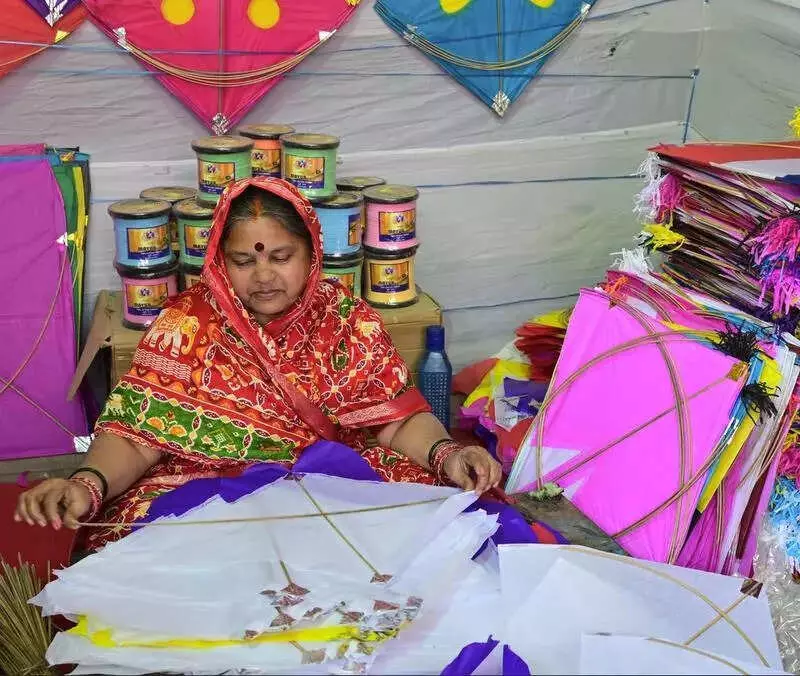
A visit to Dhoolpet ahead of the festive season reveals women at work in almost every establishment. Sitting in cramped rooms, on shaded verandahs, or in crowded backyards, they work with a focused silence, their pallus often drawn over their heads. Hunched over vibrant layers of coloured paper, their hands move with a practised, rhythmic precision—cutting, pasting, and aligning delicate bamboo frames. This meticulous work continues steadily inside, a stark contrast to the loud customer bargaining happening just outside their workspace.
For most of these women, kite-making was never a career choice but an inherited duty. Marriage traditionally marked the beginning of their apprenticeship. Entering their husbands' homes, they learned the craft from the ground up—observing first, assisting next, and gradually mastering the intricate process that defines a genuine Dhoolpet kite. Over years, they became the indispensable backbone of family-run enterprises.

Hansa Bai, 60, whose in-laws were kite makers for decades, explains, "For us, this work begins the day we get married. You come into the house and slowly you learn. First you watch, then you help, and one day you realise you can make the whole kite yourself." Today, her skilled hands produce close to 40,000 kites every Sankranti season.
"People think women just assist," Hansa Bai states, challenging the perception. "But one kite has to be handled at least 10 times. If your hand shakes even once, the kite will tear or fly badly. This work needs patience, not strength." Her grandson, Balaji Singh, 24, adds that the craft defined their childhood. "We didn't grow up seeing our grandmother rest. A Dhoolpet kite is not factory-made; it's paper stretched carefully on a thin bamboo frame, dried slowly and balanced by hand. That balance is something only experience teaches."
More Than Tradition: A Question of Survival
For many women, this craft transcended tradition to become a vital means of survival. After her husband's death, Aruna Bai, 57, took charge of her family's four-generation-old kite business. "There was no question of stopping. This is the work that fed us," she says. With no male heir, she proactively trained her four daughters in every facet of the trade, from craftsmanship to commerce.
"My daughters don't just make kites. They go to buy paper, negotiate rates, manage accounts. For 6-7 months, this is our life," Aruna Bai elaborates. "People ask why we didn't let the tradition end. But when you live with this work your whole life, you can't let it go."
The physical toll is significant. Sangeeta Bai, 60, who married into a kite-making family forty years ago, describes gruelling days that start before sunrise and end late at night. "I make around 500 kites every day. There are days when my back hurts, my eyes burn, but the work cannot stop," she shares.
Financial Strain and Unseen Bias
Despite decades of labour, financial security remains elusive for many artisans. Sangeeta Bai reveals the precarious nature of their finances: "This year I took a Rs 2 lakh loan on interest. Paper prices have increased, sales are uncertain, but the investment has to be made before the season begins." In the off-season, she shifts to making Ganesh idols to supplement income, a common practice for survival.
The dedication to the craft runs deep in family lineages. Sangeeta's married daughter, who returns home every year before Sankranti to help, says, "This work is in our hands, in our memory." She lists classic kite designs like ‘jibiya, jubba, lenga dho langot, lenga chibiya, and lenga chantara', noting, "These are not just names. Each one needs a different cut, a different balance."

However, the women also face persistent gender bias from some customers. Aarti Singh, 36, part of a third-generation kite-making family, encounters this regularly. "They ask where the man is. If they know a woman made the kite, they doubt its quality." Her response is both confident and poetic: "I tell them, try flying it once. The sky will answer."
As Hyderabad prepares for the sky to fill with colour this Sankranti, the stories from Dhoolpet serve as a powerful reminder. The flight of each handmade kite is a testament not just to a tradition, but to the patience, skill, and resilience of the women whose hands carefully guide them into the wind.