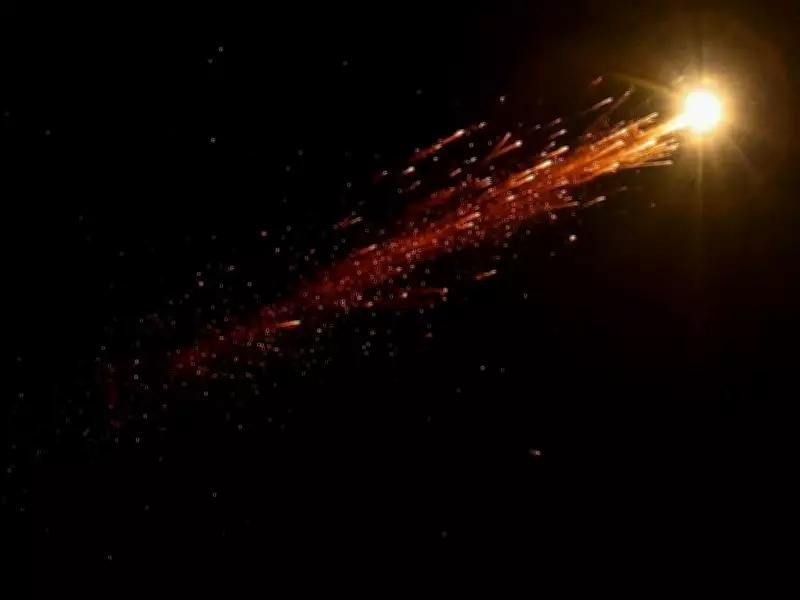
Iran Escalates Conflict with 64th Wave of Operation True Promise 4 Against Israel
In a significant escalation of hostilities in West Asia, Iran launched the 64th wave of Operation True Promise 4 against Israel on Thursday, as reported by the country's state media, Press TV. This latest offensive marks a continuation of the ongoing conflict that has seen a dramatic increase in military engagements between the two nations.
Background and Rationale for the Operation
Operation True Promise 4 was initiated by Iran in response to what it describes as an "unprovoked act of aggression" by the US-Israeli coalition against the Islamic Republic of Iran on February 28. According to Press TV, the Islamic Revolution Guards Corps (IRGC) and the Iranian Army have been conducting multiple strikes under this operation, which aims to retaliate against perceived threats to Iranian sovereignty.
Since the operation began, Iranian forces have carried out a total of 63 waves of missile and drone attacks prior to this latest escalation. These attacks have utilized advanced weaponry to target Israeli military facilities in occupied territories, as well as US bases and assets across the West Asia region. The operation underscores Iran's commitment to a sustained military campaign against its adversaries.

Israeli Retaliation and Military Actions
In response to Iran's offensive, the Israeli Defence Forces (IDF) have taken decisive action. The IDF announced that its Air Force destroyed an Mi-17 helicopter belonging to Iran at the Sanandaj Airport in Hamadan. This strike was based on precise real-time intelligence, as detailed in a post on the social media platform X.
The IDF stated that this action deepens the blow to Iran's military capabilities and expands Israel's aerial superiority in western Iran. The post read, "The Air Force destroyed an Mi-17 helicopter at the Sanandaj Airport in Hamadan. The IDF continues to deepen the blow to the military capabilities of the Revolutionary Guard Corps (IRGC) Air Force and to expand its aerial superiority in western Iran. Yesterday (Wednesday), based on precise real-time intelligence guidance, an Air Force aircraft identified and struck an 'MI-17' helicopter at the Sanandaj Airport in Hamedan."
Expansion of Conflict to Economic Targets
The conflict has further intensified with Israel striking Iran's South Pars Gas field on Wednesday night. According to a report by Axios, this move was coordinated with and approved by the White House, with US President Donald Trump giving it a green light. Israeli officials cited in the report indicated that Prime Minister Benjamin Netanyahu and President Trump coordinated the strike to deter Iran from disrupting oil supply through the Strait of Hormuz.
In retaliation, Iran targeted Qatar's Ras Laffan Industrial City with ballistic missiles, causing extensive damage. This attack on the world's largest liquefaction facility represents the second such incident in the last 12 hours, highlighting the broadening scope of the conflict to include economic and infrastructure targets.
Current State of the Conflict
The third week of the conflict in West Asia has witnessed a critical expansion in the scale of attacks mounted by both the US-Israel coalition and Iran. The exchange of strikes between the nations has created a volatile situation, with no immediate signs of de-escalation. The involvement of economic targets like gas fields adds a new dimension to the hostilities, potentially impacting global energy markets.
As both sides continue to engage in military operations, the international community watches closely, concerned about the potential for further escalation and its implications for regional stability. The ongoing conflict underscores the deep-seated tensions and the complex geopolitical dynamics at play in West Asia.