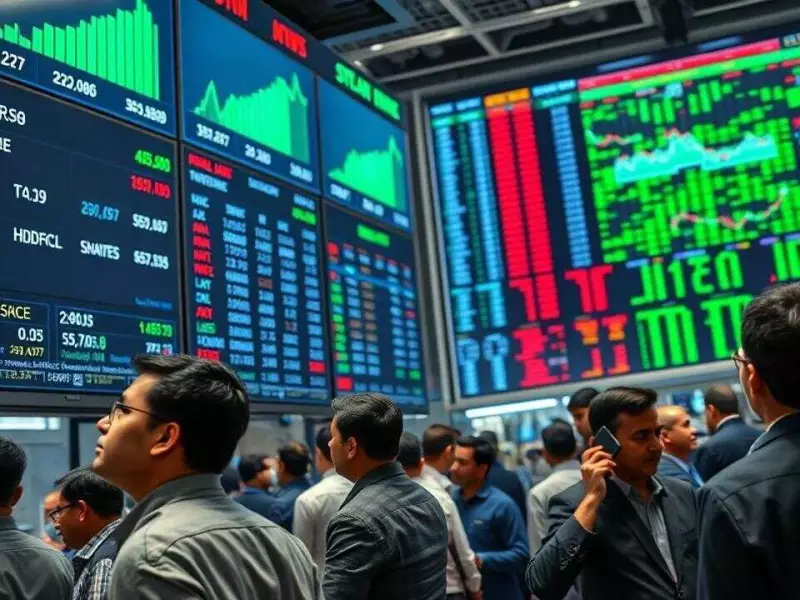
Stock markets across the Asia-Pacific region witnessed a powerful upswing on Monday, as investor sentiment was buoyed by the enduring artificial intelligence frenzy and growing anticipation of further interest rate reductions in the United States. This bullish momentum unfolded against the backdrop of a dramatic geopolitical development: the removal of Venezuela's President Nicolas Maduro by US military forces over the weekend.
Markets in Green: AI and Rate Cuts Fuel Optimism
The rally was broad-based, with major indices posting significant gains. Japan's benchmark Nikkei 225 index was the standout performer, skyrocketing by 1,419 points, or 2.8%, to close at 51,759. The surge was propelled by heavyweight technology stocks, with SoftBank Group climbing approximately 4% and semiconductor equipment giant Tokyo Electron advancing 5%.
In South Korea, the Kospi index jumped 2.66% to reach 4,424 points by 8:30 AM Indian Standard Time (IST). Mainland China's markets also joined the uptrend, with the Shanghai Composite rising 0.9% and the Shenzhen Component index gaining 1.77%. Hong Kong's Hang Seng Index (HSI) was relatively flat, managing a modest gain of 0.16% to settle at 26,381.

Analysts noted that the equity markets are continuing the strong upward trajectory established last year, driven predominantly by insatiable demand for shares of companies linked to the artificial intelligence revolution.
Venezuela Shockwave: Oil and Gold in Focus
While equities rallied, commodity markets reacted to the seismic political shift in Venezuela. In a bold operation early Saturday, US forces struck military installations in Caracas and transported President Nicolas Maduro and his wife to New York to face federal narcotrafficking charges.
This event immediately sharpened the global focus on Venezuela's crippled energy sector. As the holder of the world's largest proven oil reserves, the potential for the country to eventually return to higher production levels has raised concerns. A significant increase in Venezuelan crude supply could exacerbate the existing global oversupply and place additional downward pressure on oil prices.
After initial weakness in Asian trading hours, crude benchmarks managed to recover. Brent crude futures rose 0.28% to $60.92 per barrel, while the US benchmark West Texas Intermediate (WTI) edged up 0.16% to $57.41. US President Donald Trump stated that Washington would now "run" Venezuela, with American companies expected to play a key role in repairing the nation's heavily degraded oil infrastructure.
Long Road to Recovery for Venezuelan Oil
However, industry experts have swiftly tempered expectations, warning that restoring Venezuela's oil output will be a protracted and expensive endeavor, shrouded in political and economic uncertainty. Years of stringent international sanctions and severe under-investment have decimated the country's production capacity.
Current output has plummeted to around one million barrels per day, a stark decline from approximately 3.5 million barrels per day in 1999. "Any recovery in production would require substantial investment given the crumbling infrastructure resulting from years of mismanagement and underinvestment," UBS analyst Giovanni Staunovo told AFP.
The outlook for attracting fresh capital remains challenging. The oil market has already been grappling with a supply glut, and prices fell in 2025 amid headwinds like trade wars and geopolitical conflicts. Meanwhile, safe-haven asset gold attracted buying interest amid the uncertainty, with prices rising 1.28% to $4,388 per ounce.
The day's market movements underscore a complex interplay of technological optimism, monetary policy expectations, and sudden geopolitical shocks, setting a volatile stage for global finance in the days ahead.