Andhra Pradesh's Fertility Divide: Urban Centers Embrace Small Families as Tribal Areas Lag
Visakhapatnam: Amid ongoing concerns over fertility rates falling below replacement level in Andhra Pradesh, a distinct demographic gradient is visible across the rural, tribal, and urban pockets of north coastal AP. According to official data, there are 8.19 lakh mothers across the six north coastal districts — Alluri Sitharama Raju (ASR), Parvathipuram-Manyam, Visakhapatnam, Srikakulam, Vizianagaram, and Anakapalli.
Of these, 49.35% have one child, 44.53% have two children, and only 6.12% have three or more kids. The overwhelming dominance of one- and two-child families (93.88%) reflects the strong adoption of the small-family norm across the region.
District-Level Variations Reveal Uneven Demographic Transition
At a broader level, the data shows that fertility transition is well underway. However, beneath this overall convergence towards smaller families, district-level variations reveal an uneven pace of demographic change. The tribal districts of ASR and Manyam display comparatively higher proportions of larger families.

ASR stands out, with nearly 19% of mothers having three or more children — the highest among the six districts. Manyam records around 11% of mothers in this category. This indicates a relatively slower demographic shift in tribal areas, likely influenced by socio-cultural traditions, early marriage patterns, geographic isolation, and differing levels of access to education and healthcare.
In contrast, Visakhapatnam presents a markedly different pattern. With only about 3% of mothers having three or more children, it represents the most advanced stage of demographic transition.
The rural and semi-urban districts — Srikakulam, Vizianagaram, and Anakapalli — fall between these extremes. With 5 to 8% of mothers having three or more children, they demonstrate a gradual yet steady move towards smaller family norms.
Expert Insights on Changing Family Dynamics
Dr Santhosh Kumar Routhu, chief intensivist and head of the department of paediatric intensive care at KIMS Cuddles, Sheela Nagar, noted that the growing emphasis on education and career is often leading to later marriages and delayed childbirth.
"Medical technologies have also made pregnancies possible at later ages. People feel they can give more time, attention, and financial security if they have one or two children rather than more. Some couples are even opting for a DINK (double income, no kids) lifestyle. The one- or two-child norm has clearly become the social standard," he told ToI.
While the region as a whole has largely embraced the small-family norm, tribal pockets continue to exhibit higher fertility, and urban and semi-urban centres have moved closer to stabilisation.
Broader Implications for Andhra Pradesh's Demographics
These trends gain added significance as Andhra Pradesh's fertility rate, estimated at 1.5, falls below the replacement level of 2.1. This has sparked discussion on the long-term demographic and economic implications of sustained low fertility. The state government has already indicated plans to introduce a population management policy to address emerging demographic challenges.
Dr V Sreemannarayana Murthy, head of sociology department at Andhra University, said a declining population could have far-reaching repercussions. "Multiple factors are contributing to this trend. Long-term strategies need to be considered to manage demographic changes effectively," he opined.

Key Statistical Highlights from the Data
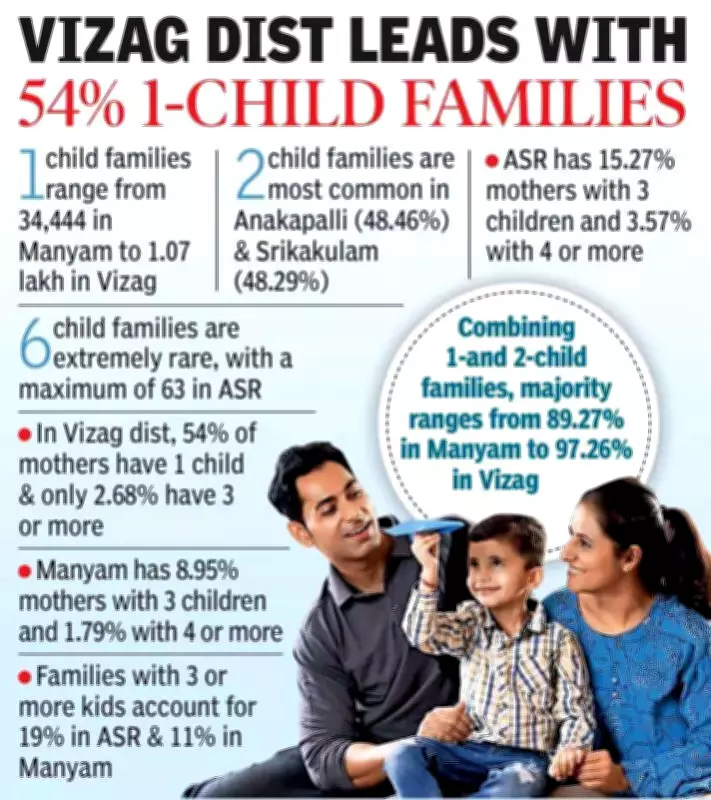
- One-child families range from 34,444 in Manyam to 1.07 lakh in Visakhapatnam
- Two-child families are most common in Anakapalli (48.46%) and Srikakulam (48.29%)
- ASR has 15.27% mothers with three children and 3.57% with four or more
- Six-child families are extremely rare, with a maximum of 63 in ASR
- In Visakhapatnam, 54% of mothers have one child and only 2.68% have three or more
- Manyam has 8.95% mothers with three children and 1.79% with four or more
- Families with three or more children account for 19% in ASR and 11% in Manyam
- Combining one- and two-child families, the majority ranges from 89.27% in Manyam to 97.26% in Visakhapatnam
The demographic patterns emerging from north coastal Andhra Pradesh highlight how socio-economic development, urbanization, and cultural factors interact to shape fertility behaviors. As the state grapples with below-replacement fertility levels, understanding these regional variations becomes crucial for formulating effective population policies that address both the challenges of declining fertility and the persistent disparities between tribal and urban areas.