Youth Incorporated and The Times of India Unveil Global University and Business School Rankings 2026
Youth Incorporated, in partnership with media collaborator The Times of India, has officially launched the annual Global University and Business School Rankings for 2026. This comprehensive analysis arrives at a pivotal moment for higher education, as institutions worldwide grapple with the transformative impact of artificial intelligence and evolving global student mobility patterns.
The AI Revolution in Academia: From Debate to Implementation
Just two years ago, university faculty were engaged in heated debates about whether students should be permitted to use tools like ChatGPT. Today, that discussion appears almost antiquated. In 2026, AI tools have become standard at leading universities, seamlessly integrated into student learning processes, assignment assessments, and institutional management from admissions to academic support.
The conversation has not vanished but has evolved into a more nuanced inquiry: not whether AI belongs in higher education, but whether universities are extracting genuine value from its implementation. The reality is mixed. Institutions that have fundamentally restructured their programs around AI—rethinking assessments, retraining faculty, and redesigning curricula—are producing graduates who are demonstrably better prepared for the modern workforce.

Conversely, universities that have merely attached a chatbot to outdated courses are failing to deliver meaningful benefits. Students are increasingly discerning this difference, and employers are following suit. A significant 65% of organizations worldwide now prioritize hiring based on demonstrated competencies rather than the prestige of a degree certificate. This represents not merely a trend but a structural shift in the employment landscape, with institutions that ignore it facing serious consequences.
This evolution does not diminish the importance of a degree; rather, it amplifies the significance of choosing the right program and institution. The events of February 2026 underscored this point dramatically, as approximately $830 billion in market value evaporated from global software stocks within weeks. AI is no longer just assisting knowledge workers; it is beginning to replace them in specific functions.
Recent developments, such as Anthropic's launch of specialized AI agents targeting finance, engineering, legal, accounting, and HR work, signal that these tools will reshape job categories that millions of students are currently training to enter. Consequently, how a university prepares its graduates has become more critical than ever before.
India's Economic Ascent and Its Implications for Education
India's economic trajectory adds a compelling dimension to these educational choices. In mid-2025, India surpassed Japan to become the world's fourth-largest economy. The Economic Survey 2025-26 projects GDP growth of 7.4% for FY26, marking the fourth consecutive year that India has been the fastest-growing major economy among its peers.
Additional milestones include the finalization of a long-awaited free trade agreement with the European Union in January 2026 and S&P's upgrade of India's sovereign credit rating in August 2025—the first such upgrade in 18 years. For students currently preparing for entrance exams, these developments indicate that the economy awaiting them upon graduation is both different and more promising.
The demand for international education among Indian students remains robust, with over 1.8 million enrolled overseas in 2025 and spending projected to reach approximately USD 70 billion in 2026. India continues to be the world's largest source of international students by a significant margin. However, the destinations for these students have undergone a notable transformation.
Canada, once the preferred destination for Indian students, has seen a rapid decline, with rejection rates for study permit applications hitting 71% through 2025. The United States has not fared much better, with F-1 visa issuances to Indian students dropping 44% in the first half of 2025 compared to the same period in 2024. Australia continues to process Indian students but applies considerably more scrutiny to new applications.

As a result, government immigration data shows that the number of Indian students actually departing for overseas study fell nearly 31% between 2023 and 2025. This gap has been filled by emerging destinations such as Germany, Ireland, and Spain, all of which have experienced sharp increases in Indian enrolments.
France, in particular, has openly declared its ambitions, setting a formal target of 30,000 Indian students by 2030 and actively conducting recruitment campaigns in India. The appeal is substantial: tuition fees that are a fraction of those in the US or UK, programs taught in English, and functional post-study work rights. For many students, this represents not a compromise but a financially sensible and considered choice.
This shift underscores a broader point: selecting where to study in 2026 demands a different calculus than it did just three years ago. While rankings remain important, factors such as visa stability, post-study work rights, employability data, and total degree cost are now equally critical. A university with higher prestige but located in a country with uncertain visa approval rates may no longer be the optimal choice.
2026 Global Undergraduate University Rankings: Stability and Consolidation
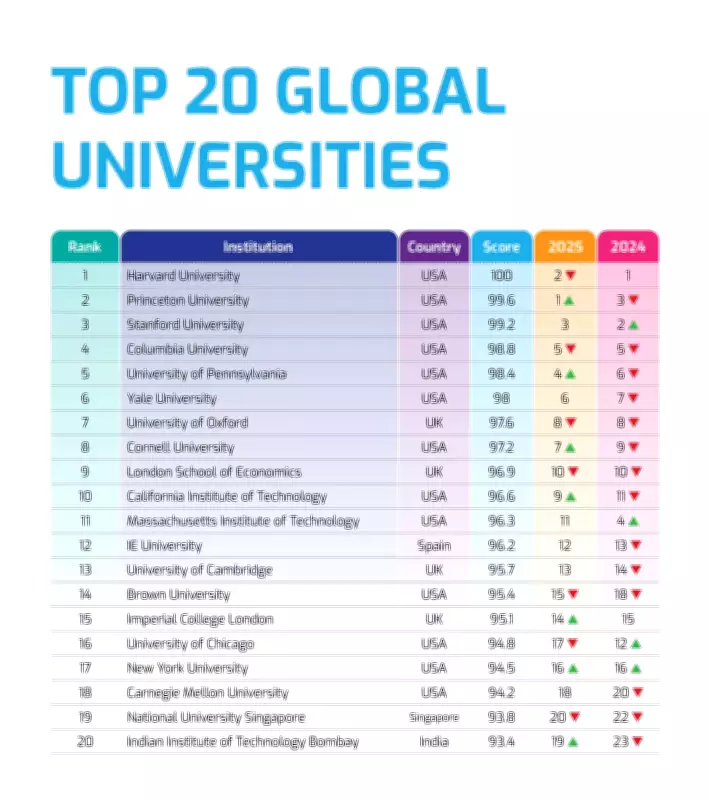
The Global University Rankings 2026 reveal a narrative of consolidation at the top. Harvard University maintains its first-place position, followed by Princeton in second and Stanford in third—a trio that has dominated the summit for several consecutive years. This consistency is not accidental; it reflects deep research funding, exceptional faculty quality, and decades of institutional investment that do not shift rapidly.
The tier immediately below follows a similar pattern, with Columbia, Penn, and Yale occupying fourth through sixth places. Oxford holds seventh, Cornell eighth, and the London School of Economics and Caltech complete the top ten. While minor movements occur, the defining characteristic of this year's undergraduate rankings is stability rather than disruption, with shifts measured in inches that mirror the slow pace of genuine institutional quality change.
MIT's placement at eleventh is notable, illustrating the extremely thin margins separating universities in this range and the intensely competitive landscape even for institutions of its caliber. Cambridge and Imperial College London also maintain strong positions within the top 20, demonstrating the UK's continued appeal for international students despite a more complicated visa environment.
India's performance requires a measured assessment. IIT Bombay at 20th globally remains the country's strongest result, with IIT Delhi close behind, confirming that India's leading technical institutions are internationally competitive. However, beyond these two, the rankings decline sharply, with IIT Kanpur and the University of Delhi positioned considerably lower. This exposes a persistent gap between India's elite institutions and its broader higher education system.
This gap highlights a larger tension: despite being the world's fourth-largest economy, producing more graduates annually than almost any country, and sending more students abroad than any other nation, India's domestic higher education system outside a small cluster of institutions is not yet robust enough to retain students with the means and grades to look elsewhere. While policy investments—such as new IIT seats, updated curricula, and emerging international branch campuses—are visible, structural improvement at scale takes time. The rankings currently reflect the system's present state rather than its aspirational trajectory.
2026 Global Business School Rankings: Adaptability and Career Focus
The Global Business School Rankings 2026 reflect a year of relative stability among elite institutions. Stanford University has reclaimed the top position in the MBA rankings, climbing from second place in 2025 and third in 2024. Harvard University follows in second place, having dropped from first last year. INSEAD University moves to third from fourth in 2025, while IE University reclaims fourth position after holding fifth in previous years.
The University of Pennsylvania (Wharton) demonstrates remarkable progress, now standing fifth compared to sixth and seventh in prior years. MIT has secured sixth place, up from eleventh in 2024. However, London Business School, which ranked first in 2024 and third in 2025, has fallen to seventh place in 2026. Within the top ten, Columbia University remains stable at eighth, HEC Paris continues at ninth, and Dartmouth College rounds out the list at tenth.
Beyond individual movements, the 2026 rankings underscore a broader shift in business education. Institutions are increasingly evaluated not only on legacy and academic rigor but also on employability outcomes, recruiter recognition, global exposure, and curriculum innovation. Strong employer pipelines, international mobility opportunities, and measurable career advancement have become key differentiators.
Among Indian institutions, IIM Ahmedabad and IIM Calcutta maintain steady but competitive positions within the top 20 global business schools. IIM Ahmedabad ranks thirteenth, down from eleventh in 2025 and eighth in 2024, while IIM Calcutta stands fifteenth compared to thirteenth in 2025. The Indian School of Business continues to hold its 30th position after significant improvements from 38th in 2024.
Overall, the 2026 rankings confirm that while leadership at the top remains consolidated, global business education is becoming more technologically adaptive, internationally connected, and intensely focused on real career impact. For students, reputation still matters, but global exposure, industry integration, and tangible career outcomes are increasingly defining the true value of a business degree.
Content Produced by Youth Incorporated Magazine