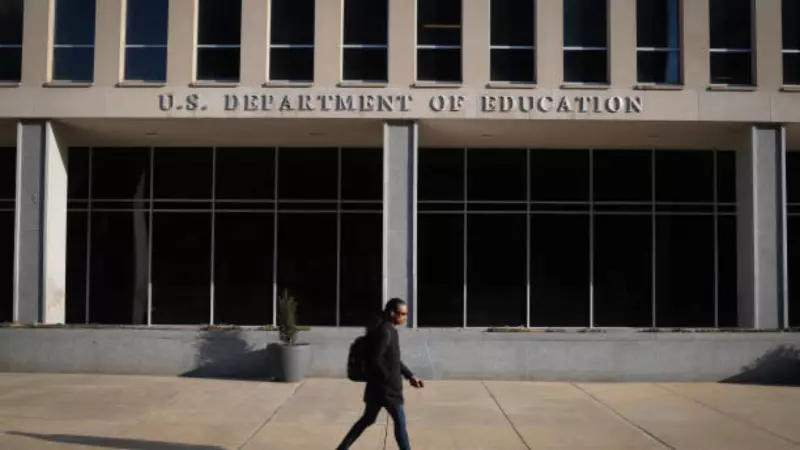
The United States Department of Education has concluded a landmark regulatory process, paving the way for sweeping reforms in how American colleges and universities are held accountable for their students' financial success. This development, stemming from President Donald Trump's Working Families Tax Cuts Act, is set to reshape the landscape of higher education, with significant implications for international students, including those from India.
A Single Accountability System for All Institutions
After concluding the third and final round of the Accountability in Higher Education and Access Through Demand-driven Workforce Pell (AHEAD) negotiated rulemaking committee meetings, the department announced a consensus on a new framework. The core principle is a single accountability system that will apply uniformly to all postsecondary institutions, whether they are public, private, non-profit, or for-profit. This move ends decades of what officials called "selective enforcement," where oversight previously depended on an institution's tax status rather than on the outcomes of its graduates.
The department's action is driven by mounting concerns over the nearly $1.7 trillion federal student loan portfolio and the burden of loan defaults on taxpayers. A key issue identified is that many students, burdened by high tuition, find themselves financially worse off after graduation, while their colleges have faced little consequence.

Earnings Thresholds and the "Do Not Harm" Standard
The agreed-upon rules align the Act's "Do Not Harm" standard with existing Financial Value Transparency and Gainful Employment regulations. This creates clear, earnings-based thresholds to determine if an academic programme provides sufficient financial value to its students.
Under the new system, if a specific programme fails to meet these earnings benchmarks for two out of three consecutive years, it will face severe penalties. The institution will lose access to the federal Direct Loan programme for students in that failing programme, and Pell Grant eligibility will also be revoked. Furthermore, if at least half of an institution's students receiving federal aid (Title IV) or half of its Title IV funding is linked to underperforming programmes, those programmes will no longer qualify for Pell Grants.
This rule applies to all levels of study, from short-term certificate courses to undergraduate and graduate degrees, ensuring a comprehensive approach to accountability.
Simplifying Oversight and Ensuring Stability
As part of the streamlined framework, negotiators agreed to remove the Gainful Employment debt-to-earnings measure. The Department of Education stated this metric was redundant, as it identified the same poorly performing programmes as the new earnings threshold. Its removal is intended to reduce administrative complexity for both colleges and the government while maintaining rigorous oversight.
Under Secretary of Education Nicholas Kent emphasised that these rules provide long-needed stability after years of fluctuating policies. He noted that institutions now have a clear framework for planning, while students and taxpayers gain stronger protection against low-value educational programmes.
The final agreement reportedly garnered broad support from a diverse group of stakeholders, including student representatives, college administrators, state agencies, businesses, and consumer advocates. Many welcomed the department's commitment to treating all institutions equally and creating durable rules likely to withstand changes in future administrations.
The rulemaking process, mandated by the Higher Education Act, involved extensive public consultation. The Department is expected to publish a formal Notice of Proposed Rulemaking in the coming months, opening a final period for public comment before the regulations are fully finalised.