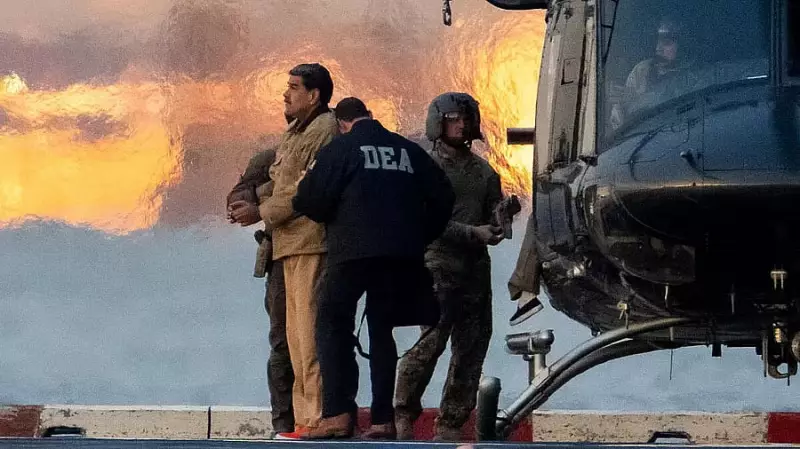
The United States has once again demonstrated its willingness to take decisive, unilateral action in its own backyard with the reported capture of Venezuelan President Nicolás Maduro. This dramatic event, which unfolded recently, has sent shockwaves through international diplomacy. What has drawn the most intense scrutiny, however, is not just the act itself, but the clear signal it sends: Washington is re-emphasizing the enforcement of its influence across the Western Hemisphere.
The Capture and Its Immediate Aftermath
While specific operational details remain closely guarded, credible reports confirm that Nicolás Maduro is now in US custody. This action represents the most direct and confrontational step taken by Washington against the Venezuelan government after years of sanctions, diplomatic pressure, and recognition of opposition leader Juan Guaidó as interim president. The move, executed with precision, underscores a shift from a policy of containment and pressure to one of direct intervention. The date of this pivotal event is noted as 11 January 2026, marking a new chapter in the long-standing political and humanitarian crisis in Venezuela.
Washington's Renewed Hemispheric Focus
Analysts are interpreting Maduro's capture not as an isolated incident, but as the centerpiece of a broader strategic recalibration. For years, critics argued that US attention had drifted from Latin America towards other global theatres like the Indo-Pacific and Eastern Europe. This operation decisively counters that narrative. It is a stark reminder of the Monroe Doctrine's enduring shadow, where the US asserts its right to intervene in the Americas to protect its interests and promote its vision of governance. The renewed emphasis appears to be a multi-pronged strategy involving:
- Military and Security Assertion: Demonstrating the capability and will to conduct high-stakes operations.
- Political Re-ordering: Seeking to physically remove a regime it deems illegitimate to catalyze political change.
- Geopolitical Signaling: Sending a clear message to other regional actors about the limits of US tolerance.
Global Reactions and Future Implications
The international response is likely to be sharply divided. While US allies may offer cautious support, nations like Russia, China, Iran, and several Latin American countries are expected to condemn the action as a blatant violation of sovereignty and international law. The long-term consequences are profound and uncertain. Key questions now loom large:
Will this lead to a stable transition in Venezuela, or plunge the country into further instability? How will other left-leaning governments in the region, from Cuba to Nicaragua, respond? Does this mark the beginning of a more interventionist US era in Latin America? The capture of Maduro is more than a headline; it is a geopolitical earthquake whose aftershocks will reshape diplomatic relations and power dynamics across the Americas for years to come. The world now watches to see if this "US way" will bring resolution or deeper conflict.