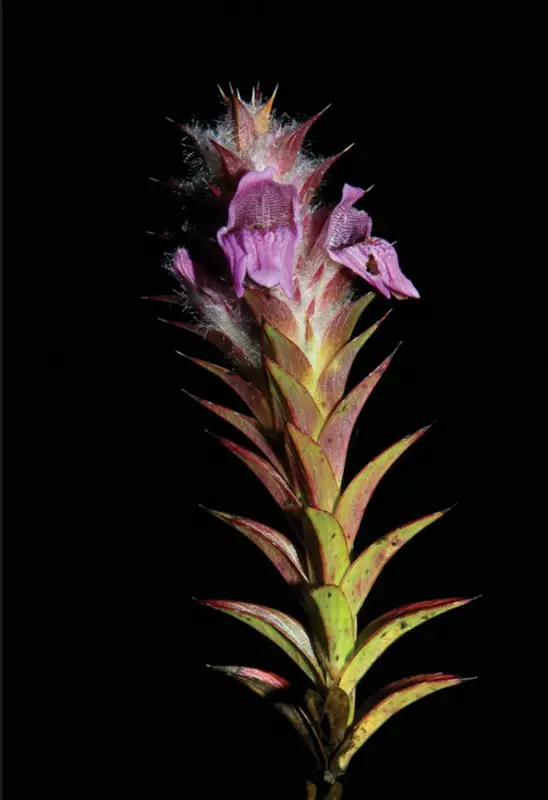
In a remarkable discovery for Indian botany, a rare flowering herb, lost to science for over a century and a half, has been found again in the Western Ghats. The plant, known scientifically as Lepidagathis clavata and locally as Koch, was first documented 166 years ago and has now been studied anew, revealing its extraordinary seven-year flowering cycle.
A Botanical Mystery Rediscovered
The story of this elusive plant begins in 1851, when it was first discovered by N A Dalzell on the Chorla plateau. For the next 166 years, the herb remained largely unseen and unstudied, becoming a botanical enigma. Its existence was confirmed only recently when a dedicated research team, led by doctoral researcher Rutuja Kolte-Khanolkar, rediscovered it on the Chaukul plateaus in Sindhudurg district.
The team's significant findings have now been published in the Journal of Threatened Taxa in its December 26, 2025 issue. The paper is co-authored by Rahul Khanolkar, Sharad Kambale, Prabha Pillai, Gunadayalan Gnanasekaran, and Malapathi Janarthanam alongside Kolte-Khanolkar.

The Unique Seven-Year Life Cycle
The research has shed light on the plant's bizarre and rare reproductive behaviour. Lepidagathis clavata exhibits what is known as monocarpic plietesial behaviour. This means the plant flowers only once in its lifetime, sets seed, and then dies. Crucially, all individuals in a population synchronize this event, flowering simultaneously in a spectacular natural display.
Similar to the well-known Karvi (Strobilanthes species), this herb has a long vegetative growth period. The researchers documented that all Koch plants at Chaukul flowered in November 2016. After seed maturation, the plants died during the 2017 monsoon, making way for new seedlings to emerge from the seeds. Faithful to its cycle, the next generation flowered precisely seven years later, in November 2024.
Critical Status and Future of Conservation
The International Union for Conservation of Nature (IUCN) has already listed Lepidagathis clavata as Critically Endangered, highlighting its precarious existence. The plant is endemic to the rocky plateaus of the Western Ghats, a biodiversity hotspot under constant threat.
Despite this exciting rediscovery, scientists emphasize that much about the herb remains a mystery. The research paper clearly states that further detailed studies and continuous long-term monitoring are urgently required. Understanding its full life cycle, ecological role, and specific threats is vital to formulating an effective conservation strategy to ensure this rare natural wonder does not vanish again.
The rediscovery of Koch underscores the incredible, often hidden, biodiversity of India's Western Ghats and the continuous need for dedicated botanical exploration and preservation efforts.