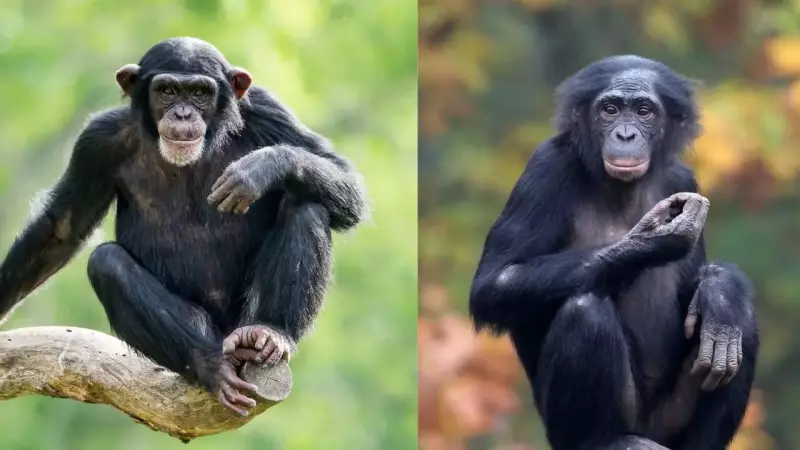
Sharing over 98% of our DNA, chimpanzees and bonobos stand as humanity's closest living relatives. Yet, these two primate species, separated by the mighty Congo River, exhibit remarkably different societies, behaviours, and physical traits. Their contrasting worlds offer a profound window into how environment shapes evolution and provide critical insights into our own human origins.
Two Species, Two Worlds: Taxonomy and Habitat
For years, bonobos were mistakenly classified as a subspecies, often called 'pygmy chimpanzees'. It was only in 1954 that they were officially recognised as a distinct species: Pan paniscus, while chimpanzees are Pan troglodytes. Both belong to the genus Pan and the great ape family, Hominidae.
Their geographical separation is stark. Chimpanzees are found across twelve nations in East, Central, and West Africa. Bonobos, however, live exclusively south of the Congo River in the Democratic Republic of the Congo. This river has acted as an impassable barrier for millions of years, allowing the two species to evolve independently.

Contrasting Societies: Conflict vs Cooperation
The social structures of these apes could not be more different, offering a natural study in conflict and cohesion.
Chimpanzee society is male-dominated and fiercely hierarchical. Alpha males control territory and mating through aggression, and infanticide is a recorded tactic to improve reproductive success. Their groups are characterised by competition for food and mates.
In a striking contrast, bonobo society is matriarchal and centred on female alliances. Strong bonds between females shape group dynamics. Bonobos are famous for using socio-sexual behaviour to diffuse tension, resolve conflicts, and strengthen social bonds. While young females may leave to join new groups, males stay in their natal groups, reinforcing the stable female-led network.
Physical Traits and Diet: Spotting the Differences
At first glance similar, key physical distinctions set them apart. Bonobos are more slender with longer legs and less sexual dimorphism. They are born with dark faces and striking bright pink lips. Chimpanzees are more robust, with males significantly larger than females. Their faces are light at birth but darken with age, and they have dark lips.
Dietarily, both are primarily frugivores. However, chimpanzees are more predatory, with males hunting smaller primates like colobus monkeys to gain social status. Bonobos also hunt but are more likely to share the spoils communally, reflecting their cooperative ethos.
Communication, Tools, and Conservation
Their communication styles mirror their social temperaments. Chimpanzees use lower-pitched barks, grunts, and screams signalling aggression or alerts. Bonobos communicate with higher-pitched squeals and soft vocalisations linked to social bonding and play.
Tool use is well-documented in chimpanzees, who use sticks, leaves, and rocks for foraging. Mothers teach these skills to their young, indicating cultural transmission. While bonobos in captivity use tools, observed instances in the wild are less frequent.
Tragically, both our closest cousins are endangered, as listed by the IUCN. They face existential threats from habitat destruction, poaching, and climate change. Conservation efforts, inspired by pioneers like Jane Goodall, are critical not only for biodiversity but for preserving a living library of our own evolutionary past.
Studying chimpanzees and bonobos is more than primatology; it's a quest to understand the intricate dance between genes and environment that shaped them, and ultimately, us.