Security forces at the heavily guarded Ram Janmabhoomi complex in Ayodhya were put on high alert on Saturday evening following a concerning incident. A 55-year-old man from Jammu and Kashmir entered the temple premises and was allegedly attempting to offer namaz near a restricted zone, prompting immediate intervention by alert personnel.
Immediate Detention and Questioning
The individual was identified as Abu Ahmad Sheikh, a resident of Wodapora village in Shopian district, Jammu and Kashmir. Officials stated that Sheikh had completed his darshan and was in the process of exiting the campus when his actions near the southern circumambulatory corridor, close to the Sita Rasoi area, drew the attention of security staff. He was promptly restrained.
Sources indicate that the man raised slogans after being stopped, which led to intelligence agencies and police teams swiftly taking charge of the situation. He was taken to the Ram Janmabhoomi police outpost located within the complex for detailed interrogation. The questioning is being conducted under the supervision of SP (Security) Balramachari Dubey.

SSP Ayodhya Gaurav Grover confirmed that the man's background is being thoroughly verified, and a detailed report has been requested from the Jammu and Kashmir Police. "No suspicious object has been recovered from his possession so far," Grover stated, emphasizing that the matter is being examined from every possible angle. The district administration and the Ram Temple Trust have not released an official statement yet.
Former Police Chiefs Sound Alarm on Temple Security
This incident has sharply refocused attention on the security architecture of the Ram temple, with former directors general of police (DGPs) warning that protections must be absolute and constantly evolving.
Former DGP Vikram Singh asserted that the event highlights why even the smallest lapse cannot be tolerated. "The Ram Janmabhoomi complex is not just a place of worship; it is the holiest centre of Sanatan faith. The sheer number of pilgrims visiting... reflects its sanctity and also its vulnerability," he said. Singh cautioned that provocative statements from fringe elements could mislead susceptible individuals. "Today's incident involving a Kashmiri man is another indicator that fanatics... may try devious routes to test the system," he added.
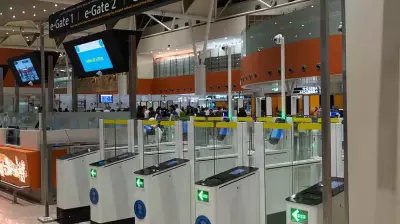
He strongly advocated for mandatory facial recognition systems, real-time identification of undesirable elements, and strict airport-style access protocols. "Entry should be like boarding an aircraft—no mobile phones, no electronic gadgets... Anyone attempting mischief must know there will be serious and unavoidable consequences," Singh stressed.
Echoing this sentiment, former DGP OP Singh described security in Ayodhya as a "living system" that must continuously adapt. "Regular technological upgrades, intelligence coordination and constant human preparedness are not optional—they are essential," he stated.
Multi-Layered Security and Rising Threat Perception
The current security setup at the Ram Janmabhoomi complex is a multi-layered grid. Access is strictly regulated through different gates for common darshan, Sugam Darshan, wheelchair access, and VVIP pass-holders. The inner cordon security is managed by the CRPF, supported by six companies of the force, along with 12 companies of the Uttar Pradesh Special Security Force (SSF) and PAC deployed across various layers.
The renewed security focus is not without context. The temple has faced a series of threats over the past year, including:
- A WhatsApp message in August 2024 threatening to destroy the temple with "4,000 kg of RDX," leading to an arrest by the UP Anti-Terrorism Squad.
- A threat traced to a minor in Kushinagar.
- A bomb threat issued by SFJ chief Gurpatwant Singh Pannun in November 2024.
Since the consecration of Ram Lalla, the temple attracts around 1.5 lakh devotees daily, significantly amplifying security challenges. In response to repeated threats and rising footfall, the state government is preparing to establish a permanent NSG hub in Ayodhya to bolster rapid response capabilities.

Both former DGPs concluded that incidents like Saturday's detention should serve as critical reminders for sustained vigilance. They emphasized that advanced screening, proactive intelligence, and an ever-evolving security strategy are paramount to safeguarding the temple's sanctity in an increasingly complex threat landscape.