Governor Shukla Advocates for Indian Knowledge Systems in Modern Education
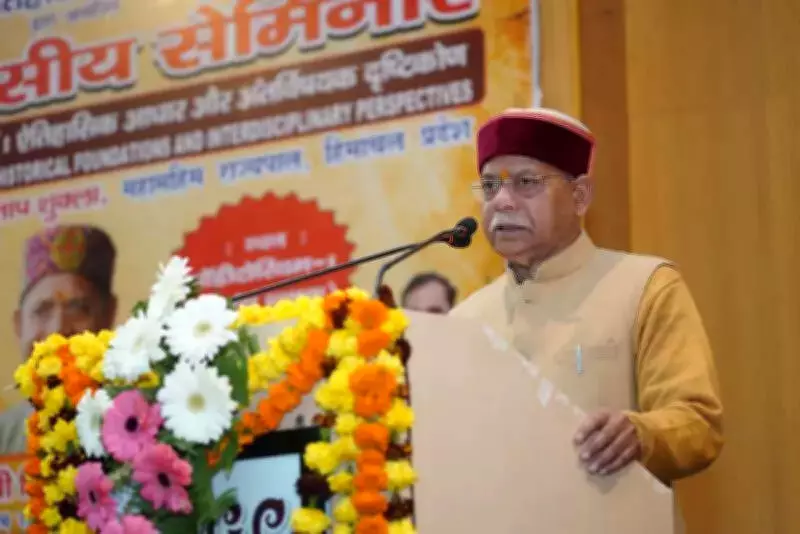
In a significant address at a seminar in Lucknow, Himachal Pradesh Governor Shiv Pratap Shukla passionately highlighted the profound historical depth, contemporary relevance, and interdisciplinary potential of Indian Knowledge Systems (IKS) within higher education. The event, organized by the history department of National PG College, served as a platform to discuss the integration of traditional wisdom with modern academic frameworks.
Historical Contributions and Global Recognition
Governor Shukla underscored India's early and substantial contributions to global knowledge across various fields. "India's pioneering advances in mathematics, astronomy, medicine, governance, and political economy have significantly enriched world understanding," he stated. He pointed to renowned scholars such as Aryabhata in mathematics and astronomy, and Charaka and Sushruta in medicine, whose documented works remain foundational.
Furthermore, Shukla referenced historical travellers like Fa-Hien and Hiuen Tsang, who acknowledged India as a major centre of learning during their visits. "These accounts counter colonial-era stereotypes that often overlooked or misrepresented India's intellectual legacy," he emphasized, challenging narratives that have historically marginalized indigenous knowledge.

Core Principles and Ethical Foundations
The Governor elaborated on the core principles embedded within Indian Knowledge Systems, which promote equality, ethical responsibility, and holistic education. "Indian knowledge traditions uniquely combine external and inner knowledge, offering a comprehensive approach that should guide contemporary teaching, research methodologies, and institutional values," he explained.
He particularly highlighted the Gurukul system under Rishi Vashishtha as a model of inclusivity. "In this system, students were treated equally regardless of their background, and discrimination had no place. This principle of fairness remains vital for modern educational practices," Shukla asserted, advocating for its relevance today.
Reinterpreting Historical Systems
Addressing misconceptions, Shukla provided a nuanced perspective on the Varna system. "Originally, the Varna system was based on guna (qualities) and karma (actions), not birth, highlighting India's long-standing principles of fairness and inclusivity," he clarified. This reinterpretation aims to correct colonial narratives that stereotyped Indian society, often ignoring its legacy as a global hub for learning and intellectual exchange.
Call for Integration and Contemporary Application
Governor Shukla stressed the urgent need to integrate traditional knowledge with modern education. "By weaving Indian Knowledge Systems into current curricula and pedagogy, we can foster a more balanced and ethically grounded educational environment," he said. He argued that this integration not only preserves cultural heritage but also enhances critical thinking and holistic development among students.
The seminar concluded with interactive paper presentations by students and faculty, which reinforced the importance of incorporating IKS into academic frameworks. Participants engaged in discussions that reaffirmed the value of these systems in addressing contemporary challenges and enriching educational outcomes.
In summary, Governor Shiv Pratap Shukla's address in Lucknow serves as a compelling call to action for educators and policymakers to embrace Indian Knowledge Systems. By recognizing their historical significance and modern applicability, higher education can evolve to be more inclusive, ethical, and globally informed, ultimately countering outdated stereotypes and fostering a renewed appreciation for India's intellectual contributions.