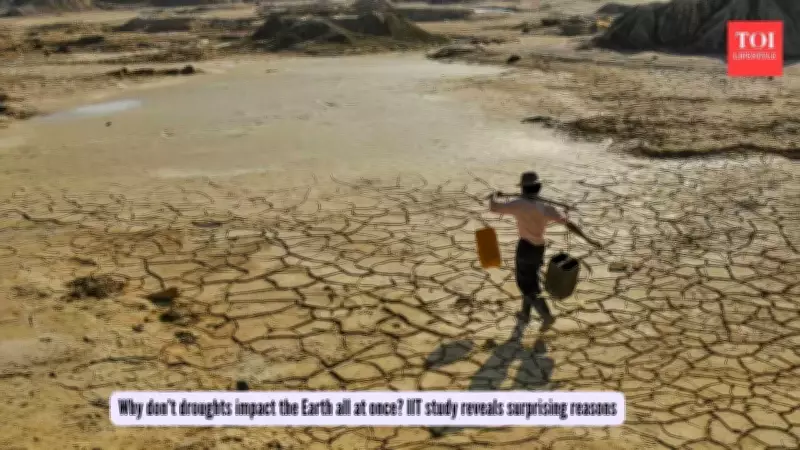
Nature's Warning Signs and the Hidden Safety Net Against Global Drought
Climate change has been delivering increasingly dire warnings about the potential transformation of the world's most productive agricultural regions into barren dustbowls. The threat looms large over wheat fields in Ukraine, rice paddies across Asia, and the expansive corn belts of the United States. The frightening scenario of simultaneous crop failures across multiple continents could lead to empty supermarket shelves, skyrocketing food prices, and widespread hunger spreading across nations.
This nightmare scenario has kept policymakers and scientists awake at night, but groundbreaking new research suggests nature may have built-in protective mechanisms we haven't fully appreciated until now. A comprehensive study reveals eye-opening facts about how Earth's climate systems naturally limit the synchronization of drought events across the globe.
Understanding the Limited Synchronization of Global Droughts
A research team from India's prestigious IIT Gandhinagar, led by Dr. Udit Bhatia, conducted an extensive analysis of climate data spanning from 1901 to 2020. Their findings reveal that synchronized droughts affect just 1.8% to 6.5% of Earth's surface at any given time, providing a crucial buffer against simultaneous global crop failures.

The researchers employed innovative modeling techniques, treating drought onsets as events within a global network. Dr. Bhatia explained their methodology: "We treated drought onsets as events in a global network. If two distant regions entered drought within a short time window, they were considered synchronised." This approach allowed the team to map connections between regions experiencing dry spells close together in time.
The Ocean's Role in Preventing Global Drought Alignment
The study identifies ocean temperature shifts, particularly the El Niño-Southern Oscillation (ENSO), as the primary mechanism preventing droughts from aligning everywhere simultaneously. During El Niño phases, specific regions like Australia transform into what researchers call "drought hubs," while La Niña phases scatter drought impacts geographically across different areas.
Co-author Danish Mansoor Tantary elaborated on these findings: "These ocean-driven swings create a patchwork of regional responses, limiting the emergence of a single, global drought covering many continents at once." This natural variability creates a protective distribution pattern that prevents the worst-case scenario of simultaneous agricultural collapse across all major food-producing regions.
Identifying High-Risk Drought Regions and Agricultural Vulnerabilities
The research specifically highlighted several regions most prone to drought synchronization, including Australia, South America, southern Africa, and certain parts of North America where droughts frequently overlap. These areas represent critical agricultural zones with heightened vulnerability to climate impacts.
Hemant Poonia from IIT Gandhinagar provided concerning statistics about crop failure probabilities: "In many major agricultural regions, when moderate drought occurs, the probability of crop failure rises sharply, often above 25%, and in some areas, above 40–50% for crops like maize and soybean." These numbers underscore the significant risk even moderate drought conditions pose to global food production.
The Changing Dynamics of Drought Drivers
While rainfall patterns remain the dominant factor driving drought severity globally, accounting for approximately two-thirds of drought conditions, the study reveals a significant shift in contributing factors. Rising temperatures now claim a growing one-third share of drought severity, particularly in Europe and Asia where warming trends are most pronounced.
Dr. Rohini Kumar from the Helmholtz Centre for Environmental Research commented on this evolving dynamic: "Rainfall remains the dominant driver globally, especially in regions like Australia and South America, but the influence of temperature is clearly growing in several mid-latitude regions, such as Europe and Asia." This indicates that future drought patterns may increasingly reflect temperature-driven moisture loss rather than just precipitation deficits.

Strategic Implications for Global Food Security
The research carries profound implications for how humanity approaches food security in an era of climate uncertainty. Professor Vimal Mishra emphasized the importance of adaptive strategies: "These findings underline the importance of international trade, storage, and flexible policies. Because droughts do not hit all regions at the same time, smart planning can use this natural diversity to buffer global food supplies."
The study suggests that strategic international cooperation, diversified food sourcing, enhanced storage infrastructure, and flexible agricultural policies can leverage nature's built-in protection against synchronized droughts. By understanding and working with these natural patterns rather than against them, humanity can develop more resilient food systems capable of withstanding climate challenges.
This research provides both a warning about the vulnerabilities of our current agricultural systems and a roadmap for building greater resilience through scientific understanding of Earth's natural climate patterns. The findings offer hope that strategic human intervention, informed by nature's own protective mechanisms, can help prevent the worst-case scenarios of global food system collapse.