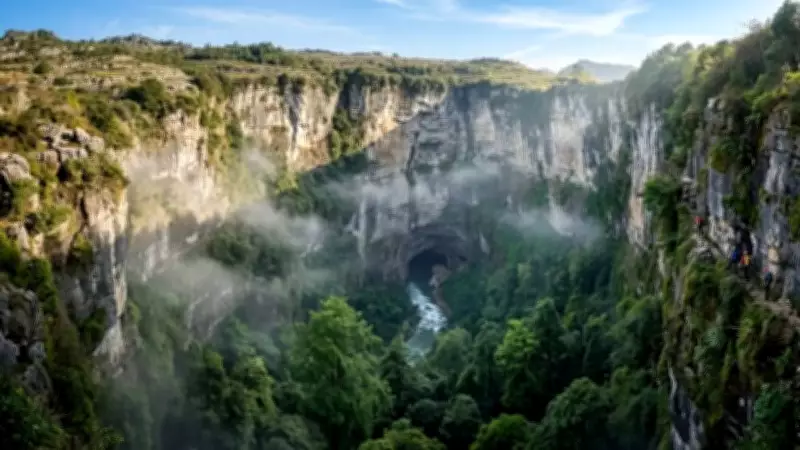
China's 'Heavenly Pits': Nature's Vertical Greenhouses
China's remarkable 'Heavenly Pits,' known as Tiankeng, are colossal sinkholes formed through the gradual dissolution of carbonate bedrock, primarily limestone, by powerful underground rivers over millennia. These geological wonders result from the collapse of massive underground caves, creating vertical chasms that plunge 500 to 600 meters deep, as documented by UNESCO.
Formation and Structure of Tiankeng
The formation process begins with underground rivers carving extensive voids in the rock. Over time, erosion or tectonic shifts weaken the cave roofs, leading to dramatic collapses that produce these deep, enclosed depressions. According to research on ResearchGate, their great depth and verticality establish a semi-isolated physical barrier, crucial for maintaining unique environmental conditions.
Microclimates and Thermal Buffers
These sinkholes function like natural greenhouses, trapping heat and moisture to create stable, humid climates. The 'thermal buffer' effect arises from temperature differentials between the pit bottoms—cooler in summer and warmer in winter—and the external air. This stability, combined with humidity from internal river systems, shields the interiors from outside atmospheric fluctuations.

Biodiversity and Evolutionary Refuges
Tiankengs are hailed as 'evolutionary islands' or biological refugia due to their isolation by sheer cliffs. They harbor over 1,200 species, including ancient forms like ginkgo trees and rare animals such as the Chinese giant salamander. The Journal of Karst Mountain Sinkhole notes that many species here have survived extinction or alteration in the external world, preserved from climate change and human impacts.
Air Quality and Forest Growth
Inside these pits, air quality differs markedly from above, with dense vegetation and moisture sources like waterfalls generating high levels of negative oxygen ions and humidity. This micro-atmosphere prevents soil erosion and supports massive trees, some exceeding 40 meters tall, protected from destructive plateau winds.
In summary, China's Heavenly Pits are not just geological marvels but vital sanctuaries for ancient life, offering insights into prehistorical ecosystems and conservation challenges.