Karnataka Surpasses Cauvery Water Release Mandate by Nearly Double
According to official data presented in Parliament, Karnataka has released almost double the stipulated quantum of Cauvery water to Tamil Nadu at the Biligundlu measuring point between June 2025 and January 4, 2026. The information, shared by the Jal Shakti ministry, highlights a significant excess in water discharge compared to legal requirements.
Exceeding Legal Mandates
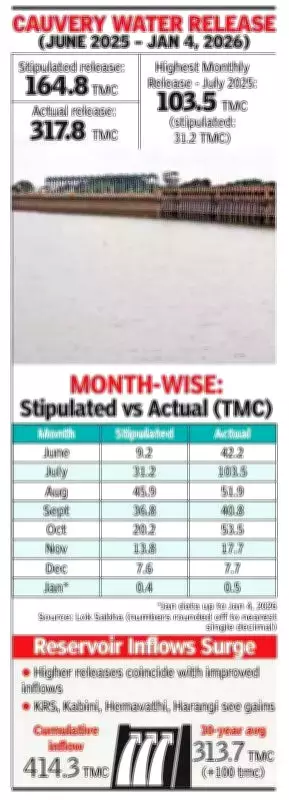
As per the final award and subsequent Supreme Court orders, Karnataka was required to release 164.8 thousand million cubic feet (TMC) of water annually to Tamil Nadu. However, the actual release during this period stood at 317.7 TMC, marking a substantial overshoot of the mandated quantity. This data was documented in the minutes of the 47th meeting of the Cauvery Water Management Authority (CWMA) on January 6, 2026.
Monthly Breakdown Shows Consistent Surplus
The month-wise figures indicate that Tamil Nadu received the highest volume of water in July 2025, with 103.5 TMC released against a stipulated 31.2 TMC. In fact, Karnataka released more water than mandated every single month of the water year. Particularly notable were the months of June, October, and November, where releases exceeded double the prescribed levels.

Detailed Monthly Comparison (in TMC):
- June: Stipulated 9.2, Actual 42.2
- July: Stipulated 31.2, Actual 103.5
- August: Stipulated 45.9, Actual 51.9
- September: Stipulated 36.8, Actual 40.8
- October: Stipulated 20.2, Actual 53.5
- November: Stipulated 13.8, Actual 17.7
- December: Stipulated 7.6, Actual 7.7
- January (up to Jan 4, 2026): Stipulated 0.4, Actual 0.5
Enhanced Reservoir Inflows Support Higher Releases
The increased water releases coincided with better inflows into major reservoirs within the Cauvery basin. Data shows that the four key reservoirs in the old Mysuru region—KRS, Kabini, Hemavathi, and Harangi—recorded significantly higher inflows during this period. The cumulative inflow into these reservoirs reached 414.3 TMC, compared to the 30-year average of 313.7 TMC, indicating an excess inflow of approximately 100 TMC.
Similarly, the combined live storage in these reservoirs as of early January 2026 stood at 76.7 TMC, higher than the 30-year average of around 57.1 TMC—an increase of nearly 18 TMC. This surplus in reservoir levels provided the necessary buffer for Karnataka to release additional water without compromising local agricultural needs.
Positive Impact on Local Agriculture
Kempu Gowda, president of the Karnataka Rajya Raitha Sangha's Mandya district unit, confirmed that there was no water crisis for crops in the district during the 2025-26 period. "Water was released from KRS according to the requirements of the farmers," he stated, underscoring that the surplus releases did not adversely affect Karnataka's own agricultural demands.
Parliamentary Disclosure and Authority Oversight
The data was shared by the Jal Shakti ministry in response to questions raised by Members of Parliament Tamil Selvan and Ganapathy Rajkumar in the Lok Sabha. The Cauvery Water Management Authority continues to monitor and regulate water sharing between the two states, ensuring compliance with judicial directives while adapting to hydrological realities.