

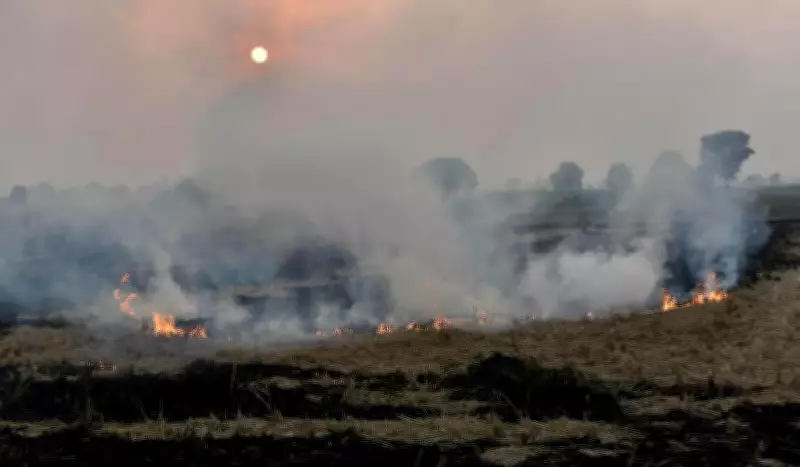
Gurgaon: Haryana will deploy satellite surveillance to monitor stubble burning and take swift action against violators amid a recent rise in incidents, officials said. Real-time tracking through the Haryana Space Applications Centre will detect fires and flag GPS coordinates of affected fields, enabling rapid response by enforcement teams.
Strict Penalties for Offenders
Farmers found burning crop residue will face strict penalties, including a red entry in revenue records, barring them from registering crops on the Meri Fasal-Mera Byora portal and selling produce at government mandis. Offenders will also be denied access to agricultural subsidies, schemes, and financial assistance for the upcoming season, officials said.
Rise in Farm Fire Incidents
The move follows a sharp spike in wheat residue burning this April, with 1,565 farm fire incidents recorded between April 1 and 30 — a 157% increase over 608 cases during the same period last year, according to the Indian Council of Agricultural Research (ICAR).

District authorities have intensified high-tech monitoring of farmlands. “Real-time satellite surveillance will form the backbone of enforcement this season,” said Jhajjar deputy commissioner Swapnil Ravindra Patil.
Patil added that the administration will adopt a zero-tolerance approach. “Stubble burning is not only illegal but also harmful to the environment and soil health. Farmers must understand that the economic and legal repercussions will be severe,” he said. He noted that the practice damages soil’s organic structure, destroys beneficial microorganisms, and contributes to dangerous spikes in air pollution. Cases may be registered under the Environment Protection Act, the Air (Prevention and Control of Pollution) Act, the Disaster Management Act, and relevant provisions of the Bharatiya Nagarik Suraksha Sanhita (BNSS).
Awareness Drives and Scientific Alternatives
Patil directed the agriculture and farmers welfare department to intensify village-level awareness drives, informing farmers about scientific residue-management options such as mulchers, rotavators, super seeders, and other machinery that incorporate residue back into the soil.
The administration is also forming district-, subdivision-, block-, and village-level committees for close surveillance and immediate action against violations.
- At the district level, committees will be headed by the additional deputy commissioner and include officials from revenue, rural development, agriculture, and HSPCB.
- Subdivisional panels will be led by SDMs along with police, revenue, and agriculture officers.
- Block-level teams will include BDPOs, naib tehsildars, SHOs, and agriculture officials.
- Village-level groups will comprise patwaris, panchayat secretaries, agriculture supervisors, police representatives, and sarpanches to ensure on-ground vigilance.
“The administration has directed all committees to maintain strict monitoring and take prompt action to eliminate stubble burning during the harvesting season,” said Gurgaon deputy commissioner Uttam Singh.






