Chhattisgarh High Court Strikes Down 2022 Molasses Control Rules as Unconstitutional
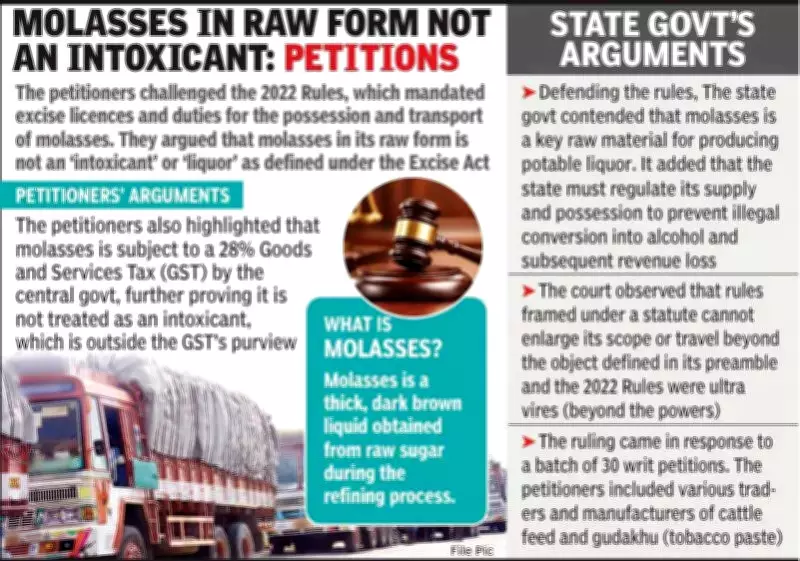
In a landmark judgment, the Chhattisgarh High Court has declared the 'Chhattisgarh Molasses Control and Regulation Rules, 2022' as ultra vires and unconstitutional. This decisive ruling came in response to a batch of 30 writ petitions filed by various traders and manufacturers, challenging the state government's authority to impose excise licences and duties on the possession and transport of molasses.
Petitioners' Argument: Molasses Not an Intoxicant
The petitioners, which included cattle feed producers and gudakhu (tobacco paste) manufacturers, argued vehemently that molasses in its raw form does not qualify as an 'intoxicant' or 'liquor' as defined under the Chhattisgarh Excise Act, 1915. They contended that molasses is primarily utilized for non-intoxicant purposes, such as:
- Cattle feed production
- Industrial applications
- Agricultural uses
Senior counsel Manoj Paranjpe, representing the petitioners, emphasized that molasses is a by-product of sugar refining—a thick, dark brown liquid—and its regulation for ordinary trade activities exceeds the state's legislative competence. The petitioners also highlighted a critical point: molasses is subject to a 28% Goods and Services Tax (GST) by the central government, which further proves it is not treated as an intoxicant, as intoxicants fall outside the GST's purview.

State Government's Defense and Court's Analysis
The state government, defended by Additional Advocate General Shashank Thakur, maintained that molasses is a key raw material for producing potable liquor. They argued that regulation is necessary to prevent illegal conversion into alcohol and to safeguard state revenue from potential losses.
However, a division bench comprising Chief Justice Ramesh Sinha and Justice Ravindra Kumar Agrawal meticulously examined the legal framework. The court observed that:
- Section 2 of the Chhattisgarh Excise Act does not list molasses as an 'excisable article,' 'intoxicant,' or 'intoxicating drug.'
- The expression 'any other base' in Section 8 of the Act cannot be arbitrarily stretched to include raw molasses.
- Rules framed under a statute cannot enlarge its scope or travel beyond the object defined in its preamble.
The bench clarified that while the state can legitimately control molasses intended for distilleries, extending this control to agricultural or industrial uses violates settled principles of statutory interpretation. "The Rules of 2022 extend control to non-intoxicant uses, impose licensing and duty, and regulate ordinary trade activity. This clearly travels beyond the scope of the Excise Act," the court stated unequivocally.
Outcome and Implications
Following the declaration of the rules as unconstitutional, the court allowed all writ petitions. The petitioners are now entitled to consequential reliefs, including the withdrawal of any past or proposed coercive measures initiated by the excise authorities. This judgment reinforces the limits of state power under excise laws and protects businesses involved in legitimate, non-intoxicant trade of molasses.
The ruling underscores a significant legal precedent: regulatory measures must align strictly with statutory definitions and cannot overreach into areas beyond their intended purview, ensuring fairness and legal clarity for industries reliant on molasses for non-alcoholic purposes.