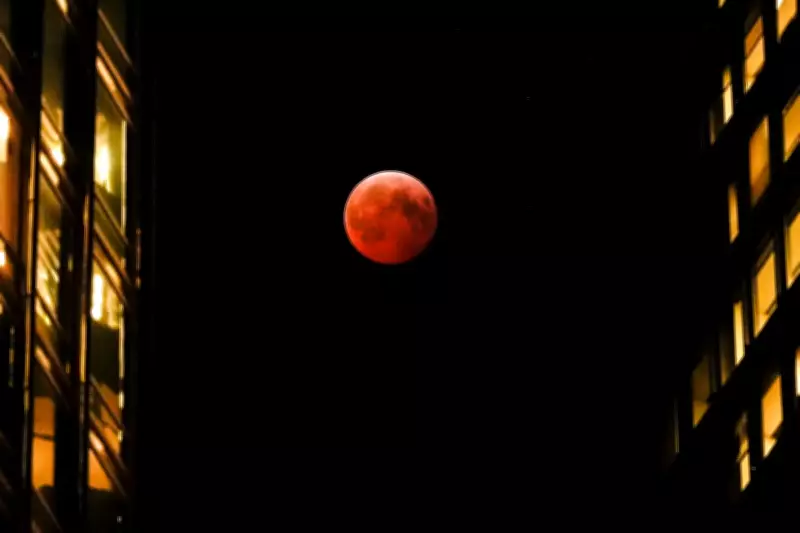
Total Lunar Eclipse to Illuminate Holi Night in 2026
On March 3, 2026, the celestial stage will be set for a remarkable total lunar eclipse, an event that will uniquely coincide with the vibrant festival of Holi across India. This astronomical phenomenon occurs on the full moon day in the Hindu lunar calendar, creating a rare convergence of cultural celebration and scientific observation. For students throughout the nation, this presents more than just a festive moment—it offers a profound gateway into the realms of astronomy and physics, blending tradition with educational exploration.
Understanding the Lunar Eclipse Mechanism
A lunar eclipse unfolds when the Earth positions itself directly between the Sun and the Moon, casting its shadow upon the lunar surface. During a total eclipse, the full Moon traverses into the darkest segment of Earth's shadow, known as the umbra. This precise alignment allows sunlight to filter through Earth's atmosphere before reaching the Moon. As this occurs, shorter blue wavelengths scatter away, while longer red wavelengths bend and illuminate the Moon, resulting in the iconic reddish hue that earns it the moniker Blood Moon.
Astronomical data confirms this will be the inaugural lunar eclipse of 2026, visible across extensive regions including the Americas, Australia, the Asia Pacific, and the Indian subcontinent. In Indian Standard Time, the eclipse will commence in the afternoon and extend into the early evening, providing a window for observation despite some geographical limitations.

Eclipse Timing and Visibility Across India
The eclipse is scheduled to begin at approximately 3:20 PM IST, with the peak viewing period occurring between 6:33 PM and 6:40 PM IST. The event will conclude around 6:47 PM IST. However, visibility varies significantly across different parts of India due to the timing of moonrise. In major metropolitan areas such as Delhi, Mumbai, Bengaluru, and Chennai, the Moon will rise during the later stages of the eclipse, meaning observers will only catch the final segment shortly after moonrise, typically between 6:20 PM and 6:30 PM IST.
Conversely, students in northeastern states like Assam, Arunachal Pradesh, Meghalaya, and West Bengal will enjoy a more favorable viewing opportunity, as the Moon rises earlier in these regions, allowing them to witness a larger portion of the eclipse. This geographical disparity is not a matter of significance but rather a consequence of Earth's rotation, which dictates moonrise times locally.
What Indian Students Can Expect to See
For viewers in central and western India, the visible phase will primarily consist of the concluding part of totality, when the Moon already exhibits its red coloration. In Chennai, the observable period may last about thirty minutes post-sunset, while cities such as Cuttack and Kolkata could witness up to ninety percent of the eclipse. This variation underscores the importance of location in astronomical observations, highlighting how planetary dynamics influence what we see from Earth.
The red appearance of the Moon is not due to heat or fire but stems from atmospheric filtering. As sunlight passes through Earth's atmosphere, shorter blue wavelengths scatter, while longer red wavelengths persist and bend toward the Moon, akin to the process that creates vivid red sunsets. Importantly, unlike solar eclipses, lunar eclipses are entirely safe to observe with the naked eye, requiring no special filters or protective glasses.
Educational Significance for Students
Lunar eclipses serve as invaluable tools for scientific inquiry, enabling researchers to study how Earth's atmosphere interacts with sunlight. By analyzing the shade and intensity of the red light, scientists can glean insights into atmospheric particles and composition. For students, this event vividly demonstrates several key concepts:

- The orbital motion of Earth and the Moon
- The principles of shadows, including umbra and penumbra
- Light scattering and wavelength behavior
- The relationship between astronomical cycles and calendar systems
- The cultural intersection with festivals like Holi
The coincidence with Holi offers a unique opportunity to explore how lunar cycles influence religious calendars, festival dates, and traditional practices, bridging science and culture in a meaningful way.
Practical Tips for Observing the Eclipse
To enhance the viewing experience, students are advised to select a location with a clear eastern horizon and avoid areas with excessive artificial lighting. Using binoculars or a small telescope can provide clearer details, and comparing the Moon's color over time can enrich the observational process. If local conditions hinder viewing, numerous scientific organizations are expected to livestream the event, ensuring accessibility for all.
This celestial occurrence is more than a mere spectacle; it is a live lesson in alignment, motion, light, and timekeeping. It illustrates how planetary movements shape both scientific understanding and cultural life. On March 3, 2026, as the Moon rises tinted red above the horizon, students across India will not only witness a breathtaking event but also observe physics in motion, deepening their appreciation for the wonders of our universe.