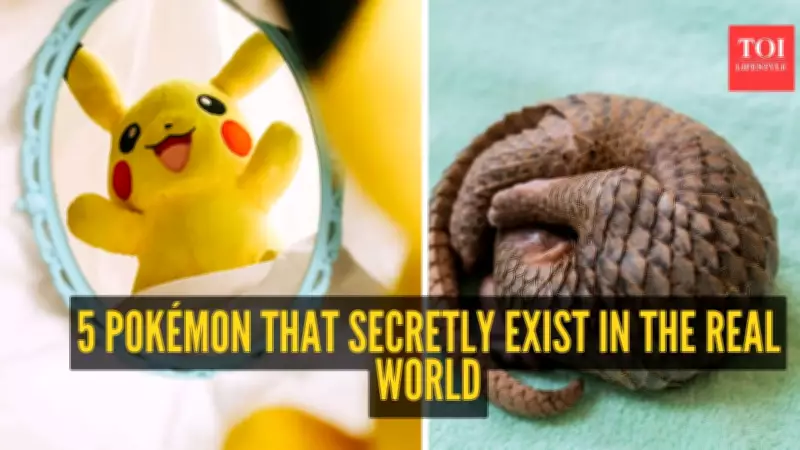
Whether you grew up trading cards in the school canteen or you are currently haunting local parks to catch a Shiny in Pokémon GO, the world of Pokémon has always felt like a fever dream of biology. But here is the kicker: Game Freak's most "out-there" designs are not just random doodles. Many are actually love letters to some of Earth's weirdest, rarest, and most fascinating wildlife.
From the rivers of India to the deep trenches of the Pacific, the real world is teeming with "monsters" that do not need a Pokéball to be impressive. Here are five Pokémon that were pulled straight from the wild.
Poliwag and the Glass Frog Tadpole
We all remember Poliwag – the cute, watery blob with a mesmerizing swirl on its belly. While most fans assumed that swirl was just a quirky design choice, it is actually a literal anatomical detail. In the wild, Glass Frog tadpoles have translucent skin on their undersides. Because their skin is so clear, you can actually see their tightly coiled intestines through their bellies. That iconic Poliwag spiral? It is not a pattern; it is a gut-check.

Sandshrew and the Sunda Pangolin
Sandshrew looks like a cross between a brick wall and a mouse, but its real-life counterpart is far more exotic – and unfortunately, far more endangered. The Pangolin is the world's only scaled mammal, covered in tough, overlapping plates. Just like Sandshrew, when a pangolin feels threatened, it does not fight back; it rolls into a near-impenetrable ball of keratin scales. While Sandshrew is a staple of the Kanto region, real-world pangolins are facing a crisis due to illegal wildlife trade, making them some of the most protected "Pokémon" on the planet today.
Krookodile and the Indian Gharial
If you have ever looked at the Ground/Dark-type Krookodile and thought its long, narrow snout looked a bit "off" compared to a standard crocodile, you have not met the Gharial. Native to the northern Indian subcontinent, the Gharial is a critically endangered crocodilian known for its incredibly thin, elongated snout – perfect for zipping through water to catch fish. While Krookodile might stand on two legs and wear "sunglasses" (those black patches around its eyes), the resemblance to the Chambal River's most famous resident is unmistakable.
Drowzee and the Malayan Tapir
In the games, Drowzee is known for its trunk-like nose and its odd, "waistcoat" colour scheme. This is not a coincidence; it is an exact match for the Malayan Tapir. These animals are born with spots, but as they mature, they develop a striking black-and-white contrast that looks like they are wearing a small vest. While Drowzee uses its snout to sniff out "dreams," the real-world tapir uses its prehensile nose to grab leaves and navigate the forest floor.
Caterpie and the Tiger Swallowtail Caterpillar
Caterpie is a near-exact replica of the Eastern Tiger Swallowtail caterpillar. Both share a lime-green colour and prominent "eye spots" on the thorax, which are used to deter birds by mimicking a larger predator. Additionally, when threatened, both the caterpillar and the Pokémon can extend an orange, Y-shaped organ called an osmeterium to release a chemical scent that wards off attackers.