In a striking paradox, India, home to the world's third-largest sheep population of nearly 74 million, discards a staggering 80% of its indigenous wool production annually. This amounts to roughly 32,000 tonnes of wool deemed unsuitable for apparel, even as the country imports double its domestic output. A grassroots movement named Desi Oon is now spearheading a revival, aiming to channel this forgotten resource into high-value, sustainable supply chains.
The Pastoral Paradox: From Wool to Meat
The story behind the discarded wool is rooted in a decades-long shift in India's political economy. Since the 1990s, government policies have increasingly promoted fatty sheep breeds for meat export, an industry where India is now a global leader. "Traditional breeds were faster, nimbler and produced better-quality wool," explains Sushma Iyengar, lead curator from the Centre for Pastoralism (CfP). This pivot has compelled pastoralists, once reliant on diverse income from wool, meat, and manure, to depend heavily on meat production.
The consequence is a flooded market with wool considered coarse for clothing, and a crippled domestic supply chain. Sushma Iyengar highlights a stark fact: "85% of the wool used in the carpet industry today is imported… most from New Zealand and Australia." Simultaneously, cheaper acrylic fibres have proliferated, making it harder for herders to find a market for their native wool and diversify their livelihoods.

Desi Oon: Weaving a Sustainable Future
To bridge this gap, the CfP launched Desi Oon, a collaborative wool programme involving over 20 organisations. Its mission is to enhance the use of Indian indigenous wool beyond traditional apparel. The initiative works closely with shepherds, knitters, spinners, and weavers to innovate and create new demand.
"This wool is unsuitable for apparel, but an excellent thermal and acoustic insulant," states Iyengar. Desi Oon is promoting its application in three key areas:
- Textiles & Home Furnishings: For durable carpets, rugs, and fabrics.
- Built Environment: As a natural, fire-retardant insulation material for buildings, replacing energy-intensive fibreglass.
- Packaging Solutions: As a biodegradable alternative to harmful materials like thermocol and bubble wrap.
The potential is immense. Vasant Saberwal, director of CfP, notes, "Wool can be a great replacement. The world over, wool insulation is replacing high-energy, environmentally harmful rock wool and fibreglass in buildings."
Exhibition and Ecological Impact
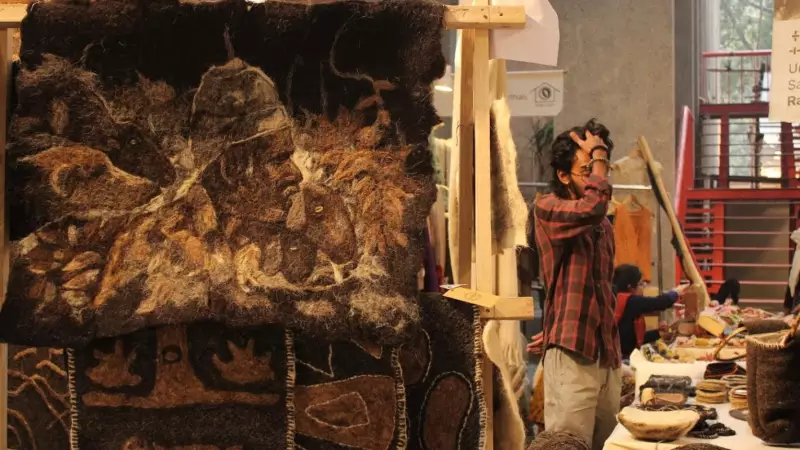
The movement's fifth edition was showcased at an exhibition held at Triveni Kala Sangam in Mandi House, Delhi, from December 11 to 15, 2025. The event displayed innovative products ranging from car foot mats to protective packaging, demonstrating wool's versatility. "Our final goal is to absorb wool in high-value supply chains. We believe that responsible customers will pay a premium," Saberwal added.
The benefits extend beyond economics. Sheep grazing aids in the regeneration of grasslands, which are powerful carbon sinks. "India is losing its grasslands rapidly… herders are losing access to them and industrialists are taking over. These are great at absorbing CO2," warns Iyengar. Thus, supporting pastoralism and native wool also contributes to ecological conservation.
To amplify its message, CfP commissioned a stop-motion film titled "Desi Oon," directed by Suresh Eriyat. The film, telling the story of a shepherd protecting his sheep's genetic integrity, recently won the Jury Award for Best Commissioned Film at the Annecy International Animation Festival 2025, standing out among nearly 4,000 global entries.
By redirecting focus to the inherent value of Desi Oon, this initiative is not just reviving a forgotten material; it's championing a sustainable model that supports India's pastoral communities, bolsters ecological health, and offers consumers conscious alternatives.