TVS Motor Achieves Dual Market Share Gains in ICE and EV Segments
In a significant development within India's competitive two-wheeler industry, TVS Motor Company has distinguished itself as the sole major legacy manufacturer to expand its market share across both internal combustion engine (ICE) and electric vehicle (EV) segments during the current fiscal year. Based in Chennai, the company has not only increased its overall market presence but also achieved a notable milestone where its EV market share now exceeds its ICE share, positioning it uniquely for the ongoing transition to electric mobility.
Steady Rise in Overall Market Share
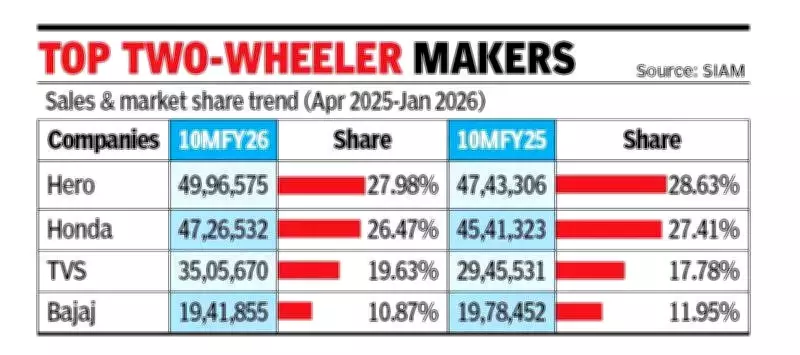
TVS Motor, the third-largest two-wheeler manufacturer in India by volume, has seen its overall market share climb to approximately 20% over the first ten months of this fiscal year. This marks a substantial improvement from around 18% in the same period last year and nearly 15% in FY19. The growth is attributed to a combination of factors, including rising motorcycle volumes driven by premiumisation trends and strong performance in the electric mobility space, particularly with its successful electric scooter portfolio.
Analysts at Nuvama Institutional Equities highlight that multiple product launches over the years, such as the Jupiter, Ntorq, iQube, and Raider, have been instrumental in driving these market share gains. Recent introductions, including the Orbiter, Ntorq 150, and Apache RTX300, further underscore the company's commitment to expanding and diversifying its product offerings to cater to evolving consumer preferences.

Peers Witness Declines in Market Share
In contrast to TVS Motor's upward trajectory, other major players in the industry have experienced year-on-year declines in their overall market share during the same ten-month period. According to data from the Society of Indian Automobile Manufacturers (SIAM):
- Hero MotoCorp's share fell from 28.64% to 27.98%.
- Honda Motorcycle & Scooter India's share declined from 27.43% to 26.47%.
- Bajaj Auto, the fourth-largest player by volume, saw its share drop from 11.95% to 10.87%.
This divergence highlights TVS Motor's effective strategies in a challenging market environment, where it has managed to outperform its competitors consistently.
Strong Momentum in Electric Two-Wheeler Segment
TVS Motor has also made significant strides in the electric two-wheeler segment, reinforcing its leadership in the EV space. Its EV market share has increased from about one-fifth a year ago to nearly one-fourth currently, according to Vahan registration data. This growth is particularly noteworthy as it surpasses the company's ICE market share, providing confidence that TVS is better positioned for the EV transition compared to its peers, as noted by Nuvama analysts.
While Bajaj Auto has maintained its position with around a one-fifth share in the EV segment, Hero MotoCorp has expanded sharply, more than doubling its share to about 10% from 4% last year. However, TVS Motor's ability to achieve a higher EV share than ICE sets it apart, indicating a robust and balanced approach to both traditional and emerging markets.
Focus on Premiumisation and Future Plans
Alongside its aggressive push into electric vehicles, TVS Motor continues to invest in strengthening its premium motorcycle portfolio under the Apache brand. The company is also preparing to launch six new premium motorcycles under the Norton brand over the next three years, starting this year. These initiatives are aimed at establishing a stronger foothold in the high-end segment, capitalizing on the growing demand for premium two-wheelers in India.
Industry analysts, including those from ICRA, note that premiumisation remains a defining trend in India's two-wheeler market. Entry-level motorcycle demand continues to face pressure due to rising vehicle prices and affordability constraints, while premium motorcycles and scooters have witnessed a sharp recovery. TVS Motor's strategic focus on this trend, combined with its EV advancements, positions it well for sustained growth and competitiveness in the evolving automotive landscape.