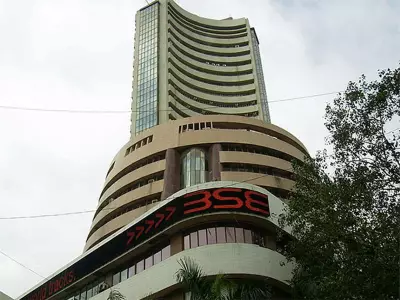
Market Divergence Creates Investor Dilemma
Indian equity markets witnessed a dramatic divergence on Monday, February 2, as the benchmark Sensex jumped over 600 points in intraday trading while precious metals experienced a sharp downward spiral. This contrasting performance has left investors grappling with a crucial question: should they increase exposure to equities or protect their wealth by staying on the sidelines during this period of market volatility?
Precious Metals Plunge, Equities Rally
The commodity markets experienced significant turbulence with MCX Gold February futures crashing by over ₹47,000 per 10 grams, representing a staggering 26% decline from their peak levels. Silver prices faced even more severe pressure, with MCX Silver March futures plunging by ₹1.94 lakh per kilogram, marking a dramatic drop of over 46% from their highest points.
Meanwhile, the equity markets presented a different picture entirely. The Sensex surged over 600 points, representing nearly a 1% gain, while the Nifty 50 successfully reclaimed levels above 24,800. However, this rally was not uniformly distributed across market segments, as mid-cap and small-cap indices faltered during the trading session, indicating selective investor interest primarily focused on large-cap stocks.

Budget 2026 Provides Market Boost
One major factor driving the rally in domestic markets has been strategic buying in select large-cap stocks following the Union Budget 2026 presentation. Finance Minister Nirmala Sitharaman's budget avoided populist measures while maintaining a careful balance between growth initiatives and fiscal prudence, which has been positively received by market participants.
Bhuvaneshwari A., MD and CEO of SBICAP Securities Limited, noted that "Union Budget 2026 strikes a strong balance between growth and macro-economic stability, with continued fiscal consolidation improving the estimated fiscal deficit to 4.3% from 4.4% in the current year and reinforcing investor confidence."
She further elaborated that "The sustained push on capex-led growth across various sunrise sectors such as semiconductors, data centres, critical minerals, electronics, biopharma, infrastructure, shipping and railways strengthens the foundation for long-term capital formation and competitiveness. With GDP growth projected at a robust 10%, the Budget reinforces India’s position as a compelling destination for long-term investment and capital market growth."
STT Hike Impact Analyzed
The budget did include a hike in Securities Transaction Tax (STT) on futures and options (F&O) trading, which initially disappointed traders. However, market experts suggest this impact may be short-lived, particularly since the government left transaction taxes on cash-based equity trades unchanged.
VK Vijayakumar, Chief Investment Strategist at Geojit Investments, explained that "the STT hike is sentimentally negative in the short run, but is a welcome move in the interest of small, retail traders." He emphasized that "It is important to understand that this is not a revenue-raising measure, but a decision to discourage retail traders, 92% of whom were losing money in F&O trades, from trading in the F&O market."
Investment Strategy Amid Uncertainties
The current market environment presents multiple uncertainties, including evolving geopolitical factors and potential tariff moves by US President Donald Trump. In this context, experts suggest different approaches for short-term versus long-term investors.
Vijayakumar advised that "During periods of uncertainty, it’s prudent to stay with large caps. Global uncertainty is likely to remain elevated, especially given unpredictable geopolitical developments. In such environments, history shows that small caps tend to suffer prolonged declines—as seen in 2008, 2013, and 2018–19—often taking years to recover."
He contrasted this with large-cap performance, noting that "Large caps, on the other hand, typically bounce back sharply once conditions stabilise. They behave like a rubber ball—falling during stress, but recovering quickly." He identified banking and core industries as sectors where leading large caps offer particular stability, with limited downside even during difficult phases and faster recovery when market sentiment improves.

Vijayakumar highlighted that "Earnings visibility is the key differentiator. That’s why large caps tend to outperform when uncertainty fades—they have the balance sheets and business scale to deliver consistent growth once conditions improve." He projected that "For FY27, earnings growth for the NSE 500—which represents over 90% of India’s market capitalisation—could exceed 15%."
Sectoral Recommendations and Valuation Comfort
Ajit Mishra, SVP of Research at Religare Broking, pointed out that "valuation comfort is clearly better in large caps. Small caps are still expensive, while select large caps are available at reasonable valuations." He added that "As earnings visibility improves, especially in India, large caps are likely to rebound faster when markets stabilise."
Regarding specific opportunities, Mishra suggested that "Very selective buying is possible in the small-cap space where earnings support is strong. Larger mid-caps are still relatively better placed. The focus should be on companies where earnings are clearly backing the price action." For medium to long-term investment horizons, he recommends focusing on banking, metal, energy, and capital goods sectors.
Experts believe the second half of the year will bring clearer signs of an earnings recovery, suggesting that investors should consider accumulating quality stocks during market dips. This strategic approach allows investors to potentially benefit from both the current market volatility and the anticipated recovery in corporate earnings as economic conditions stabilize.