Gurgaon Road Inspection Uncovers Alarming Encroachments and Narrow Carriageways
A three-member joint commission, constituted on the directions of the Punjab and Haryana High Court, has uncovered significant violations and encroachments on Gurgaon's internal residential roads. The commission's findings, based on a physical inspection conducted on Saturday, highlight narrow motorable roads, rampant parking violations, and unauthorized house ramps and electrical installations occupying substantial portions of road stretches across the city.
Spot Inspection Reveals Ground Realities
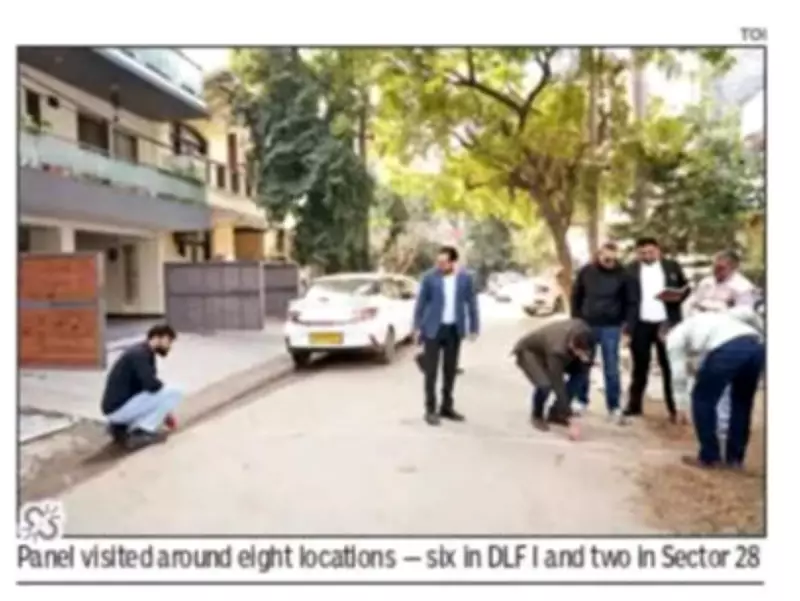
The commission conducted a detailed physical inspection of internal residential roads in parts of Gurgaon to verify their actual width and condition. This exercise was a key component of the public interest litigation challenging Haryana's controversial stilt-plus-four construction policy. The panel visited approximately eight locations, including six in DLF I and two in Sector 28, meticulously measuring the metalled carriageway and the distance between opposing houses.
According to officials familiar with the inspection, the findings are particularly concerning. In DLF I, roads have a wall-to-wall width of about 12 metres, but the actual motorable, metalled portion on the ground was found to range between a mere four metres and 4.8 metres. Similarly, in Sector 28, while the sanctioned right of way is 10 metres, the metalled carriageway measured only 3.9 metres to 4 metres at various points.

Commission Documents Multiple Violations
The commission's report, supported by comprehensive on-site photographs, documents several critical issues:
- Vehicles parked along the narrow carriageways severely restrict movement, making it difficult for two cars to pass simultaneously
- Although the overall corridor between boundary walls measures 10 to 12 metres, a significant portion is occupied by various encroachments
- House ramps, electrical installations, sewerage and drainage lines, water pipelines, and trees collectively leave limited space for vehicular movement
The inspection was conducted in the presence of representatives from the Haryana government, the town and country planning department, the district legal services authority, and counsels for the petitioner. The panel was formed after a division bench led by Chief Justice Sheel Nagu and Justice Sanjiv Berry observed that rival claims over road widths could not be resolved without a spot inspection to establish ground realities.
Core Issues in the S+4 Policy Challenge
The road-width dispute lies at the heart of the PIL against the stilt-plus-four policy. Petitioners have argued that the term "road" should specifically mean the motorable carriageway available for vehicles, not the entire right of way that includes green verges and service areas. They have presented compelling claims that narrow carriageways significantly hamper the movement of essential emergency vehicles, including fire tenders, ambulances, and garbage collection vehicles, posing serious safety risks in densely populated neighbourhoods.
The petition further alleges that vertical densification triggered by the S+4 policy has exacerbated multiple urban challenges:
- Worsened traffic congestion throughout residential areas
- Critical parking shortages affecting daily life
- Increased pressure on already strained civic infrastructure
- Unauthorized ramps and encroachments steadily reducing usable road space
However, developer groups and planning officials maintain a different perspective. They argue that approved norms define road width as the entire corridor between plots and that the metalled portion represents only one component of this comprehensive definition.
Implications for Urban Planning and Enforcement
The commission's findings are expected to play a crucial role when the High Court hears the matter next on February 17. The outcome could have significant implications for urban planning enforcement not only across Gurgaon but potentially throughout the wider National Capital Region. The inspection results provide concrete evidence of how theoretical planning norms translate into practical realities on the ground, revealing substantial gaps between policy intentions and actual implementation.

This case highlights the complex challenges facing rapidly urbanizing cities like Gurgaon, where development pressures often conflict with infrastructure planning and public safety considerations. The commission's detailed documentation of road conditions provides valuable data for policymakers, urban planners, and judicial authorities as they grapple with balancing development needs with sustainable urban living standards.