

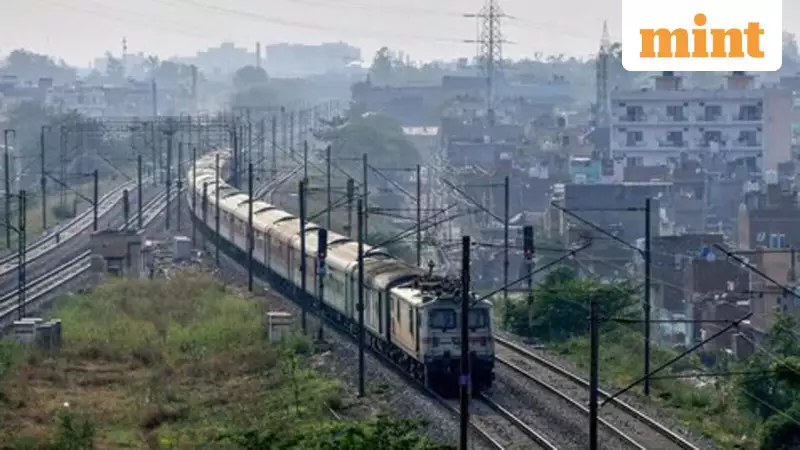
Record Budget Allocation for Railway Modernization
The Indian Railways is set to receive its highest-ever capital expenditure allocation of approximately ₹2.76 trillion for the fiscal year 2026-27, according to government sources familiar with the matter. This represents a significant 12% increase over the current budgetary support and marks a departure from the flat allocations of the previous two years.
This ambitious funding boost comes as the government accelerates its comprehensive modernization program for the national transporter, focusing on faster trains, enhanced safety systems, and substantial infrastructure expansion. The planned increase follows unusually rapid spending patterns observed in the current fiscal year, where the railways has already utilized over 78% of its 2025-26 budget by mid-November – the highest mid-year utilization rate on record.
Accelerated Spending Drives New Funding Demand
The railways' accelerated expenditure pattern has been a key factor driving the demand for increased budgetary support. Budgetary allocations had remained steady at about ₹2.52 trillion in both FY25 and FY26 as the government balanced fiscal consolidation with competing expenditure priorities. However, the rapid pace of project execution has necessitated a revision of this approach.

"An allocation in the range of ₹2.76 trillion will be a new high, but it's in line with the scale of projects already underway, from dedicated freight corridors and higher-speed routes to a full overhaul of rolling stock," revealed the first source, who requested anonymity due to the sensitivity of budget discussions.
The second source confirmed that Indian Railways is on track to deploy its entire capital outlay well before the end of the current fiscal year and may seek additional funds through supplementary demand for grants. This underscores the remarkable speed at which large-scale infrastructure projects are moving from planning to execution phase.
Comprehensive Modernization Initiatives
The substantial funding increase will support multiple transformative projects across the railway network:
- Rollout of 300-400 Vande Bharat trains in multiple configurations, including sleeper versions
- Procurement of 7,000-8,000 new trains over the coming decade to eliminate waiting lists
- Long-term plan to build approximately 50,000 km of new tracks
- Doubling of safety budget to achieve the railways' Mission Zero Accidents goal
- Expansion of the Kavach automatic train protection system
- Complete recasting of signalling networks and track renewals
Current spending has been concentrated on capacity expansion through new lines, track doubling, electrification projects, metropolitan transport systems, and the acquisition of modern locomotives, coaches, and wagons.
Broader Economic Implications
The enhanced budgetary support is expected to have significant positive effects on both railway operations and the broader economy. A higher allocation could enable the railways to maintain stable passenger fares and freight rates for another year, though a reclassification of freight categories is anticipated.
"The stability in tariffs aligns with the government's strategy of supporting users during a period of heavy infrastructure build-out," explained the first source.
Progress on dedicated freight corridors, particularly the completion of the Western dedicated freight corridor and significant advancements on the Eastern DFC, is expected to be a central focus of the next budget. As these critical routes become operational, freight capacity is projected to improve substantially, boosting the railways' core revenue streams.
The modernization push for Indian Railways gained momentum in 2022-23 when the government substantially increased support to accelerate construction and replace aging assets. The upcoming phase is envisioned to be even more expansive, transforming India's railway infrastructure to global standards.

Financial experts suggest that the railways' capital expenditure should ideally come from a mix of gross budgetary support and market borrowings. V Shanker, former executive director (planning) at Indian Railways, emphasized that "private money flowing in through borrowings would ensure that funds are used efficiently" and would help prevent the masking of revenue expenditure as capital expenditure.
Representatives from both the railways and finance ministries have not responded to queries regarding these budgetary developments. The proposed allocation comes at a time when the Centre is considering maintaining overall infrastructure spending at similar levels to 2025-26, banking on a revival in private capital expenditure to sustain economic growth momentum.





