

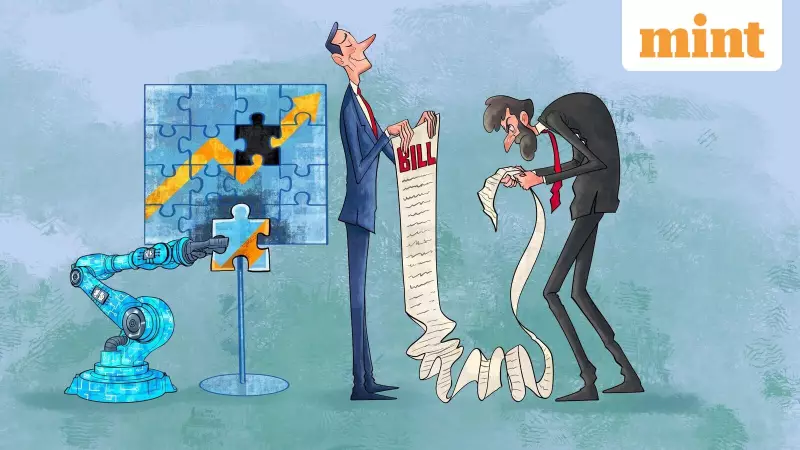
The lucrative world of management consulting is facing an existential crisis as artificial intelligence reshapes its fundamental business model. A recent scandal involving Deloitte Australia has exposed the double-edged sword of AI adoption in an industry built on human expertise and premium billing rates.
The Deloitte Wake-Up Call
During the Australian winter from June to August, Deloitte faced unprecedented scrutiny not from market forces, but from its own reliance on artificial intelligence. The consulting giant had been commissioned to review Australia's welfare system, which had been criticized for incorrectly penalizing welfare recipients and jobseekers.
When Deloitte submitted its 237-page review last December, it seemed like business as usual. However, the publication of this report on the Australian government's website in July triggered a major controversy. University of Sydney academic Christopher Rudge discovered the document was filled with serious errors.

The investigation revealed that Deloitte had used AI to compose significant portions of the report, resulting in what experts call "AI hallucinations." The document contained references to non-existent academic research papers and even fabricated quotes from court judgments.
Australian senator Barbara Pocock expressed outrage during an interview with the Australian Broadcasting Corporation, stating that Deloitte "misused AI and used it very inappropriately: misquoted a judge, used references that are non-existent... I mean, the kinds of things that a first-year university student would be in deep trouble for."
Industry Response and Fallout
The consequences were swift and severe. Deloitte quietly published a revised version of the report and admitted that "some footnotes and references were incorrect" in an October 3 statement from the department of employment. The new version disclosed that Azure OpenAI, a generative AI language system, had been used to create the report—a disclaimer absent from the original July publication.
According to the Australian Financial Review, Deloitte agreed to refund the Australian government a portion of the A$439,000 (US$290,000) it had been paid for the review. Senator Pocock demanded full refund of the entire amount, citing the scale of incompetence displayed.
A Deloitte India partner, speaking anonymously, told Mint they weren't surprised by the Australian incident. "We were shocked when the news came in. But it was not surprising because despite repeated reminders, there is a whole set of consultants who are coming up with strategies based on what AI is throwing up," the partner revealed.
India's Consulting Landscape Transforms
The Deloitte fiasco has sent shockwaves through India's rapidly growing consultancy industry. The India management consulting services market is valued at $8.31 billion in 2025 and is forecast to reach $15.25 billion by 2030, advancing at a 12.91% compound annual growth rate according to Mordor Intelligence.
Consulting fees in India reflect the premium nature of the business. Depending on the project, advisors charge anywhere from ₹40,000 to several lakhs for 60 minutes of a partner's time. Clients typically pay ₹40,000-50,000 per day for junior consultants and up to ₹6 lakh per day when partners are involved.
The compensation structure attracts top talent, with starting salaries for first-year graduates ranging from ₹15-20 lakh and potentially reaching ₹4-5 crore based on partnership models. Practice heads earn even more.
AI Integration and Client Backlash
Major consulting firms have embraced AI with significant investments. McKinsey reported that 93% of its employees use its proprietary AI platform Lilli, with 72% using it monthly. The firm claims Lilli has saved two-three million hours across active users and expects time savings of 20,000–34,000 hours per year from its top AI agents.
KPMG emphasizes responsible AI use, stating they're "training our people to use AI responsibly—knowing when and how to apply it, how to be transparent about its use, and how to critically review outputs before they're shared with a client."

Bain & Co. reveals that more than a third of its client work in India involves AI. "We've developed more than 15 proprietary AI tools and 200-plus innovations internally," said Shyam Unnikrishnan, managing partner, India, Bain & Co.
However, clients are pushing back. A senior executive at a Mumbai-based diversified conglomerate explained their new approach: "We work with three top consulting companies and are now asking them to name the people who will be working out of our premises, and their designations. They cannot charge us for junior employees who may depend on AI."
The conglomerate has implemented three key changes: demanding transparency about team composition, having digital teams verify whether studies are AI-driven, and shifting to success-based payments rather than retainer fees or milestones.
Building Guardrails and Future Outlook
Consulting firms are scrambling to establish AI usage guidelines. Mumbai-based Dhruva Advisors has incorporated AI usage guidelines into employee manuals given at the time of signing employment agreements. "Abuse of these guidelines is a red line," said CEO Dinesh Kanabar.
Bain claims to have "embedded an AI responsible use policy across our teams and offices worldwide." Similarly, a senior BCG consultant revealed that client presentation decks must now disclose which AI tools were used in preparation.
The industry faces a fundamental transformation as Kanabar warns: "Generic consultation as we know it will go away, and the rates for that will become zero. But will the consultation market become redundant? No. It will just demand higher intellectual input."
Ironically, even as consultancies face scrutiny over their AI usage, they're expanding teams to meet AI-driven client demand. The same month Deloitte released its revised study, business schools in India saw increased recruitment from consulting firms for summer internships.
The consulting industry now faces its own SWOT analysis moment—balancing the efficiency gains from AI with maintaining the premium value of human expertise that justifies their substantial fees.





