

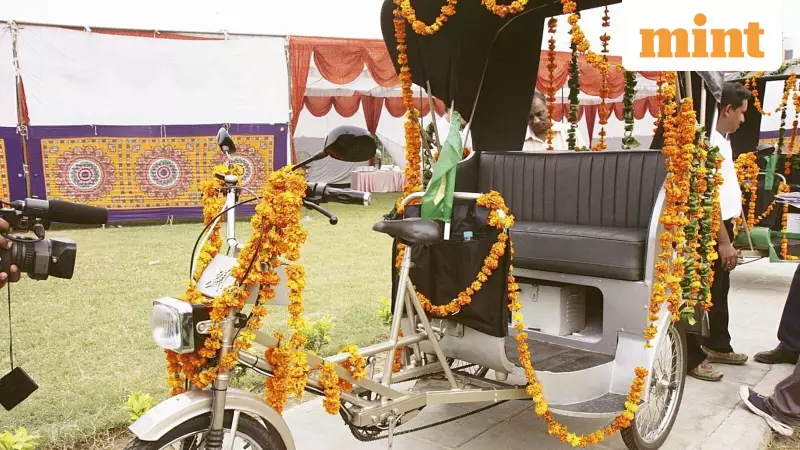
India's transportation landscape is undergoing a silent revolution, with electric three-wheelers emerging as the unexpected champions of the country's EV transition. Government data reveals that electric vehicles have captured an impressive 60% share of the three-wheeler market, dramatically outperforming their four-wheeler and two-wheeler counterparts.
The Electric Three-Wheeler Revolution
According to latest statistics, more than 687,000 of the 1.1 million three-wheelers sold in India this calendar year (as of November 24) were electric vehicles. This remarkable achievement becomes even more significant when compared to the mere 4.1% EV penetration in the car segment and 6.2% for two-wheelers.
The journey began just 14 years ago in 2011 when Saera Electric Auto launched India's first electric three-wheeler. Since those humble beginnings, the sector has experienced exponential growth, transforming urban mobility across the nation.

What Makes Three-Wheelers Different?
The exceptional adoption rate of electric three-wheelers stems from several unique factors that distinguish them from other vehicle categories. Unlike personal vehicles, three-wheelers are primarily used for commercial freight transport and last-mile connectivity, operating for extended hours each day.
This commercial usage pattern makes them ideal candidates for electrification. Vehicles running longer distances benefit more significantly from lower operating costs, while their predictable routes and overnight charging opportunities eliminate range anxiety concerns that plague personal EV users.
Sharif Qamar, associate director of transport and urban governance at The Energy and Resources Institute (Teri), explains: "Two major factors have worked very well for this segment. There are multiple models available to customers, and the price parity along with lower operational costs have contributed to the rapid adoption of electric three-wheelers."
The Evolution of Electric Three-Wheelers
The electric three-wheeler revolution started with souped-up, battery-run e-rickshaws in the L3 category. These low-powered vehicles, typically used for short-distance commuter transport in cities like New Delhi and Kolkata, quickly gained popularity. By 2016, India had sold over 45,000 such battery-powered rickshaws.
The market expanded significantly when Mahindra & Mahindra entered the scene, launching the e-Alfa series in 2017 and the sturdier Treo series in 2018. The industry now features two main categories: L3 units with 2-7 kWh batteries and L5 units with more powerful 7-12 kWh batteries.
Current data shows that for every two electric L5 units added to Indian roads in 2025, five electric L3 units were introduced. However, most L3 vehicles don't qualify for government incentives due to their considerable share of imported parts and insufficient domestic value addition.
Achieving Price Parity and Lower TCO
The breakthrough moment for electric three-wheelers came when they achieved near price parity with their fossil-fuel counterparts. While upfront costs remain a crucial consideration for buyers, the total cost of ownership (TCO) has become the deciding factor.
A typical electric three-wheeler costs between ₹3-5 lakh, compared to ₹1.5-3.5 lakh for comparable ICE vehicles. However, when factoring in significantly lower operating and maintenance costs, the TCO reaches parity, making electric models financially attractive.
Commercial use cases particularly benefit from this calculation. These vehicles operate on fixed routes for fixed hours, making returns on investment clearer and more predictable for buyers. The simplicity of EV mechanics, with fewer moving parts, translates to reduced maintenance expenses and higher reliability.
Government Support and Incentives
Government policies have played a pivotal role in accelerating electric three-wheeler adoption. The FAME scheme ran for a decade from FY15 to FY24, providing manufacturers with reimbursement for selling EVs at discounted prices.

This was succeeded by the PM E-Drive scheme in October 2024, which aims to incentivize the rollout of approximately 320,000 electric three-wheelers with an outlay of about ₹900 crore. The scheme has already received claims for more than 250,000 vehicles as of early November 2025 and will continue until March 2026.
Additional support came through GST reductions, with EVs taxed at just 5% since 2019 compared to 18% and above for ICE vehicles. This significant tax advantage has made electric three-wheelers more accessible to a broader segment of buyers.
Manufacturing Boom and Market Leaders
The favorable policy environment and growing demand have triggered a manufacturing boom in the electric three-wheeler sector. According to the government's Vahan vehicle registry, more than 500 companies currently manufacture electric three-wheelers in India.
Market leadership is held by Mahindra Last Mile Mobility Ltd, a subsidiary of Mahindra & Mahindra Ltd, which has sold over 80,000 units in the current calendar year. The company operates manufacturing plants in Bengaluru, Zaheerabad, and Haridwar.
Other significant players include Euler Motors, veteran three-wheeler maker Piaggio, and the pioneer Saera Electric Auto Pvt Ltd. This competitive landscape has driven innovation and kept prices competitive, further accelerating adoption.
The success story of electric three-wheelers in India demonstrates how targeted policies, commercial viability, and appropriate technology can combine to create sustainable transportation solutions. As India continues its journey toward cleaner mobility, the three-wheeler segment stands as a shining example of what's possible when the right conditions align.





