Budget 2026's Mega Textile Parks Initiative Poised to Reshape India's Apparel Manufacturing Landscape
The Union Budget 2026-27 has unveiled a transformative proposal to establish mega textile parks in challenge mode, a move that is expected to fundamentally alter how India dresses while simultaneously boosting the economic fortunes of key states like Madhya Pradesh. This strategic initiative aims to modernize India's textile manufacturing sector, creating integrated hubs that could position the country as a global leader in apparel production.
Madhya Pradesh's Strategic Advantage in Organic Cotton Production
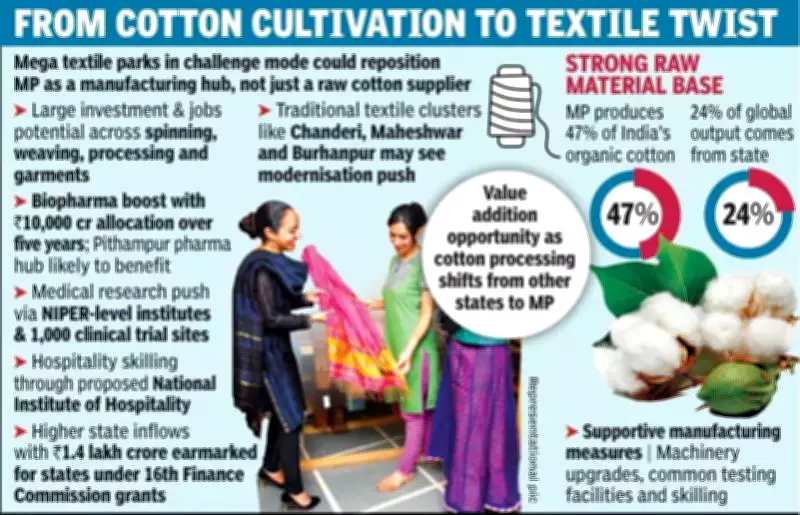
Madhya Pradesh emerges as a prime beneficiary of this textile revolution, thanks to its remarkable raw material base. The state accounts for an impressive 47 percent of India's organic cotton output and nearly 24 percent of global organic cotton production. With annual cotton production reaching approximately 31,700 metric tons alongside about 200 metric tons of silk, MP possesses a formidable foundation for textile manufacturing expansion.
Despite being India's second-largest cotton-producing state, Madhya Pradesh has historically seen much of its raw cotton processed in neighboring states like Gujarat, Maharashtra and Tamil Nadu. The mega textile parks proposal offers MP a golden opportunity to transition from being primarily a raw fibre supplier to becoming a hub for value-added manufacturing, capturing more economic benefits within the state.

Economic Impact and Employment Generation Potential
Each approved mega textile park is projected to attract investments worth several thousand crores while generating large-scale employment across the entire textile value chain. This includes opportunities in spinning, weaving, processing and garment manufacturing sectors. The parks are designed to create integrated ecosystems that streamline production processes and enhance efficiency.
Economist Jayantilal Bhandari emphasized that the challenge-mode framework could significantly accelerate modernization in India's heritage textile clusters. "Regions with rich textile traditions such as Chanderi, Maheshwar and Burhanpur stand to gain substantially if infrastructure development and execution remain robust," he noted, highlighting how the initiative could revitalize traditional textile centers while creating modern manufacturing capabilities.
Broader Manufacturing Support and MSME Benefits
The textile initiative is bolstered by comprehensive manufacturing measures outlined in Budget 2026, including machinery modernization programs, common testing and certification facilities, and expanded skilling initiatives targeting labour-intensive sectors. These complementary measures are designed to create a holistic ecosystem supporting textile manufacturing advancement.
Micro, Small and Medium Enterprises (MSMEs) represent another major beneficiary group. Madhya Pradesh currently hosts over 20.43 lakh MSME units, with 4.26 lakh manufacturing units added in just the past three years. Budget provisions including expanded credit guarantee coverage, improved access to institutional finance, and formalization initiatives are expected to alleviate liquidity constraints that have traditionally hampered MSME growth.
Gautam Kothari, president of the Pithampur Audhyogik Sangathan, expressed optimism about the manufacturing sector's prospects: "The MSME Growth Fund, expanded credit guarantees and record capital expenditure outlined in the budget are expected to better integrate Indian manufacturing into global supply chains, creating sustainable growth opportunities."
Tourism and Hospitality Sector Development
The budget also addresses complementary sectors that support overall economic development. Mahendra Pratap Singh, chairman of the FICCI Tourism Committee in Madhya Pradesh, highlighted the establishment of a National Institute of Hospitality as a significant step toward strengthening India's tourism ecosystem. "The proposed institute will serve as a vital bridge connecting academia, industry and government, fostering skilled manpower development, innovation adoption and implementation of global best practices," he explained.

This integrated approach—combining textile manufacturing advancement with tourism sector development—creates a comprehensive economic growth strategy for Madhya Pradesh. The state's unique combination of organic cotton dominance, growing MSME sector, and tourism potential positions it exceptionally well to capitalize on Budget 2026's manufacturing and infrastructure initiatives.
The mega textile parks proposal represents more than just an industrial policy—it signifies a strategic shift in India's economic development approach, emphasizing regional specialization, value addition, and global competitiveness. As implementation details emerge, Madhya Pradesh's textile and manufacturing sectors appear poised for significant transformation, potentially creating a model for other states to emulate in leveraging their natural resources and industrial capabilities for sustainable economic growth.