

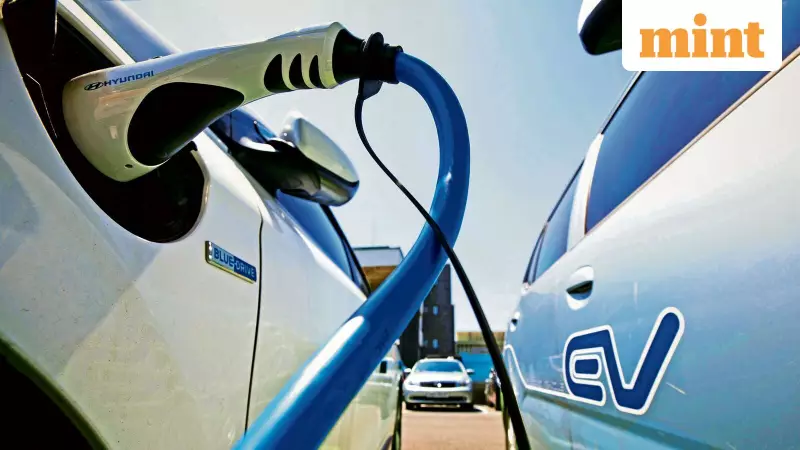
In a significant move to promote cleaner automotive technologies, one of India's leading industry associations has requested the government to grant tax benefits to range-extended electric vehicles, a specific type of hybrid technology that could help accelerate the country's transition to eco-friendly transportation.
What Are Range-Extended Electric Vehicles?
Range-extended electric vehicles (REEVs) represent a unique category of hybrid vehicles that operate primarily on electric power. Unlike conventional hybrids, REEVs use a small internal combustion engine exclusively to charge the battery when it runs low, rather than directly powering the wheels. This configuration allows the vehicle to propel entirely on battery power while eliminating the range anxiety commonly associated with pure electric vehicles.
Currently, no Indian manufacturer offers REEVs in the domestic market, partly due to the current tax structure that places these vehicles in the same category as conventional hybrids.

The Tax Disparity Challenge
The Associated Chambers of Commerce and Industry of India (Assocham) has formally approached the Ministry of Heavy Industries with a compelling argument for tax parity. In a letter dated 18 November 2025 addressed to MHI secretary Kamran Rizvi, the industry body highlighted the current tax imbalance.
Under the existing Goods and Services Tax (GST) regime, REEVs are not classified separately and face the same tax rates as hybrid vehicles – 18% for smaller vehicles and 40% for larger ones. This stands in stark contrast to the 5% GST rate applicable to battery electric vehicles (BEVs).
Assocham, whose members include automotive giants like Maruti Suzuki India Ltd, Toyota Kirloskar Motors India Ltd, JSW Group, and Mahindra and Mahindra Ltd, argues that the current tax structure would force automakers to price REEVs higher in the market. The organization emphasized that these vehicles are typically heavier and larger, making the tax burden particularly challenging.
Divided Industry Opinions on Hybrid Incentives
The push for hybrid vehicle incentives has created a clear divide within India's automotive sector. Japanese automakers, who have mastered hybrid technology, have been actively lobbying for tax concessions, consumer subsidies, and waivers on various state and central fees.
However, this position faces opposition from companies like Tata Motors Ltd and Mahindra, who argue that any incentives for hybrid vehicles would negatively impact the adoption of pure electric vehicles. This philosophical divide has already influenced state policies, with Uttar Pradesh, Chhattisgarh, and Rajasthan removing incentives for hybrid vehicles. Currently, only Chandigarh and Haryana continue to offer such benefits.
An Assocham spokesperson explained the unique value proposition of REEVs, noting that the small internal combustion engine helps "eliminate range anxiety inherent in battery electric vehicles." The ICE component activates only to charge the battery during long intercity drives, reducing dependence on charging infrastructure while the nationwide network continues to develop.
Market Realities and Future Projections
The timing of this appeal coincides with concerning market trends. According to the 2025 Global Automotive Consumer Study by Deloitte, customer preference for electric vehicles in India has declined compared to 2024. Only 8% of surveyed customers expressed preference for EVs as their next purchase, while more than a third indicated they would choose hybrids.
Recent data from the Federation of Automobile Dealers Association reveals that electric four-wheeler penetration dropped from 5.12% in September to 3.24% in October – the lowest level since February 2025.
Hyundai Motor India estimates suggest that hybrid vehicles' market share will increase significantly from 2% in FY25 to 14% by FY30, potentially reaching parity with electric vehicles. Currently, Maruti Suzuki, Toyota, and Honda Cars offer strong hybrid vehicles in the Indian market.

In its communication to the government, Assocham stated that "REEVs are uniquely positioned to significantly mitigate climate impact" within the segment representing 70% of vehicles after initial electric penetration. The industry body, founded in 1920, has requested that REEVs be classified under the 5% GST bracket based on their electric-only propulsion system and alignment with the government's EV objectives.
The letter, signed by Assocham secretary general Manish Singhal, was also sent to the Prime Minister's Office, finance ministry, Niti Aayog, and the Union roads ministry. The Ministry of Heavy Industries has not yet responded to media queries regarding this proposal.





