

Union Budget 2026-27: Navigating Fiscal Constraints After Tax Cuts
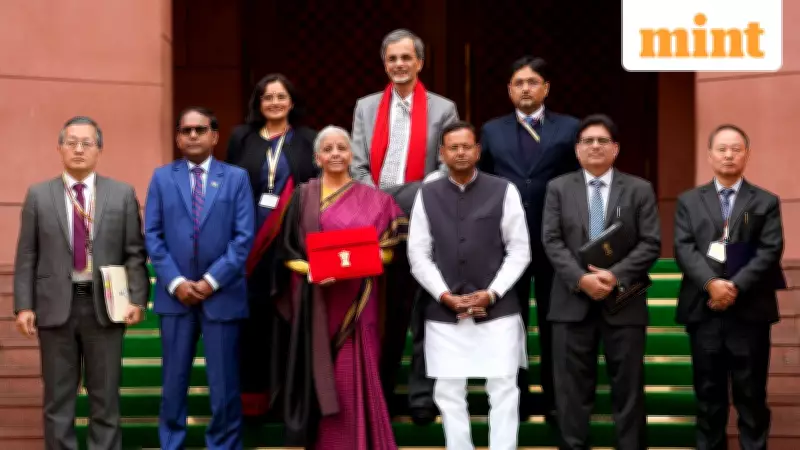
Finance Minister Nirmala Sitharaman presented the Union Budget 2026-27 against a backdrop of fiscal challenges stemming from the previous year's aggressive tax reductions. The budget documents reveal a government walking a tightrope between maintaining growth momentum and managing constrained resources.
The Fiscal Landscape: Modest Growth and Revenue Challenges
The government projects nominal GDP growth at 10% for fiscal year 2027 (FY27), marking the lowest budget projection since the pandemic-affected FY21. While this represents an improvement from the estimated 8% growth in FY26, economists note that a significant portion of this increase may simply reflect inflation returning to normal levels rather than robust economic expansion.
Tax collections present another area of concern, with overall growth expected at just 8%. Particularly worrying is the goods and services tax (GST) component, which is estimated to shrink rather than grow, indicating potential weakness in consumption patterns across the economy.

Debt Reduction and Fiscal Consolidation Pace
The government has adopted a new fiscal framework centered on reducing the debt-to-GDP ratio, targeting a reduction of 52 basis points to 55.63% in FY27. This pace represents nearly half the annual reduction needed to reach the 50% target by 2031, suggesting a cautious approach to fiscal consolidation.
Meanwhile, the traditional fiscal deficit measure shows minimal improvement, set to decline by just 5 basis points to 4.31% of GDP. This modest reduction falls short of economist expectations, who had hoped for a 20-30 basis point improvement.
Tax Revenue Shortfalls and Collection Challenges
The 2025 tax cuts have created significant revenue challenges, with the government expecting to miss its initial FY26 tax collection goal by 4.5%, amounting to ₹1.9 trillion in absolute terms. Income tax collections are projected to fall short by 8.8%, while GST collections face an even larger shortfall of 11.1%.
Looking ahead to FY27, income tax collections are expected to grow at 11.5%, a modest rate compared to the 21% average increase seen between FY23 and FY25. GST collections present a more concerning picture, projected to decline further by 2.6% despite last year's structural reforms aimed at boosting consumption.
Capital Expenditure Commitment and Implementation Questions
The budget maintains capital expenditure at 3.1% of GDP for FY27, continuing the government's focus on infrastructure development. This includes growing emphasis on capex transfers to states, though questions remain about implementation capacity given that the government has missed its budgeted capex targets for four consecutive years by margins ranging from 1.3% to 5.3%.
The ₹12.2 trillion capex target for FY27 faces additional scrutiny as public enterprise capex—which falls outside the budget—has shown continuous decline, potentially limiting the overall impact of government infrastructure spending.
Social Sector Spending: A Partial Rebalancing
Despite fiscal constraints, the budget shows increased allocations for key social sectors. Rural development receives a 28% boost in FY27, accounting for 5.1% of total expenditure compared to 4.3% in FY26. This includes substantial increases for employment guarantee schemes, with the Mahatma Gandhi National Rural Employment Guarantee Act and its upcoming version receiving ₹1.26 trillion—a 43% increase from FY26 revised estimates.
Health and education also see improved allocations, with health spending increasing by 10.5% and education by 14.2%. These increases have been partially offset by reductions in fertilizer and cooking gas subsidies, though historical patterns suggest subsidy expenditures often exceed initial budget estimates.
Revenue Alternatives and Economic Outlook
The government has placed renewed emphasis on securities transaction tax (STT) collections, projecting 15.8% growth in FY27 following rate increases on futures and options trading. However, this optimism contrasts with FY26 performance, where STT collections are tracking significantly below targets.

Disinvestment targets show similar optimism, doubling to ₹80,000 crore for FY27 despite the government being on track to miss the current year's target by 28%. The increased target relies on pipeline deals gaining momentum in the coming fiscal year.
Overall, the budget reflects a government operating within tightening fiscal constraints while attempting to balance growth priorities with social sector needs. The success of this balancing act will depend heavily on economic recovery, consumption revival, and improved tax collection efficiency in the months ahead.





