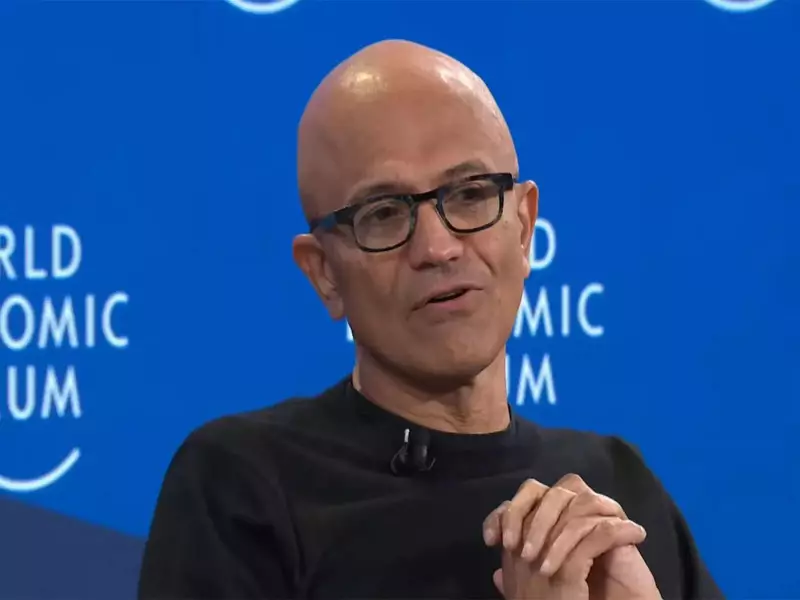
In a revealing discussion at the World Economic Forum 2026 in Davos, Switzerland, Microsoft CEO Satya Nadella offered a fresh perspective on corporate rivalry amidst the tech industry's intense AI arms race. The tech executive invoked billionaire investor Peter Thiel's philosophy to suggest that Microsoft's path to success in 2026 hinges on shifting focus away from competitors and towards a deeper understanding of customer expectations.
Nadella's Customer-Centric Approach in an AI-First World
Nadella's comments come at what he describes as a "pretty intense time" for Microsoft, a company that has faced growing competition since he joined in 1992. When questioned about the escalating rivalry in the AI-driven landscape, Nadella emphasized prioritizing customer desires over competitive anxieties. "The question that I always go back to is what's the brand identity that Microsoft has and the brand permission we have, what customers expect from us," Nadella explained.
He elaborated on this mindset, connecting it to Thiel's ideas: "It's sometimes we kind of overthink somehow that every customer wants the same thing from all of the competitors and finding that out, it's kind of a different take on the Peter Thiel thing, which is, you've got to avoid competition by really understanding what customers really want from you versus thinking everybody is a competitor."

The 'Peter Thiel Thing': A Philosophy Against Competition
The philosophy Nadella referenced originates from Thiel's longstanding critique of competition. As a co-founder of PayPal and Palantir, Thiel famously argued in his book Zero to One that "competition is for losers." His core thinking posits that intense competition forces companies to become identical, battling over margins rather than creating unique value.
Thiel has previously stated, "When you're very competitive, you get good at the thing you're competing with people on... but it comes at the expense of losing out on many other things." He advocates for a counterintuitive approach, asking himself: "How do I become less competitive in order that I can become more successful?" Nadella's adoption of this mindset signals a strategic pivot for Microsoft in the high-stakes AI arena.
Microsoft's Journey Through Decades of Rivalry
Despite the "intense" competition from new rivals emerging every decade, Nadella rejects a "zero-sum" narrative. Reflecting on Microsoft's evolution, he noted, "It's a pretty intense time. I mean, so the way I always think is, it's always helpful. When you have a complete new set of competitors every decade, because that keeps you fit. If you think about it, I joined Microsoft in 92 when I had Novell as the big existential competitor. Here we are in 2026, it's a pretty intense time. I'm glad there's the competition."
Nadella expressed gratitude for Microsoft's position in the tech industry, stating that the company is "blessed" to be part of this dynamic sector. His remarks underscore a belief that competition, while challenging, serves as a catalyst for innovation and resilience, rather than a threat to be feared.
This customer-focused strategy, inspired by Thiel's anti-competition philosophy, could redefine how Microsoft navigates the AI landscape in 2026 and beyond. By concentrating on what sets Microsoft apart in the eyes of its users, Nadella aims to steer the company towards sustained success without being distracted by the rivalries that dominate headlines.