

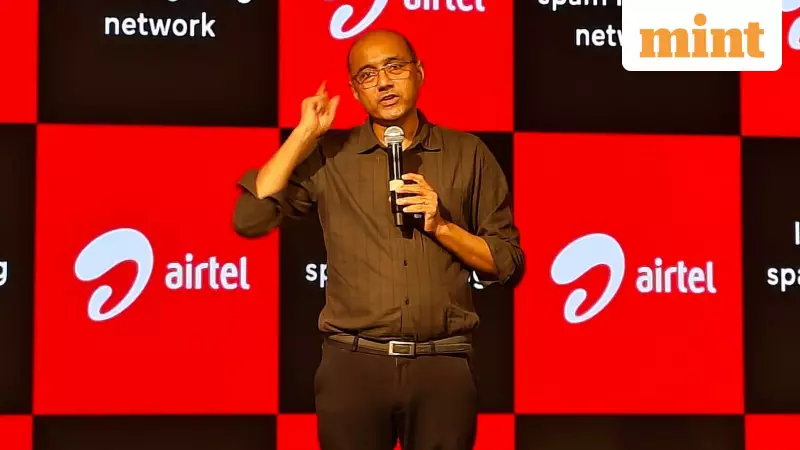
In a significant leadership transition for India's telecom giant, Bharti Airtel's Managing Director and Chief Executive Officer, Gopal Vittal, will assume the role of Executive Vice Chairman starting in 2026. This move caps a remarkable 12-year tenure during which Vittal successfully navigated the company through the most turbulent period in Indian telecom history, marked by the disruptive entry of Reliance Jio.
The Architect of Airtel's Resilience
Gopal Vittal's journey at the helm of Bharti Airtel, which began on 1 March 2013, is a story of strategic grit and financial growth against formidable odds. When he took over, the company's shares were trading at around ₹285.65. As of 22 December 2025, the stock price stands at a staggering ₹2,141.5, propelling Airtel India's market capitalization to approximately ₹12.2 trillion—a growth of over 12 times.
This translates to Vittal averaging an increase in Airtel's market value by nearly ₹1 trillion each year for a dozen years. To put this in perspective, this annual value creation is equivalent to the market cap of major Indian corporations like Havells India, Apollo Hospitals, or Lupin. Today, Airtel ranks as India's third most valued company, trailing only Reliance Industries and HDFC Bank.

Steering Through the Jio Storm
The defining challenge of Vittal's tenure was the September 2016 launch of Mukesh Ambani's Reliance Jio Infocomm. Its pricing blitzkrieg triggered a brutal industry consolidation, whittling down the number of players from 13 in 2014 to just four today. While several rivals folded or merged, Airtel, under Vittal's command, held its ground.
Sunil Mittal, founder and chairman of Bharti Enterprises, acknowledged this resilience at the Hindustan Times Leadership Summit 2025, stating that while Jio's launch made six-seven companies disappear, "Airtel has stood its ground and grown." Mittal credited the company's survival to its people and talent—a nod to Vittal's leadership.
Vittal's strategy was pivotal. Instead of chasing low-end subscriber volumes in a race to the bottom, Airtel focused on retaining premium customers by ensuring superior network quality. This focus is reflected in its Average Revenue Per User (ARPU), which has grown from ₹193 in March 2013 to ₹256 today, making it the industry leader. In comparison, Jio's ARPU is ₹211.4 and Vodafone Idea's is ₹167.
The Next Chapter and Lasting Legacy
The company announced Vittal's new role in October 2024, with a follow-up statement on 18 December. As Executive Vice Chairman, he will oversee group synergies in digital and technology, network strategy, procurement, and talent management, while also focusing on future-proofing the organization. Shashwat Sharma will take over as MD and CEO of Bharti Airtel India effective 1 January 2026.
Vittal's legacy is built on decisive moves. Analysts laud his avoidance of the expensive 700 MHz band in the 2022 5G auctions—a prudent decision as telcos now struggle to monetize 5G. Under his watch, Airtel also strengthened its position through strategic acquisitions, including spectrum from Videocon, Augere Wireless, Telenor India, and the consumer mobile business of Tata Group.
Colleagues and industry observers paint a picture of a uniquely capable leader. Sudhir Sitapati, MD & CEO of Godrej Consumer Products and a fellow Unilever alumnus, recalls finding Vittal listening to classical musician Kumar Gandharva while working on Excel sheets, calling him "one of those rare leaders who is equally left and right brained." This blend of creative and analytical thinking, honed over two decades at Hindustan Unilever, served Airtel well, much like how Vittal famously pivoted the Lifebuoy soap brand to success.
As the telecom sector's next phase shifts competition to the enterprise segment, AI-ready data centres, and satellite internet, Vittal's consumer-centric instincts and strategic foresight will continue to guide Airtel from his new vantage point. His transition marks the end of a CEO era defined by unprecedented value creation and survival against a seemingly insurmountable challenge.






