Holi 2026: Navigating Lunar Eclipse for Holika Dahan Celebrations
The vibrant festival of Holi, renowned for its explosion of colors and joyous community spirit, is scheduled for March 4, 2026. However, this year's celebrations come with an astronomical twist that requires careful planning. Preceding the main event is Holika Dahan, also known as Choti Holi, a ritual steeped in tradition and symbolism. In 2026, a rare lunar eclipse coincides with the festival, prompting families across India to seek clarity on the most auspicious timings for their observances.
Understanding the 2026 Holika Dahan Schedule
Holika Dahan traditionally occurs on the full moon night (Purnima) of the Phalgun month. For 2026, the Purnima tithi commences at 5:55 PM on March 2 and concludes at 5:07 PM on March 3. The complexity arises due to overlapping inauspicious periods and celestial events.
Key Timing Factors:

- Bhadra Kaal: This period spans from 5:58 PM on March 2 to 5:30 AM on March 3, rendering the evening of March 2 unfavorable for lighting the bonfire in most regions.
- Lunar Eclipse: A Chandra Grahan begins at 6:23 AM on March 3.
- Sutak Kaal: The 12-hour period preceding the eclipse, during which auspicious rituals are traditionally avoided.
Consequently, in the majority of Indian localities, Holika Dahan will be observed on March 3, 2026, after both the lunar eclipse and Sutak Kaal have concluded. Dhulendi, the day of colorful revelry, follows on March 4. It is highly recommended to consult local Panchang or almanacs for precise muhurat timings specific to your city, as variations may occur.
Step-by-Step Guide to Holika Dahan Rituals
Holika Dahan transcends mere bonfire lighting; it embodies community unity, prayer, and symbolic purification. Here is a detailed procedure to perform the ritual with devotion:
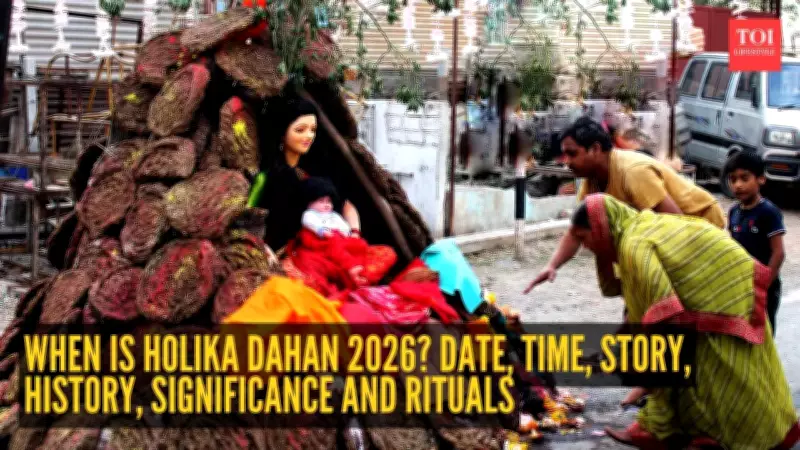
- Preparation of the Pyre: Assemble wood to construct a pyre. Place an effigy of Holika, often accompanied by a small figure of Prahlada, representing the mythological tale. Incorporate items symbolizing negativity, such as dried cow dung cakes or old household waste, to signify the release of harmful energies.
- Circumambulation: Family members and participants circle the pyre three, five, or seven times in a clockwise direction while chanting sacred prayers. Some individuals carry offerings like water, milk, or Gangajal to present at the ritual's culmination.
- Igniting the Fire: Light the pyre from the southeast direction. Offer prayers to Lord Vishnu and Agni, the fire deity. Following this, many apply a tilak of sacred ash on their foreheads for spiritual protection.
- Distribution of Prasad: Roast grains such as wheat, chana, or corn in the embers and share them as prasad. This act is believed to bestow good health and prosperity upon all participants.
In numerous households, women observe a day-long fast, breaking it only after completing the Holika Dahan ceremonies.
The Mythological Foundation of Holika Dahan
This ritual originates from a profound narrative in Hindu mythology. King Hiranyakashipu, consumed by arrogance, decreed that he alone be worshipped as a deity. His son Prahlada, however, remained steadfast in his devotion to Lord Vishnu. Enraged, the king conspired to eliminate his own child.
Holika, the king's sister, possessed a boon that made her immune to fire. She entered a blazing pyre with Prahlada on her lap, confident in her survival and his demise. Yet, divine intervention shifted the protective blessing to Prahlada, resulting in Holika's incineration while Prahlada emerged unscathed.
This story conveys a timeless message: faith, truth, and righteousness invariably triumph over ego and malevolence.
Contemporary Relevance of Holika Dahan
At its core, Holika Dahan symbolizes the incineration of negative traits—anger, jealousy, pride—and the embrace of spring with a rejuvenated spirit. It serves as a powerful social catalyst, fostering neighborly bonds and communal harmony. Essentially, Holika Dahan marks an emotional and spiritual renewal, mirroring nature's rebirth during springtime.
May this Holi season imbue your life with warmth, unity, and abundant prosperity!