

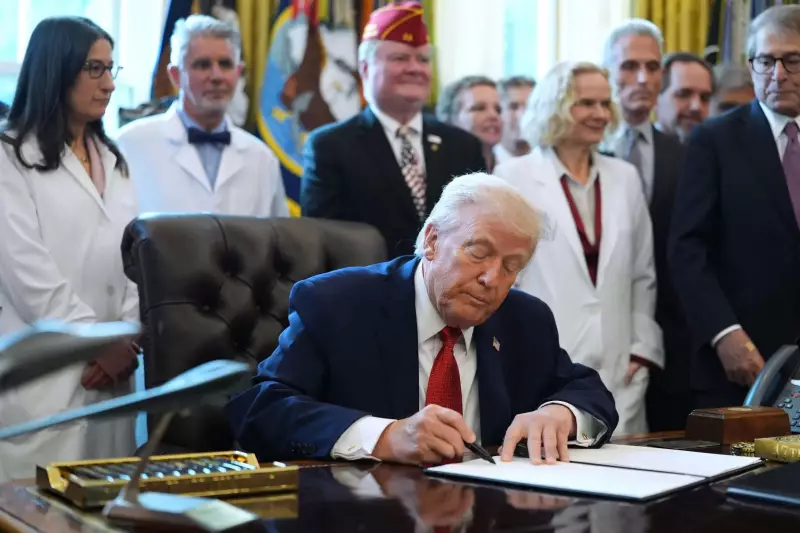
In a landmark policy shift that marks a decisive break from decades of stringent drug war ideology, the administration of President Donald Trump has initiated a move to significantly ease the federal government's stance on marijuana. This development seeks to alter the strange American political paradox where cannabis is culturally mainstream yet federally classified alongside the most dangerous narcotics.
The Core of Trump's Announcement: Reclassification and Regulatory Relief
President Trump has issued directives to federal agencies with two primary objectives: to relax existing restrictions on marijuana and to expand access to Cannabidiol (CBD). The most consequential element is his explicit support for reclassifying cannabis under the Controlled Substances Act. Currently, marijuana holds a Schedule I status, a category reserved for substances considered to have a high potential for abuse and no accepted medical use, such as heroin or LSD.
The proposed change would move marijuana to Schedule III. This new category includes drugs with a moderate to low potential for dependence and accepted medical applications, like ketamine or certain codeine-based painkillers. It is crucial to note that this is not federal legalization or decriminalization. Marijuana would remain illegal under federal law, and states retain the power to enforce their own cannabis restrictions. The change primarily alters the tone and priorities of federal enforcement, particularly concerning users and medical research.

Why This Bureaucratic Change Carries Substantial Weight
The reclassification from Schedule I to Schedule III is far more than a semantic update; it carries profound practical implications. For years, the Schedule I designation has acted as a scientific chokehold, imposing layers of red tape that made rigorous, large-scale medical research on cannabis extremely difficult. A shift to Schedule III would streamline this process, allowing scientists and doctors to study its therapeutic effects more freely.
Furthermore, there is a significant financial angle. Legitimate cannabis businesses operating in states where it is legal have been severely handicapped because federal law treats them as traffickers of an illicit substance. This denies them standard tax deductions for business expenses. Reclassification would end this penalty, offering major fiscal relief to a multi-billion dollar industry that exists in a legal grey area.
Expanding CBD Access and the Political Significance
Parallel to the marijuana shift, the Trump administration is moving to clarify and expand access to CBD, the non-intoxicating cannabis compound used for pain, epilepsy, and anxiety. Plans include a pilot programme for Medicare reimbursement of certain CBD therapies. The administration has also asked Congress to solidify regulations ensuring medical CBD remains legally available and is not inadvertently targeted in drug enforcement actions.
Politically, this move is significant as it represents a Republican departure from the hardline "war on drugs" orthodoxy of the Reagan era. It acknowledges a reality where over 40 U.S. states have legalized medical marijuana and nearly half permit recreational use. The policy also shows rare continuity, as the formal process for reclassification began under the Biden administration, which Trump is now choosing to see through.
Opposition exists, notably from some conservatives who fear normalizing drug use and public health experts who caution that evidence for marijuana's benefits for certain conditions remains mixed. However, the administration's stance is framed pragmatically: enable proper study, implement better regulation, and stop treating cannabis as something it is not.
In essence, this is not a cultural revolution but a long-overdue bureaucratic correction. The federal government is slowly aligning its policies with medical science, state laws, and prevailing social reality. The rhetoric of war is fading, and the user, for once, is not being treated as the enemy.






