Premium UPSC Key: Essential Topics for January 25, 2026
For UPSC aspirants, staying updated with current affairs is crucial for both the Preliminary and Main examinations. This edition of the UPSC Key covers significant developments, including the India-EU summit, Census 2027 issues, revised cadre allocation policies, universal health coverage insights, and EPFO reforms. Understanding these topics enhances analytical skills and exam readiness.
India-EU Summit: Trade and Mobility Agreements in Focus
Syllabus Relevance: Preliminary Examination: Current events of national and international importance. Main Examination: General Studies-II, III: Bilateral agreements, effects of liberalisation on the economy.
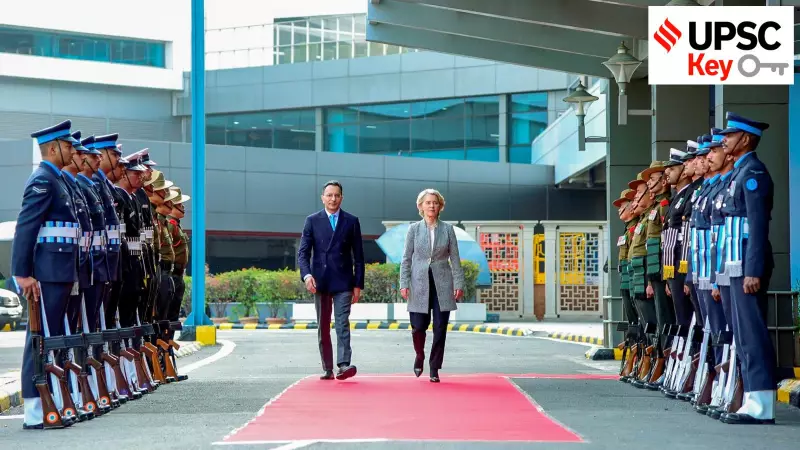
What’s the Ongoing Story: European Commission President Ursula von der Leyen and European Council President Antonio Costa are visiting India, with Prime Minister Narendra Modi highlighting that trade and mobility pacts will create new opportunities for Indian youth. The EU-India Summit on January 27 aims to conclude Free Trade Agreement (FTA) negotiations and launch a cooperation framework on mobility.

Key Points to Ponder:
- Evolution of India-EU relations since diplomatic ties began in 1962.
- Significance of the India-EU trade deal for market access and supply chain diversification.
- Role of the India-Middle East-Europe Economic Corridor (IMEC) in enhancing connectivity.
- Other areas of cooperation beyond trade, such as security, defence, and clean energy.
- Impact of recent trade deals on India’s geopolitical stance.
Key Takeaways:
- Von der Leyen arrived on Saturday, with Costa expected on Sunday; both are chief guests for Republic Day celebrations.
- The summit will endorse a five-year comprehensive strategic agenda covering economic relations, sustainability, and technology.
- EU is India’s largest trading partner in goods, with total trade worth about $136 billion in 2024-25.
- A joint statement and roadmap will outline outcomes and future cooperation.
Do You Know: The European Union comprises 27 countries, established to promote cooperation and safety. India’s relations with the EU have strengthened since the 1993 Joint Political Statement.
Census 2027: Centre-West Bengal Tussle Over Notification
Syllabus Relevance: Preliminary Examination: Indian Polity and Governance. Main Examination: General Studies-II: Federal structure, government policies.
What’s the Ongoing Story: The Centre has flagged that West Bengal has not republished the Census 2027 notification in its official gazette, a statutory requirement. This issue arises amid ongoing disputes between the central and state governments.
Key Points to Ponder:
- History and significance of the census in India, including the Census Act, 1948.
- Differences between Census, caste census, and Socio-Economic Caste Census (SECC).
- Role of the Registrar General of India in conducting the decadal exercise.
- New features in Census 2027, such as data on housing, demography, and economic activity.
Key Takeaways:
- Republication of the notification is mandatory for states to conduct the census, with the first phase starting on April 1.
- West Bengal also lags in confirming the Centre’s definition of Urban Agglomerations.
- Census is a Union subject under the Constitution, with the Centre empowered to notify its intent.
- Census 2027 will be the 16th decadal census and eighth since Independence.
Do You Know: The Indian Census is the world’s largest administrative exercise, initiated in a non-synchronous form in 1872 and synchronously from 1881.
Revised Cadre Allocation Policy for All-India Services
Syllabus Relevance: Preliminary Examination: Current events, polity. Main Examination: General Studies-II: Constitutional bodies, civil services role.

What’s the Ongoing Story: The central government has revised the cadre allocation policy for IAS, IPS, and IFoS, introducing a new alphabetical grouping structure to replace the earlier zonal system. This reform aims to enhance transparency and national integration.
Key Points to Ponder:
- Constitutional provisions related to public service commissions and All-India Services.
- Insider-outsider principle in cadre allocation and its implications.
- Challenges and reforms needed in UPSC and state commissions.
- Role of civil services in sustaining democratic governance.
Key Takeaways:
- Four new groups: Group I (e.g., AGMUT, Bihar), Group II (e.g., Gujarat, Karnataka), Group III (e.g., Maharashtra, Tamil Nadu), Group IV (e.g., Telangana, West Bengal).
- Allocation based on merit and vacancy, with insider candidates requiring willingness to serve in their home state.
- Vacancies determined annually, including categories like UR, SC, ST, OBC, and EWS.
- The policy seeks to address uneven vacancy distribution and streamline administrative processes.
Do You Know: The UPSC, established in 1950, is governed by a chairman and members appointed by the President, with a mandate under Articles 315-323 of the Constitution.
Universal Health Coverage: Challenges and Progress in India
Syllabus Relevance: Preliminary Examination: Economic and Social Development. Main Examination: General Studies-II: Health sector policies, social services.
What’s the Ongoing Story: A Lancet Commission report highlights that while India has made strides in universal health coverage (UHC) through political will and funding, challenges persist in quality, spending efficiency, and fragmented care.
Key Points to Ponder:
- Definition and difference between UHC and universal healthcare.
- Relevance of the Alma-Ata Declaration and government initiatives like Ayushman Bharat.
- Strategies to strengthen primary healthcare and ensure affordable, long-term care.
- Role of technology and community participation in health system governance.
Key Takeaways:
- Key barriers include uneven care quality, inefficient spending, and poor governance, rather than lack of resources.
- Recommendations focus on publicly financed, integrated healthcare systems and leveraging private sector strengths.
- India’s doctor-to-population ratio is 1:1,263 for MBBS doctors, with concerns over education quality and inequitable distribution.
- Ayushman Bharat PM-JAY is the world’s largest public health insurance scheme, covering the bottom 40% economically.
Do You Know: UHC ensures access to full-range health services without financial hardship, covering promotion, prevention, treatment, and palliative care.
EPFO 3.0: Next Phase of Reforms with AI and Centralised Systems
Syllabus Relevance: Preliminary Examination: Current events. Main Examination: General Studies-II, III: Government policies, economy, employment.
What’s the Ongoing Story: The Employees’ Provident Fund Organisation (EPFO) is launching EPFO 3.0, featuring a new portal, AI-backed translation tools, and a core banking solution for nationwide access. This follows EPFO 2.0 reforms that simplified withdrawal norms.
Key Points to Ponder:
- EPFO’s role and provisions under the new Social Security Code.
- Features of EPFO 3.0, including Bhashini AI translation and centralised operations.
- Challenges in administering social security for unorganised sector workers.
- Implications of expanded coverage to all establishments with 20+ employees.
Key Takeaways:
- EPFO 3.0 will enable members to resolve issues at any regional office, benefiting mobile workers.
- The website will use Bhashini for language translation, enhancing accessibility.
- EPFO may administer funds for unorganised workers separately from gig workers.
- Current reforms include UPI-linked withdrawals by April and streamlined withdrawal categories.
Do You Know: Bhashini, launched in 2022, is an AI tool for real-time translation of 22 Indian languages, part of the National Language Technology Mission.
Martyrs’ Day: Origin of the Two-Minute Silence Tradition
Syllabus Relevance: Preliminary Examination: History. Main Examination: General Studies-I, II: Modern history, government interventions.
What’s the Ongoing Story: The tradition of observing a two-minute silence on January 30, Mahatma Gandhi’s death anniversary, began in 1955 after suggestions from Field Marshal K. M. Cariappa. It honours those who sacrificed their lives for India’s freedom.
Key Points to Ponder:
- Historical significance of January 30 as Martyrs’ Day.
- Gandhi’s role in the freedom movement and contemporary relevance of his principles.
- Impact of national rituals on collective memory and nation-building.
Key Takeaways:
- Cariappa proposed a minute’s silence on Republic Day, but Nehru shifted it to January 30.
- The ceremony includes wreath-laying, a two-minute silence, and the Last Post bugle call.
- Nehru emphasized the importance of widespread observance, even in office settings.
Other Key Updates for UPSC Aspirants
US National Defence Strategy 2026: Shifts focus to deterring China through strength rather than confrontation, emphasizing burden-sharing with allies like India in the Quad.
Gorkhaland Demand: Hill leaders in Darjeeling have demanded statehood or Union Territory status with legislative powers during talks with the Centre’s interlocutor.
Election Commission Revisions: Special Intensive Revision of electoral rolls to be extended to more states, ensuring accurate voter lists.
Power Sector Insights: Public sector discoms clear dues faster than private ones, despite higher financial stress, as per a recent ministry report.
These topics are vital for UPSC preparation, offering insights into governance, international relations, and socio-economic developments. Regular review and practice with previous year questions can boost exam performance.