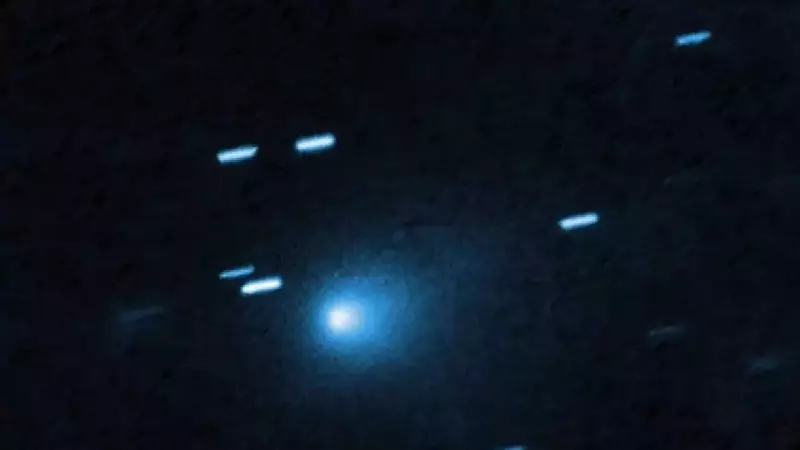
In an exciting development for astronomy enthusiasts and scientists alike, NASA is gearing up to present never-before-seen imagery of one of the rarest cosmic visitors to our solar system – the interstellar comet known as 3I ATLAS. This extraordinary event will be broadcast live to the public, offering an unprecedented look at an object that originated from beyond our cosmic neighborhood.
Live Event Details and How to Watch
The space agency has scheduled a special live event for 3 pm EST on Wednesday, 19 November, which will originate from NASA's Goddard Space Flight Center in Greenbelt, Maryland. The broadcast will showcase detailed visual data collected by multiple NASA missions, including advanced telescopes and spacecraft instruments that have been observing the comet's journey through our solar system.
Viewers around the world can tune in through multiple platforms to witness this historic revelation. The event will be streamed on NASA+, the NASA mobile application, the agency's official website, its YouTube channel, and Amazon Prime. This multi-platform approach ensures maximum accessibility for global audiences interested in cosmic discoveries.

The Significance of 3I ATLAS
What makes 3I ATLAS particularly remarkable is its origin story. Discovered by the ATLAS observatory earlier this year, this celestial body is only the third confirmed interstellar object to enter our solar system from elsewhere in the Milky Way galaxy. Unlike regular comets that originate within our solar system, 3I ATLAS carries material formed in another planetary system entirely.
While the comet poses absolutely no danger to Earth, its relatively close approach has provided a golden opportunity for scientists to study its characteristics in detail. The way its materials react to sunlight, its movement patterns, and its brightness offer valuable clues about planetary formation processes in distant star systems.
Expert Panel and Public Participation
NASA has assembled an impressive team of experts to explain the findings and their scientific importance during the live event. Amit Kshatriya, NASA Associate Administrator, will provide high-level context about the agency's role in the mission. Nicky Fox, head of NASA's Science Mission Directorate, will discuss the scientific goals connected to observing 3I ATLAS.
Meanwhile, Shawn Domagal Goldman, acting director of the Astrophysics Division, will explain how interstellar comets expand our understanding of the wider cosmos. Tom Statler, lead scientist for solar system small bodies, will outline what makes 3I ATLAS unique compared to typical comets from our own solar system.
The event will be interactive, with NASA inviting questions from the public through social media using the hashtag #AskNASA. Selected questions will be answered during the broadcast, making this a truly engaging experience for cosmic curious minds across India and beyond.
This revelation of interstellar comet imagery represents more than just stunning visuals – it's a significant step forward in understanding how planetary systems form throughout our galaxy and whether the processes we observe in our solar system are universal or unique.