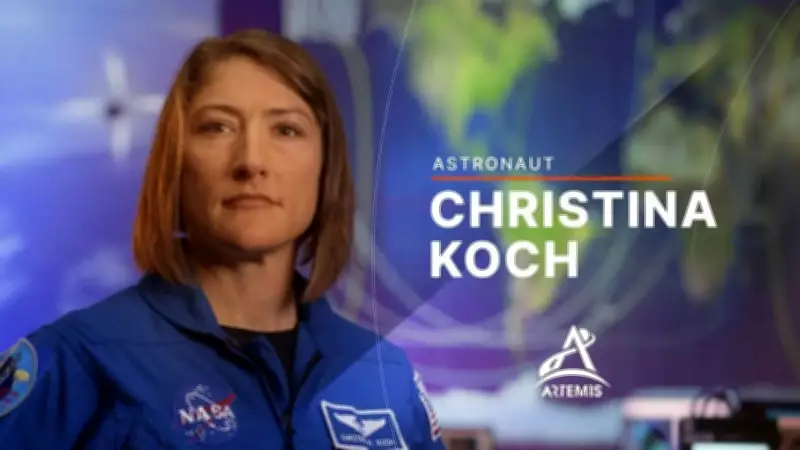
NASA's Artemis II Mission: Christina Koch to Become Farthest-Traveling Woman in History
The upcoming Artemis II mission is poised to be a landmark event in human space exploration, one that will be remembered for generations. This historic journey is not only significant for its technological advancements and the return to deep space but also for the groundbreaking achievements of its crew members. Among the four astronauts selected for this mission is Christina Koch, a name already celebrated in spaceflight circles, who is now on the verge of making history once more by traveling farther from Earth than any woman has ever ventured before.
Christina Koch's Record-Breaking Career and Background
Christina Koch is no stranger to setting records. According to NASA reports, she previously spent 328 consecutive days aboard the International Space Station during her mission in 2019, establishing a record for the longest single spaceflight by a female astronaut at that time. Koch's journey to the stars began in the United States, where she spent her early years in Grand Rapids, Michigan, and Jacksonville, North Carolina. She pursued higher education at North Carolina State University, earning degrees in electrical engineering and physics, followed by a master's in electrical engineering. Her academic pursuits also included international study at the University of Ghana, broadening her global perspective.
Before joining NASA's astronaut corps, Koch built a robust career in space science and instrumentation. She contributed to significant projects at NASA's Goddard Space Flight Center and the Johns Hopkins University Applied Physics Laboratory, where she helped develop instruments for missions like Juno and the Van Allen Probes. Additionally, Koch gained invaluable experience in extreme environments, working as a field engineer in Antarctica and Greenland. Experts note that such fieldwork mirrors the isolation and teamwork essential for space missions, preparing her for the challenges of deep space travel.

Artemis II Mission Details: Crew, Timeline, and Objectives
Artemis II is scheduled for launch on April 1, 2026, marking the first crewed flight of NASA's Orion spacecraft. This 10-day mission will send four astronauts—Christina Koch, Reid Wiseman, Victor Glover, and Jeremy Hansen—on a journey that loops around the Moon and returns to Earth. Koch will serve as a mission specialist, playing a critical role in the operation and success of the flight.
The mission is designed as a test run rather than a lunar landing attempt, focusing on evaluating the spacecraft's systems and crew performance under deep space conditions. This step is crucial for ensuring safety and reliability before future missions aim to land astronauts on the Moon as part of NASA's Artemis program. The crew will travel farther from Earth than any humans have since the Apollo era, pushing the boundaries of human exploration once again.
Milestones in Women's Space Exploration: From Tereshkova to Koch
Space exploration has been marked by numerous milestones for women, each contributing to a broader narrative of inclusion and progress. Valentina Tereshkova made history in 1963 as the first woman in space, orbiting Earth alone. Sally Ride followed as the first American woman in space, and Mae Jemison became the first African American woman to orbit Earth. Christina Koch has already added to this legacy; in 2019, she participated in the first all-female spacewalk with Jessica Meir, a seven-hour event that symbolized a significant step forward for gender equality in space missions.
How Artemis II Supports Future Crewed Missions to the Moon
Artemis II represents a pivotal shift in human spaceflight, as it will carry astronauts beyond low-Earth orbit on a crewed mission for the first time since the Apollo program. Koch's inclusion in the crew reflects her extensive experience and technical expertise, which align perfectly with the demands of deep space travel. Her background in long-duration missions, combined with her hands-on work in field engineering and instrumentation, positions her as a key asset for this historic endeavor. This mission not only tests critical systems but also paves the way for future lunar landings, reinforcing NASA's commitment to sustained human presence on the Moon and beyond.