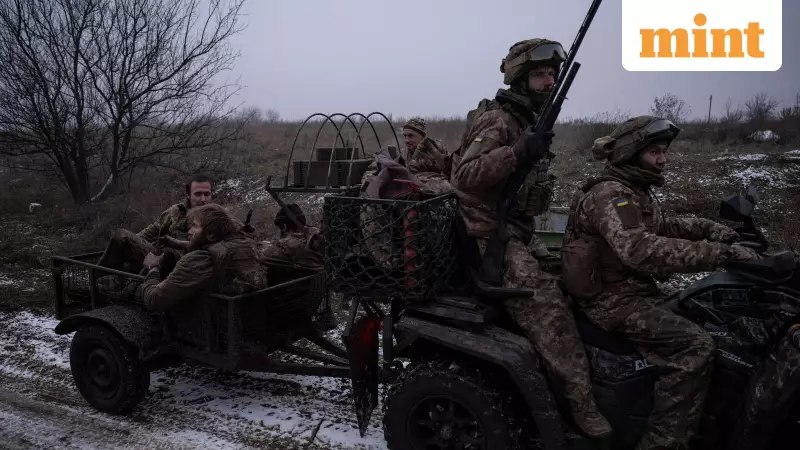
In a rare tactical victory, Ukrainian forces have successfully recaptured most of the key railway town of Kupiansk in the country's north-east. This counter-offensive, however, shines as a bright spot against a grim backdrop where Russian forces are applying immense pressure across multiple fronts, leveraging superior numbers and growing drone capabilities.
The Kupiansk Counter-Strike: A Secretive Success
On December 12th, situation maps around Kupiansk dramatically flipped from red, indicating Russian control, to blue for Ukraine. The shift was credited to a successful Ukrainian operation that liberated most of the town, leaving pockets of Russian defenders encircled in basements. The operation's success was underscored by Ukrainian President Volodymyr Zelensky, who posted a selfie video from the town's edge, barely a kilometre from enemy positions, directly challenging Kremlin claims of victory.
The planning for the Kupiansk counter-attack began in late summer in response to increasing Russian pressure. The critical situation peaked in mid-September when Russian troops breached the Oskil River, occupied the town centre, and threatened a larger Ukrainian force grouping to the south. The full counter-charge was launched on September 21st by a task group including the Khartiia corps, the 92nd Brigade, and the elite Code 9.2 regiment.

Over October and November, this group methodically pushed Russian forces back across the river. A key to their success was cutting off enemy supply routes by securing two villages to the north. In a telling incident, Russia attempted to reinforce its encircled troops via a disused pipeline, unaware that Ukrainian artillery controlled the exit. "Every day [they sent] a platoon. A platoon a day is a thousand men a month," said Ihor Raikov, head of Khartiia's drone forces. The pipeline became a death trap.
Commander Ihor Obolensky of the Khartiia corps, who developed the original plan, emphasised the role of secrecy and ingenuity. "Above all it's about creative thinking, a feel for the enemy, a sense of his rhythm," he stated, refusing to divulge tactics to circumvent Russia's surveillance and kill-zones.
A Broader Battlefield: Russian Gains and Ukrainian Strain
Despite the success in Kupiansk, the overall military picture for Ukraine remains deeply challenging. Russian forces continue to push their advantage in manpower and equipment across other fronts, leading to what a Ukrainian intelligence source described as Russian forces being "several weeks" ahead of their operational plan near Huliaipole in Zaporizhia province.
The situation is particularly acute in several key locations:
- Pokrovsk and Myrnohrad: The 22-month-long defence here is reaching a bitter end. Russia has assembled roughly 160,000 troops in this area. By early December, Myrnohrad was effectively encircled, with several hundred Ukrainian soldiers trapped, many sheltering underground from Russian glide bombs. "There are wounded, and they cannot be evacuated," said a relative of a missing soldier.
- Siversk: This small mining town in Donetsk, a crucial Ukrainian outpost on high ground, saw Russian forces gain a significant foothold in the second week of December. A senior Ukrainian officer warned anonymously that its fall could trigger a domino effect, stating, "Siversk is only the first domino. It will create a chain of panic."
Why Ukraine is Struggling: Manpower, Drones, and Command
Analysts point to three primary factors behind Ukraine's current difficulties. First is the stark disparity in manpower. While Ukraine struggles with conscription, Russia is consistently meeting and exceeding recruitment targets. A Ukrainian intelligence officer noted Russia exceeds its goals by 20-30%, partly by creating economic conditions where signing a military contract becomes a necessity. The Russian grouping in Ukraine now stands at approximately 710,000 troops, with an operational reserve of about 50,000.

The second factor is Russia's growing dominance in drone warfare. New, well-funded units like Rubikon are striking Ukrainian logistics deep behind the front lines. In some sectors, Russia fields more long-range drones, allowing it to hunt and eliminate Ukrainian drone operators first—a reversal from earlier war dynamics where front-line infantry suffered higher casualties.
The third issue is inconsistent command and coordination. Not all Ukrainian commands operate as effectively as the one in Kupiansk. The Pokrovsk axis, for instance, has long suffered from coordination problems. However, the Kupiansk operation proved that where Ukraine mounts a coherent, systematic defence, Russian advances grind to a halt, demonstrating that numbers alone do not decide modern battles.
The current Russian surge appears designed to project strength during sensitive negotiations. Ukraine estimates Russia is suffering over 1,000 casualties a day, but intelligence suggests the offensive can continue for several more months, potentially until February. Russia's aim is to seize as much territory as possible and weaken Ukraine's position before any potential settlement.
For now, Ukraine's Western allies hope it can hold the line, denying Russia major strategic gains. The Kupiansk victory, while tactical, serves as a crucial morale booster and a proof of concept. "We don't lie. We are under pressure. But we have shown that when we are organised, we can beat them," affirmed Khartiia's Ihor Raikov. The challenge is to replicate that organisation and success across a vast and punishing frontline.