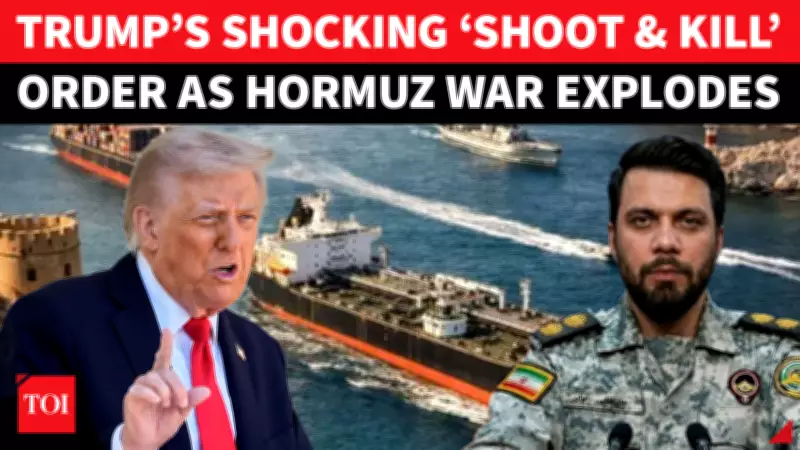
President Donald Trump's order to 'shoot and kill' Iranian boat operators in the Strait of Hormuz has dramatically escalated tensions with Tehran, marking what analysts call a 'desperate attempt' to assert control after the US naval blockade of the strategic waterway appeared to falter. The directive, reported by multiple sources on April 23, 2026, comes amid a series of US seizures of Iran-linked oil tankers and increasing clashes between American forces and the Islamic Revolutionary Guard Corps (IRGC).
Background of the Conflict
The Strait of Hormuz, a narrow passage connecting the Persian Gulf to the open ocean, is a critical chokepoint for global oil shipments. Approximately 20% of the world's petroleum passes through this waterway. Tensions have been simmering for months, with the US accusing Iran of targeting commercial vessels and Iran retaliating against what it views as illegal interference in its territorial waters.
The latest US blockade, announced earlier this month, aimed to prevent Iranian oil exports and curb Tehran's regional influence. However, reports indicate that Iranian speedboats and drones have continued to harass US Navy vessels and allied tankers, prompting the White House to authorize lethal force.

Details of the 'Shoot and Kill' Order
According to internal memos cited by defense officials, the new rules of engagement permit US warships to fire on Iranian small boats that approach within 100 meters without warning. The order specifically targets 'fast-attack craft' operated by the IRGC Navy, which have been involved in near-daily incidents in the strait. Critics argue that this policy could lead to unintended escalation, as distinguishing between hostile and civilian vessels in crowded shipping lanes is notoriously difficult.
'This is a recipe for disaster,' said retired Admiral James Stavridis, former NATO Supreme Allied Commander. 'A single miscalculation could trigger a broader conflict that neither side wants.'
US Seizures of Iran-Linked Tankers
In recent weeks, US forces have boarded and seized at least two tankers suspected of carrying Iranian crude oil in violation of sanctions. The operations, conducted in international waters near the Arabian Sea, have been condemned by Iran as 'piracy' and 'state terrorism.' The IRGC has responded by increasing its patrols in the Persian Gulf and threatening to disrupt shipping if the seizures continue.
The most recent capture involved a tanker flying the flag of a small Pacific island nation, which was allegedly transporting oil from Iran to a refinery in East Asia. US Navy SEALs stormed the vessel after its crew refused to stop for inspection, leading to a brief but tense standoff.
Diplomatic Stalemate
Meanwhile, efforts to revive negotiations over Iran's nuclear program have stalled. Talks in Vienna collapsed last month after Iran refused to halt its enrichment activities, and the US rejected Tehran's demand for the removal of all sanctions. Both sides have hardened their positions, with Iran now enriching uranium to near-weapons-grade levels and the US deploying additional aircraft carriers to the region.
The United Nations has called for restraint, but Security Council resolutions have been blocked by veto threats from the US and Russia. European mediators have warned that the situation is 'spinning out of control.'
Impact on Global Energy Markets
The escalating confrontation has sent shockwaves through global oil markets. Crude prices surged by 12% in a single day following news of the shoot-and-kill order, reaching a four-year high of $98 per barrel. Shipping insurance premiums for vessels transiting the Strait of Hormuz have quadrupled, leading some companies to reroute cargoes around the Cape of Good Hope, adding weeks to delivery times.
Analysts warn that a sustained disruption could tip the global economy into recession. 'We are seeing the early stages of a supply crisis,' said energy economist Dr. Fatima Al-Farsi. 'If the strait is closed, even temporarily, the consequences would be catastrophic.'

Iran's Response and Military Posture
Iran has responded defiantly, with IRGC commanders vowing to 'turn the Persian Gulf into a graveyard for American warships.' Tehran has deployed thousands of fast-attack boats, anti-ship missiles, and naval mines to the strait. In a recent exercise, Iranian forces simulated the sinking of a US aircraft carrier using swarming tactics.
Supreme Leader Ayatollah Ali Khamenei stated that 'any aggression will be met with a crushing response.' Iran has also hinted at the possibility of blocking the strait entirely if its oil exports are completely halted.
International Reactions
Allies of the US have expressed concern over the escalation. The UK and France have urged both sides to de-escalate and resume dialogue. Russia and China, which have close ties to Iran, condemned the US 'shoot and kill' order as a violation of international law and a threat to maritime security.
In the Middle East, Saudi Arabia and the United Arab Emirates have backed the US stance but are wary of being drawn into a conflict. Iraq and Oman, which share borders with Iran, have offered to mediate.
Fears of a Wider Conflict
Defense experts warn that the current trajectory could lead to an accidental war. 'Both sides are playing with fire,' said Dr. Michael Horowitz, a security analyst at the Center for Strategic and International Studies. 'The risk of miscalculation is extremely high, and there is no off-ramp in sight.'
Already, there have been reports of skirmishes between US drones and Iranian air defenses, as well as cyberattacks targeting oil infrastructure. The Pentagon has ordered all non-essential personnel to leave the region, and several countries have issued travel warnings for the Persian Gulf.
As the standoff continues, the world watches with bated breath. The Strait of Hormuz, once a symbol of global commerce, has become the epicenter of a new and dangerous confrontation between two nuclear-capable powers.