Women's Reservation Bill Creates Political Tightrope for Opposition Ahead of Key State Elections
The Narendra Modi government is strategically advancing the Women's Reservation Bill just before crucial polling phases in West Bengal and Tamil Nadu, setting the stage for a significant political confrontation. This legislative push requires opposition support for passage, placing major regional parties like the Trinamool Congress (TMC) and Dravida Munnetra Kazhagam (DMK) in a challenging position as they simultaneously work to block the Bharatiya Janata Party's electoral gains in their respective states.
Opposition's Electoral Dilemma: Balancing Political Strategy and Voter Sentiment
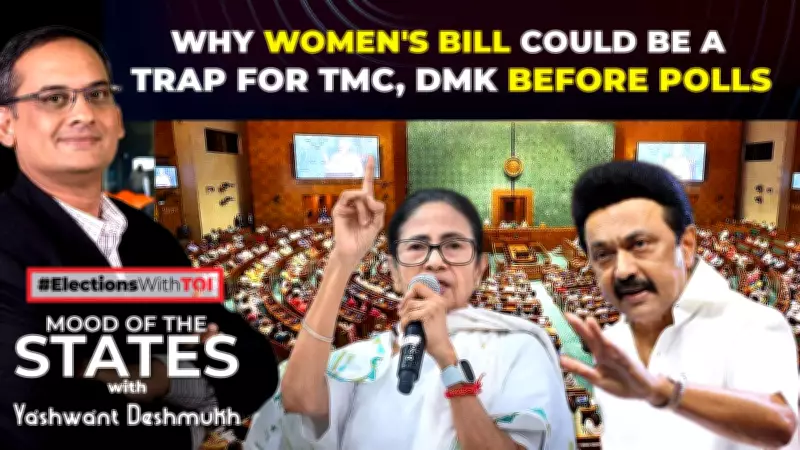
According to political analyst Yashwant Deshmukh, founder-director of C-Voter, the Women's Reservation Bill presents a complex electoral dilemma for opposition parties. While TMC and DMK aim to prevent BJP breakthroughs in West Bengal and Tamil Nadu, opposing women's reservation could potentially alienate a substantial segment of female voters who might view the legislation as progressive and empowering.
"The timing of this bill creates a perfect political storm," explains Deshmukh in an exclusive analysis for Mood Of The States. "Opposition parties face the risk of losing women's votes if they block legislation that promises greater political representation for women across India."

Strategic Implications for West Bengal and Tamil Nadu Politics
The political calculus becomes particularly intricate in West Bengal, where Chief Minister Mamata Banerjee's TMC has established strong grassroots support among women through various welfare schemes. Similarly, in Tamil Nadu, the DMK has historically positioned itself as a progressive force advocating for social justice and gender equality.
"Both parties now confront a difficult choice," notes Deshmukh. "Supporting the bill could be perceived as strengthening the central government's agenda, while opposing it might undermine their credibility on women's issues just before elections."
The legislation's potential impact extends beyond immediate electoral calculations to long-term political realignments. As Deshmukh elaborates, "This isn't just about one bill—it's about how political parties position themselves on gender representation at a time when women voters are becoming increasingly decisive in election outcomes."
Broader Political Context and Future Ramifications
The Women's Reservation Bill debate occurs against the backdrop of intensifying political competition between national and regional parties. With the BJP seeking to expand its footprint in states where it has traditionally been weaker, and regional parties fighting to protect their strongholds, the legislation has transformed from a policy issue into a strategic electoral weapon.
Deshmukh's analysis suggests that how TMC and DMK navigate this political tightrope could influence not just immediate election results but also their future credibility on gender issues and their ability to attract women voters in subsequent elections. The coming weeks will reveal whether opposition parties prioritize short-term electoral tactics or long-term positioning on women's representation in Indian politics.