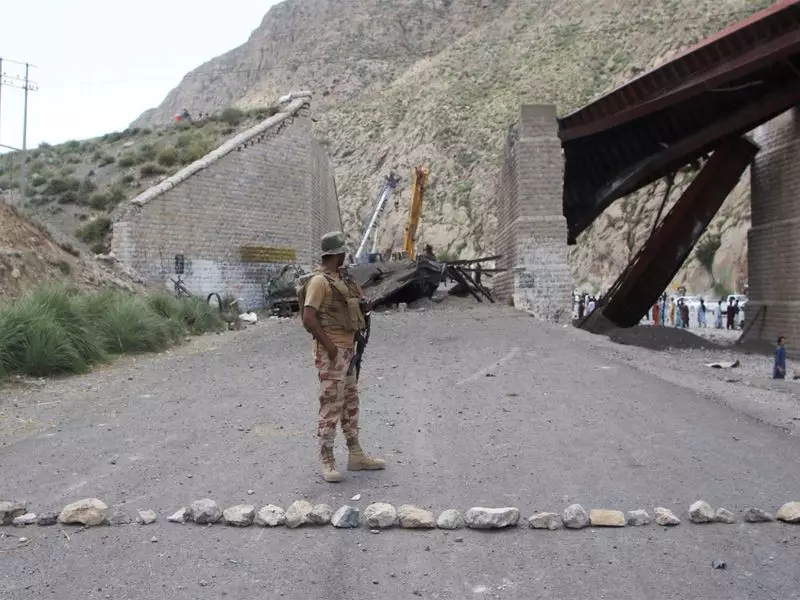
In a stark warning that reverberates across geopolitical and economic circles, the leader of a prominent Baloch separatist group has directly cautioned China and Western nations against pouring investments into Pakistan's restive Balochistan province. Dr. Allah Nazar Baloch, the chief of the Balochistan Liberation Front (BLF), framed a recent deadly assault on a paramilitary base as a clear signal to the world.
A "National Message" from Nokkundi
The BLF leader's statements come in the wake of a significant attack on February 2nd. On that day, fighters associated with the Balochistan Liberation Front targeted a Frontier Corps (FC) base located in the Nokkundi area of Chagai district. The assault was not a minor skirmish but a coordinated operation claiming the lives of at least fourteen Pakistani security personnel.
Dr. Allah Nazar Baloch did not mince words when characterizing this event. He explicitly labeled the Nokkundi attack a "national message" directed at foreign entities, particularly those with economic interests in the region. His declaration underscores a strategic shift by Baloch insurgent groups, aiming to internationalize their long-standing conflict with the Pakistani state by threatening the infrastructure and projects that attract global capital.

Direct Warning to Foreign Powers
The core of Dr. Baloch's warning is a direct threat to the economic ambitions of external powers in Balochistan. He asserted that foreign investments, especially those linked to mega-projects like the China-Pakistan Economic Corridor (CPEC), are now in the crosshairs. "We warn China and other international powers to refrain from investing in Balochistan," he stated, making it clear that such investments are seen as exploitative and detrimental to the Baloch people.
He accused these foreign investments of being a primary driver of what he termed the "genocide of the Baloch nation." In his view, the resource-rich province's wealth is being extracted while its native population faces marginalization and military oppression. The warning serves as a notice that any economic venture perceived as enabling this dynamic will be considered a legitimate target.
The BLF chief extended his caution beyond China to include Western countries, indicating a broad-based opposition to foreign economic engagement with Islamabad in Balochistan. This positions the insurgency not just against Pakistan, but against any international partner that bolsters the central government's hold over the province.
Context and Implications for Regional Stability
This explicit warning from a key insurgent leader carries profound implications. Balochistan, Pakistan's largest province, is the epicenter of the multi-billion-dollar CPEC, a flagship component of China's Belt and Road Initiative. The corridor is envisioned as a network of roads, railways, and energy projects linking China's western region to the Gwadar Port on the Arabian Sea.
Security for CPEC projects has long been a paramount concern for both Beijing and Islamabad. While attacks on Chinese personnel and interests have occurred previously, this formal, high-level warning from the BLF chief escalates the threat perception. It moves from opportunistic attacks to a declared policy of targeting the economic underpinnings of Pakistan's control over Balochistan.
The statement also highlights the persistent and potent challenge Baloch separatist groups pose to Pakistan's internal security. Despite numerous military operations, groups like the BLF continue to demonstrate the capability to launch devastating attacks on well-fortified military installations.
For the international community, particularly investors from China, the Gulf, and the West, this serves as a severe risk advisory. It underscores that the conflict in Balochistan is far from resolved and that economic projects are deeply entangled in a complex ethnic-nationalist struggle. The allure of Balochistan's mineral resources and strategic geography is now counterbalanced by a sharply elevated and explicitly stated security threat.

Dr. Allah Nazar Baloch's message is unequivocal: the fight for Baloch independence will be taken to the economic front. The Nokkundi attack, in this light, is portrayed not merely as a tactical victory but as a strategic statement aimed at isolating Pakistan economically and deterring its foreign partners. The coming months will test the resolve of the investors and the capacity of Pakistani security forces to protect these critical assets.