

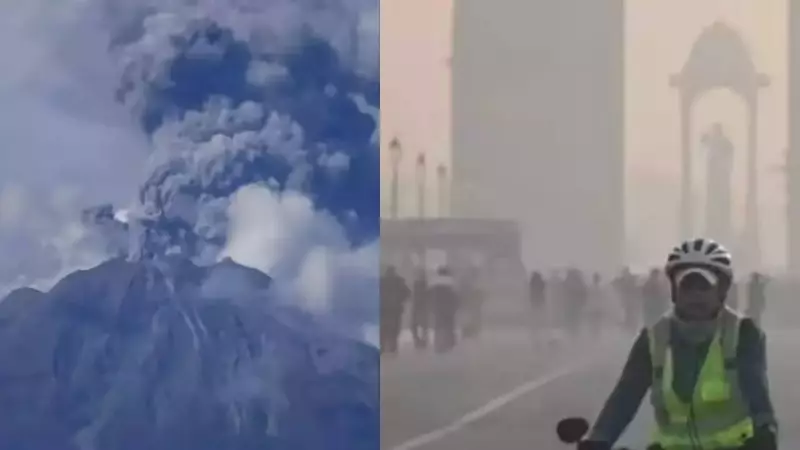
Volcanic Ash Cloud from Ethiopia Reaches Indian Skies
A significant meteorological event unfolded on Monday as a volcanic ash cloud originating from Ethiopia's recently erupted Hayli Gubbi volcano made its way into western parts of India. Meteorological authorities confirmed the plume's entry, marking an unusual atmospheric phenomenon affecting the subcontinent.
Path and Composition of the Volcanic Plume
The volcanic cloud was first detected near Jamnagar in Gujarat around 5:30 pm on Monday, according to weather monitoring agencies. The ash cloud is traveling at impressive speeds of 100-120 km/h at altitudes ranging between 15,000 to 45,000 feet above sea level.
Scientists analyzing the plume's composition have identified it contains a mixture of volcanic ash, sulphur dioxide, and microscopic particles of glass and rock. These elements are characteristic of volcanic emissions and can have varying effects on atmospheric conditions and aviation safety.

Expected Movement Across Northern India
Weather tracking agency IndiaMetSky provided detailed projections about the cloud's trajectory. "The ash cloud is about to enter Gujarat and will move towards Rajasthan, north-west Maharashtra, Delhi, Haryana, and Punjab by 10 pm," the agency stated in its latest bulletin.
Authorities have established monitoring systems to track the plume's progress toward major urban centers including Delhi and Jaipur. The continuous monitoring aims to provide real-time updates about the cloud's movement and potential impacts.
Impact on Air Quality and Visibility
While the volcanic ash may create darker and hazier sky conditions, environmental experts suggest it is unlikely to significantly affect Delhi's air quality. This assessment comes despite the national capital already experiencing challenging air conditions.
On Tuesday morning, a thick layer of haze engulfed Delhi, with the Air Quality Index (AQI) remaining in the 'very poor' category across Delhi and the National Capital Region, as reported by the Central Pollution Control Board.
Potential Disruption to Air Travel
The volcanic ash cloud poses significant concerns for air traffic management. IndiaMetSky has issued warnings that the plume could disrupt air traffic, potentially causing flight delays and extended travel times across affected regions.
The Toulouse Volcanic Ash Advisory Centre (VAAC) confirmed that authorities and airlines are closely monitoring the cloud to ensure the safety of air travel operations. The fine particles in volcanic ash can damage aircraft engines and systems, making careful monitoring essential for aviation safety.
Background: The Hayli Gubbi Eruption
The atmospheric phenomenon traces back to the eruption of the Hayli Gubbi volcano in Ethiopia, which began at 8:30 am UTC on Sunday. What makes this event particularly notable is that the volcano had been dormant for nearly 10,000 years before this sudden activity.
While the explosive phase of the eruption has ceased, the resulting ash plume continues its eastward journey across continents. The volcanic activity has already affected regions beyond Ethiopia, with ash clouds sweeping across the Red Sea toward Oman and Yemen before shifting direction toward the Indian subcontinent.
Several airlines have issued cautionary notices for Middle East flights in response to the volcanic activity, though no specific advisories have been released for flights to India as of the latest reports.






