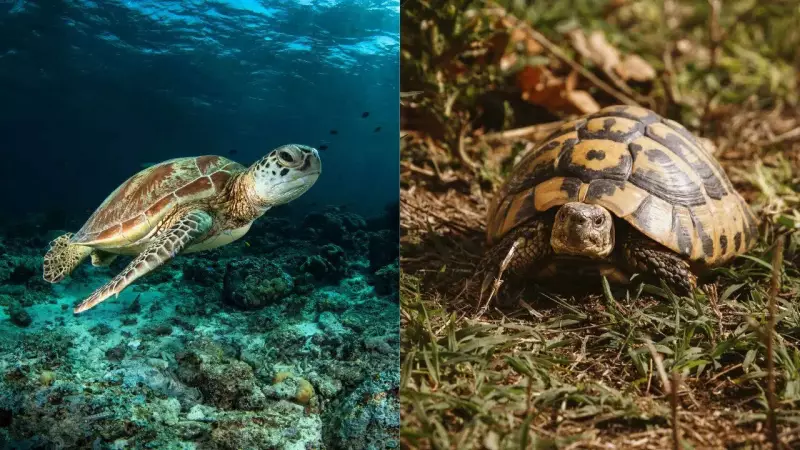
Many wildlife enthusiasts in India often mix up turtles and tortoises, using their names interchangeably. This common confusion persists despite growing public interest in wildlife identification through digital platforms and conservation initiatives. While both belong to the ancient order Testudines and share characteristic protective shells and deliberate movements, their evolutionary journeys, ecological roles, and physical characteristics are vastly different.
Common Ground: What Turtles and Tortoises Share
Turtles and tortoises share a deep evolutionary bond within the Testudines order, which grants them several fundamental similarities. Both possess a bony shell that is fused to their skeleton, acting as a part of their ribcage and spine rather than just an external cover. This unique structure offers immense protection from the moment they hatch.
Their shells are covered in scutes, which are made of keratin. These scutes create patterns that tell a story of the animal's growth, age, and even environmental changes. Another shared trait is their slow metabolism, which contributes to their remarkable longevity, with many species living for several decades.

When it comes to reproduction, both turtles and tortoises lay eggs. Their nesting behaviours, including site selection and the influence of incubation temperature on the sex of the offspring, are also remarkably similar. These shared features are a major reason why people often mistake one for the other.
Key Differences: Habitat, Diet, and Physical Traits
Scientific research, including datasets published in journals like Nature Scientific Data, has clearly outlined the major differences between these two reptile groups. The table below highlights the distinct ecological paths they have taken.
Primary Habitat: Turtles are aquatic or semi-aquatic, thriving in rivers, ponds, and oceans. Tortoises are strictly land-dwellers, found in deserts, grasslands, and forests.
Shell Shape and Structure: A turtle's shell is flatter, lighter, and streamlined for efficient swimming. A tortoise's shell is dome-shaped, heavier, and built for defence against terrestrial predators.
Limb Structure: Turtles have webbed feet or flippers for swimming, while tortoises have stout, column-like legs for walking on land.
Dietary Behaviour: Turtles are often omnivorous, eating aquatic plants, small fish, and insects. Tortoises are primarily herbivorous, feeding on grasses, leaves, and flowers.
Conservation Threats: Turtles face dangers from coastal development, plastic pollution, and bycatch. Tortoises are threatened by habitat loss, illegal trade, and road expansion.
Why Correct Identification Matters for Conservation
Understanding these differences is not just academic; it is critical for their survival. Conservation strategies for these animals must be tailored to their specific needs. Efforts that protect water quality and reduce plastic waste are vital for turtles, but they do little for tortoises, which require protected drylands and safe migration routes across increasingly human-dominated landscapes.
Public awareness is the first step. When people can accurately identify a turtle from a tortoise, they are better equipped to support the right conservation campaigns and make informed decisions that help protect these ancient reptiles for generations to come.