

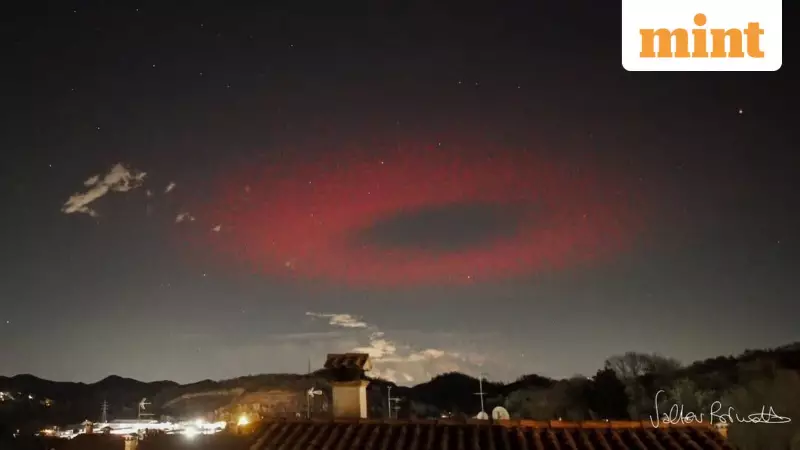
Mysterious Red Ring Returns to Italian Skies
The residents of Possagno, a small town in northern Italy, were left in awe on the evening of November 17 when a strange, red, halo-like ring materialized in the night sky above them. This was not an isolated event for the town, as a similar celestial spectacle had been witnessed back in March 2023.
Unveiling the Science Behind the Red Halo
While the sight might seem like something from a science fiction film, scientists have a clear explanation. According to reports from Live Science, the mysterious ring is a rare natural occurrence known as an ELVE. This acronym stands for Emission of Light and Very low-frequency perturbations due to Electromagnetic pulse sources.
This fascinating phenomenon is a direct result of incredibly powerful lightning bolts. These bolts emit electromagnetic pulses that shoot upwards into space. When these pulses collide with the ionosphere—a layer of the Earth's atmosphere filled with charged particles—they excite the nitrogen molecules present there. This excitation process causes the molecules to emit a distinctive red glow.

What makes ELVEs exceptionally difficult to spot is their fleeting nature. They typically last for a mere one-thousandth of a second, far too quick for the human eye to perceive. The lightning bolt responsible for this particular event was exceptionally strong, measuring around 303 kilo-amperes. This makes it 10 to 30 times more powerful than an average lightning strike during a typical thunderstorm.
The Man Behind the Camera: Capturing the Impossible
The person credited with documenting this elusive event is photographer Valter Binotto, who also captured the previous occurrence in March. Interestingly, Binotto was not specifically hunting for an ELVE that night. He was actually trying to photograph sprites, another type of upper-atmospheric electrical discharge.
"I didn't capture any sprites, but fortunately, I managed to capture this Elve!" Binotto told spaceweather.com. His success is a testament to his skill and preparation. He used a Sony A7S camera equipped with a 20 mm f/1.8 lens, set at a high ISO 51,200. The video, from which the still image was extracted, was recorded at 25 frames per second.
Experts clarify that the reason Possagno has become associated with this phenomenon is not due to any unique geographical quality of the town itself. Instead, it is purely a result of Binotto's dedicated efforts and technical expertise in sky photography. His work has inadvertently put this small town nestled in the foothills of the Alps on the map for space weather enthusiasts.
ELVEs were first observed and officially recognized by NASA in the 1990s, and they continue to be a subject of fascination for scientists and the public alike, reminding us of the complex and beautiful interactions within our planet's atmosphere.






