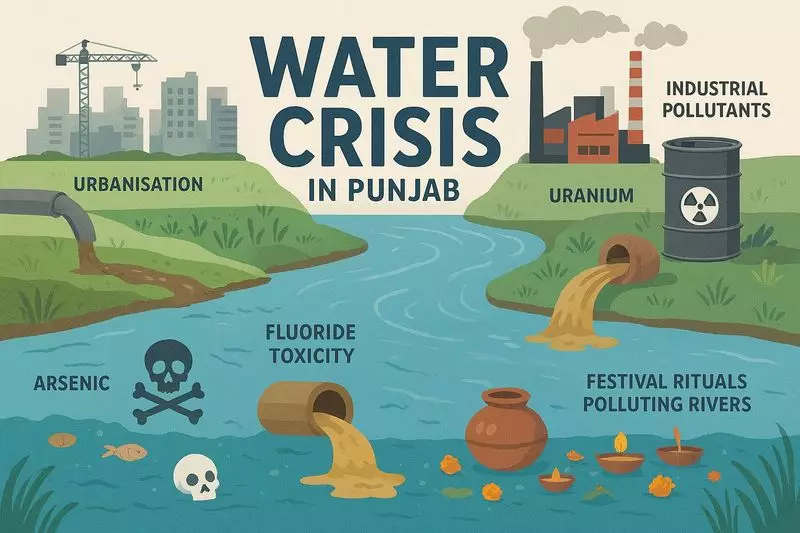
The land of five rivers, Punjab, is facing an unprecedented water crisis that threatens its very survival. Known as India's breadbasket, the state is now grappling with rapidly depleting groundwater resources that could jeopardize its agricultural future and drinking water security.
The Alarming Groundwater Situation
According to recent data, 78% of Punjab's groundwater assessment blocks are categorized as 'over-exploited'. This alarming statistic places the state at the top of India's water crisis chart. The Central Ground Water Board reports that the water table in Punjab has been declining at an average rate of 0.5 meters per year, with some areas experiencing even more dramatic drops.
The situation has become so critical that in many regions, farmers must drill borewells as deep as 500 feet to access water. This represents a significant increase from previous decades when water was readily available at much shallower depths. The over-exploitation has created a vicious cycle where deeper drilling leads to faster depletion.

Agricultural Practices and Water Mismanagement
The primary driver of Punjab's water crisis lies in its agricultural patterns. The state has become heavily dependent on water-intensive crops, particularly paddy cultivation. During the paddy season, which typically runs from June to October, the state witnesses massive water extraction that far exceeds natural recharge rates.
Experts point to the free electricity provided to farmers for agricultural pumps as a significant contributing factor. This well-intentioned policy has inadvertently led to excessive groundwater pumping without consideration for conservation. Farmers often leave water pumps running for extended periods, leading to significant wastage.
The traditional paddy transplantation method requires standing water in fields for prolonged periods, resulting in enormous water consumption. This practice, combined with the timing of cultivation during peak summer months when evaporation rates are highest, creates perfect conditions for water resource depletion.
Consequences and Future Implications
The water crisis in Punjab has far-reaching consequences beyond agriculture. Many villages now face drinking water shortages, with groundwater levels dropping below the reach of existing infrastructure. The quality of remaining groundwater has also deteriorated, with increasing contamination from arsenic, fluoride, and other harmful elements.
Farmers are feeling the economic impact directly. The cost of drilling deeper borewells and operating submersible pumps has increased their production expenses significantly. Many small and marginal farmers are finding it difficult to sustain their operations, leading to rising debt and agricultural distress.
Environmental experts warn that if current trends continue, large areas of Punjab could become desert-like within decades. The state that played a crucial role in India's Green Revolution now faces an existential threat that requires immediate and comprehensive intervention.
Potential Solutions and Way Forward
Addressing Punjab's water crisis requires a multi-pronged approach. Agricultural diversification away from water-intensive crops is essential. Promoting less thirsty crops like maize, pulses, and oilseeds could significantly reduce water demand while maintaining farmer incomes.
Water conservation techniques such as direct seeding of rice, laser land leveling, and drip irrigation show promise in reducing water consumption. The state government has initiated some programs to promote these methods, but wider adoption is necessary.
Improving water recharge through rainwater harvesting, rejuvenating traditional water bodies, and better management of canal systems could help restore the groundwater balance. Community participation and awareness campaigns are crucial for changing water usage behaviors.
The Punjab government has taken some steps, including the Punjab Subsoil Water Preservation Act that delays paddy transplantation dates. However, stronger implementation and additional measures are needed to address this urgent challenge effectively.

The survival of Punjab's agricultural economy and the well-being of its people depend on immediate and sustained action to manage water resources more sustainably. The time to act is now, before the land of five rivers runs completely dry.