

Mumbai's Green Cover Under Threat
The Maharashtra government has introduced a controversial new policy that permits compensatory tree plantation for Mumbai's public projects anywhere within the vast Mumbai Metropolitan Region (MMR). While authorities present this as a practical solution to the city's severe space constraints, environmental experts warn it represents a significant ecological threat with serious implications for public health and urban sustainability.
Questioning the Ecological Logic
Environmental activist Zoru Bathena challenges the fundamental premise of the policy with a compelling analogy: "If there's a major network issue in Colaba and they install a network tower in Thane, will that resolve Colaba's connectivity problems? The same logic applies to trees. How can you address pollution issues in one area by replanting trees you cut there in a completely different location?"
Previously, regulations required that for every mature tree cut down, an equivalent number had to be planted within Mumbai city limits, matching the age and size of the original trees. The new policy, citing "acute shortage of open space", now allows replanting in distant areas across Thane, Navi Mumbai, Palghar, or Raigad.

This shift means that when mature trees are removed for infrastructure projects like flyovers, metro lines, roads, and commercial towers, the compensatory planting occurs in far-flung MMR corners. Consequently, local residents lose immediate protection from dust and toxic pollutants that these trees provided.
Residents Feel the Heat
Churchgate resident Shefali Kapadia shares her firsthand experience: "Our area was once a beautiful boulevard. Before the Metro construction, you could only see a canopy of trees. We were promised the trees would be replanted, but that never happened. The missing green cover has made summers unbearably hot. How can they justify planting trees in distant locations when we're suffering the consequences here?"
B Stalin, Director of environmental NGO Vanashakti, expresses concern about accountability: "Now if trees are cut in Kurla or Vikhroli, government agencies can carry out transplantation in remote locations like Mogarpada in Thane, away from public scrutiny, or replant in already dense green areas, disturbing existing ecosystems."
The Transplantation Challenge
The official guidelines for tree translocation appear comprehensive on paper. They mandate using only local species, require saplings to be at least 12 feet tall, and specify a seven-year upkeep period. Project agencies must secure landowner consent, ensure proper maintenance, and local bodies are supposed to maintain "land banks" of potential sites.
However, the practical implementation faces significant hurdles. The Forest Research Institute in Dehradun outlines an elaborate protocol involving specific seasons (November-December or dormancy periods), avoiding monsoon and peak growth phases. Success depends on matching site conditions, proper soil preparation, adequate space, and pre-removal tree treatment.
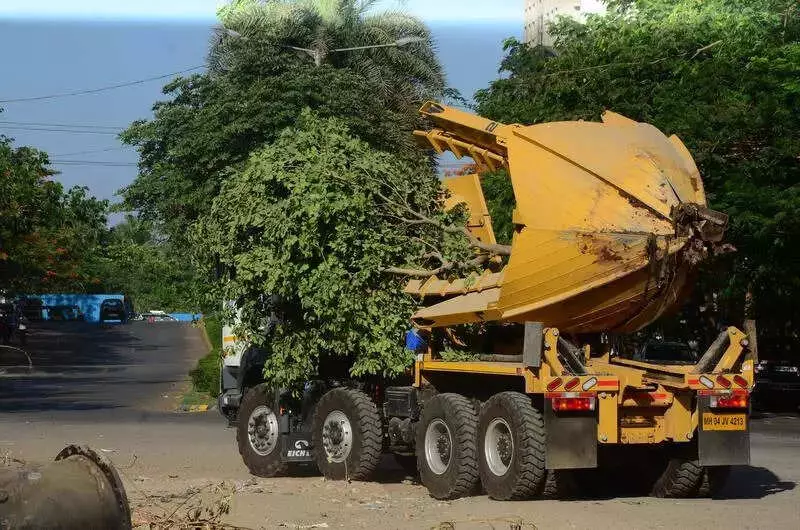
Critical to survival is keeping the root ball intact during the careful lifting process using specialized machinery like tree spade trucks. These vehicles come with three blade configurations—cone, truncated, and half moon—selected based on soil type. Post-transplantation care for 3-5 years, including watering, mulching, staking, and monitoring, significantly improves survival rates, particularly for young native species.
Alarming Survival Rates
Despite these scientific protocols, success is far from guaranteed. FRI's 2020 study revealed average survival rates of just 10%, with rare instances exceeding 50% only under ideal conditions with meticulous species selection and care.
Mumbai's track record is particularly concerning. Only half of the 20,460 compensatory trees planted during Metro construction at Aarey have survived, with many reduced to mere stubs. The Mumbai Metro Rail Corporation had claimed to hire Singapore-based arborist Simon Leong to oversee tree preservation for the Metro 3 project, but Leong later confirmed he never received such a contract.

Stalin criticizes Mumbai's transplantation methods: "There's no scientific approach used for tree transplantation in Mumbai. They first trim trees by cutting off branches, then yank them out using JCB machines. How can any tree survive such treatment?"
Professor Rajendra Shinde, former principal and botany professor at St. Xavier's College, provides a professional assessment: "In my experience, not more than 20% to 30% of translocated trees survive because India lacks the necessary equipment for successful tree relocation."
Ecological Consequences
The loss of local trees triggers multiple environmental problems: higher surface temperatures, increased heat absorption by glass and concrete structures, and amplified "street canyon" effects that trap pollutants between tall buildings. Birds, insects, and soil organisms that depended on mature avenue trees lose their feeding and nesting habitats.
Urban trees serve crucial functions—they trap particulate matter on leaves, alter wind patterns to disperse pollutants, and cool concrete-heavy cityscapes. Research indicates roadside trees can reduce PM10 and PM2.5 levels by up to 50%.
Professor Shinde emphasizes the broader ecological role: "A single tree constitutes an entire ecosystem, housing birds, squirrels, and serving as a food source for insects and other organisms. Beyond mitigating toxic air pollutants, trees also function as natural sound barriers in dense traffic areas."
The Supreme Court recently criticized the Maharashtra government for its "gross negligence" in implementing compensatory afforestation plans for Mumbai Metro and other development projects, citing poor soil usage, shoddy maintenance, and inadequate protection measures.





