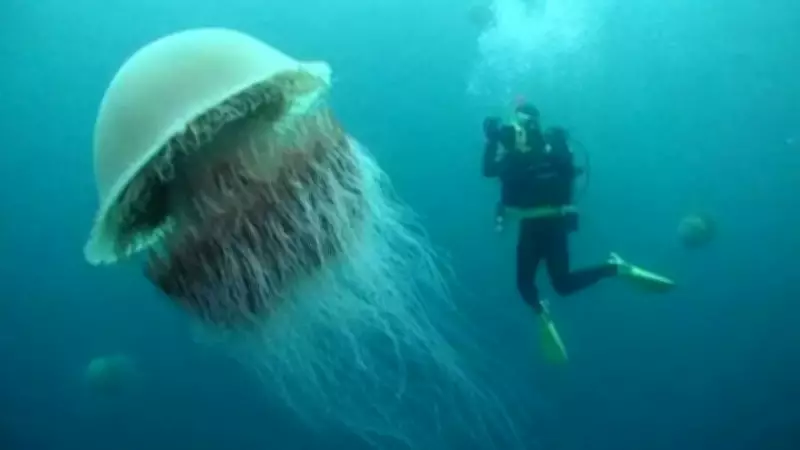
The World's Longest Jellyfish: A Brainless Marvel of the Ocean
Did you know that the world's longest jellyfish possesses neither a brain nor bones? This astonishing fact is confirmed by recent research published in the scientific journal Frontiers in Marine Science. The Lion's Mane jellyfish, scientifically known as Cyanea capillata, stands out as one of the most structurally complex 'brainless' predatory species inhabiting the entire ocean.
Giant Dimensions and Unique Anatomy
Operating without a centralized nervous system or any skeletal structure, the Lion's Mane jellyfish relies on a decentralized nerve net to coordinate its massive gelatinous body. Its bell diameter has been recorded at greater than 2 meters, making it an imposing figure in marine environments.
Research from the journal PLOS One further illuminates the extraordinary and unique structure of this predator. It consists of a very large number of stinging tentacles that form its distinctive 'mane.' Specifically, the Lion's Mane jellyfish boasts approximately 1,200 stinging tentacles, organized into 8 separate clusters. These tentacles can reach a total length of up to 36.6 meters (120 feet), enabling the jellyfish to create a giant, venomous net for capturing prey.

Why It's Called the Lion's Mane
One of the most recognizable features of this jellyfish is its 'mane,' which explains why it is commonly referred to as the 'King Mane.' According to a research article in PLOS One, the mane is not composed of hair but contains around 1,200 strands of highly elastic tentacles. Each tentacle is about 0.5 millimeters thick and grouped into eight clusters. When fully extended, these tentacles can span up to 36.6 meters, giving the jellyfish a shaggy appearance that resembles a lion's mane in both color and texture.
Cyanea capillata is not only the largest jellyfish in the world but also ranks among the longest animals on Earth. Its tentacles alone surpass the average length of a Blue Whale, which typically grows to about 30 meters.
Life Without a Brain: How It Functions
How can such a colossal creature survive without bones or a brain? Another research study published in Frontiers in Marine Science reveals that the Lion's Mane jellyfish achieves this through a decentralized nerve net instead of a central nervous system. Instead of having a single brain command center, sensory neurons are spread throughout its entire gelatinous body. This allows it to detect light, chemicals, and vibrations across its extreme 120-foot length. Coordination of movements is facilitated by a hydrostatic skeleton, supported entirely by internal body pressure.
Hunting Strategy of the Ocean's Longest Predator
The 'mane' of the Lion's Mane jellyfish serves as a critical tool for hunting. It enables prey, such as fish and smaller jellyfish, to come into contact with the jellyfish's nematocysts, or stinging cells. As a predator, the jellyfish uses its mane to bring captured prey to its mouth, located at the bottom of its bell-shaped body.
Observations indicate that the King Mane jellyfish possesses about 1,200 venomous filaments on the surface of its mane, functioning as a large, floating, venomous net. Since jellyfish lack the ability to actively hunt due to their brainless nature, they depend on the extensive surface area of these filaments to ensnare prey. When an animal touches the filaments, multiple stinging cells fire, paralyzing the prey before it is drawn toward the jellyfish's mouth.
This remarkable adaptation highlights the efficiency of nature's designs, even in the absence of traditional biological systems like brains and bones.