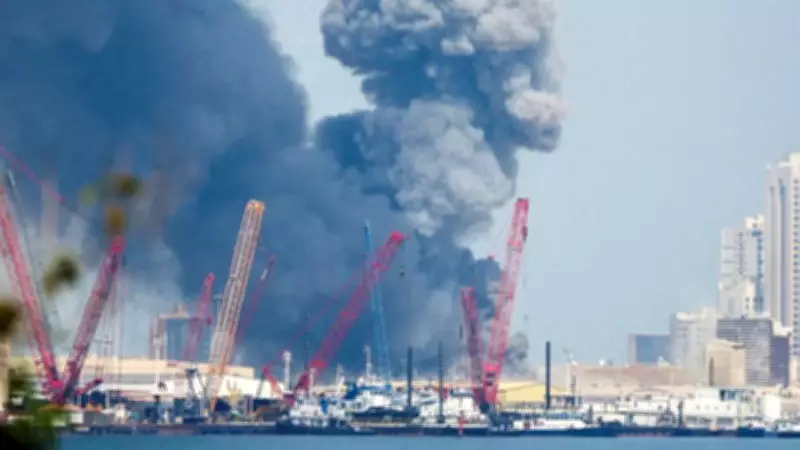
Iran Unleashes Coordinated Strikes on US Military Assets Across Gulf Region
In a significant escalation of regional hostilities, Iran has launched a series of retaliatory attacks targeting United States military installations and assets across multiple Gulf nations. This aggressive military operation comes as direct retaliation for what Tehran describes as a "massive" joint offensive conducted by the United States and Israel against Iranian interests.
Multi-Nation Assault Targets US Presence
The Iranian government officially confirmed the attacks on Saturday through the Fars news agency, identifying specific targets in Bahrain, Kuwait, Qatar, and the United Arab Emirates. These nations collectively host numerous airbases and military facilities where approximately 30,000 to 40,000 US troops are typically deployed across the Middle East region.
Iran's paramilitary Revolutionary Guard issued a stark warning on Sunday, threatening to launch what they described as "the most intense offensive operation in the history of the Islamic Republic's armed forces." This promised escalation would specifically target both Israel and US military bases throughout the region.

Casualties and Damage Across Gulf Nations
The attacks have resulted in confirmed casualties and significant property damage across several Gulf states:
- United Arab Emirates: At least one person was killed in Abu Dhabi after several Iranian-launched missiles were intercepted. In Dubai, a fire erupted near a hotel on the Palm Jumeirah Islands, injuring four people and sending massive plumes of smoke into the sky. The Dubai Media Office also reported four injuries from an incident at Dubai International Airport, though damage was described as minor.
- Bahrain: A missile strike directly targeted the headquarters of the US Navy's 5th Fleet in Manama, which Bahrain condemned as a "treacherous attack" and "blatant violation of sovereignty." Social media footage appeared to show an Iranian Shahed drone striking a nearby tower block, igniting a substantial fire. Several residential buildings in Manama were also affected, requiring emergency response teams.
- Kuwait: The Ali al-Salem Air Base came under attack by multiple ballistic missiles, all of which were reportedly intercepted by Kuwait's air defense systems. A separate drone attack targeted Kuwait International Airport, causing minor injuries to several employees and material damage to the passenger terminal.
- Qatar: Qatar's defense ministry stated they "thwarted" attacks by intercepting "all missiles" before they reached Qatari territory. Sources indicated an Iranian missile targeted a long-range early warning radar in northern Qatar, though no injuries were reported.
Diplomatic Fallout and Regional Reactions
Iranian Foreign Minister Abbas Araghchi communicated to the United Nations Security Council and Secretary-General António Guterres that Iran would "continue to exercise its right of self-defence decisively and without hesitation until the aggression ceases fully and unequivocally."
The attacks have prompted strong diplomatic responses from affected nations:
- Bahrain's ambassador to the United States described the assaults as a "blatant violation of sovereignty"
- Qatar condemned targeting by a neighbor as unacceptable "under any justification or pretext"
- Kuwait affirmed its right to self-defense through official statements
- Saudi Arabia confirmed Iran targeted Riyadh and eastern regions, though attacks were repelled
Broader Regional Impact and Security Measures
The conflict has extended beyond the immediate Gulf region, with Iraq experiencing multiple attacks. Erbil Airport in Iraq's Kurdish region was targeted twice, with a drone aimed at the airport being intercepted and shot down. Additionally, a drone strike hit a headquarters of the Kataeb Hezbollah armed group southwest of Baghdad, killing two people according to reports.

In response to the escalating violence, Qatar, Kuwait, Bahrain, and the UAE temporarily closed their airspace while condemning Iran's attacks on their territories. Maritime authorities reported closure notices for the strategically vital Strait of Hormuz, a critical oil export route connecting major Gulf producers with international waters.
Collapse of Diplomatic Efforts
The attacks effectively terminated recent diplomatic initiatives, particularly disappointing Oman which had played a central role in facilitating indirect talks between Tehran and Washington. Omani Foreign Minister Badr Albusaidi had expressed optimism about peace being "within reach" just hours before the US-Israel attacks that prompted Iran's retaliation.
Albusaidi subsequently voiced "dismay" at the outbreak of violence and urged Washington to avoid further entanglement in the conflict, stating plainly: "This is not your war."
The coordinated nature of Iran's attacks across multiple nations, combined with explicit threats of further escalation from the Revolutionary Guard, has significantly heightened fears of a broader regional conflict that could draw in additional international actors and destabilize global energy markets.