Indian Workforce Experiences Significant Drop in Weekly Working Hours Post-Pandemic
Data from the latest Periodic Labour Force Survey (PLFS) indicates that Indian workers are clocking fewer hours per week in 2025 compared to the period before the Covid-19 pandemic. This trend highlights ongoing challenges in the labour market despite some economic recovery.
Steepest Decline Among Self-Employed Workers
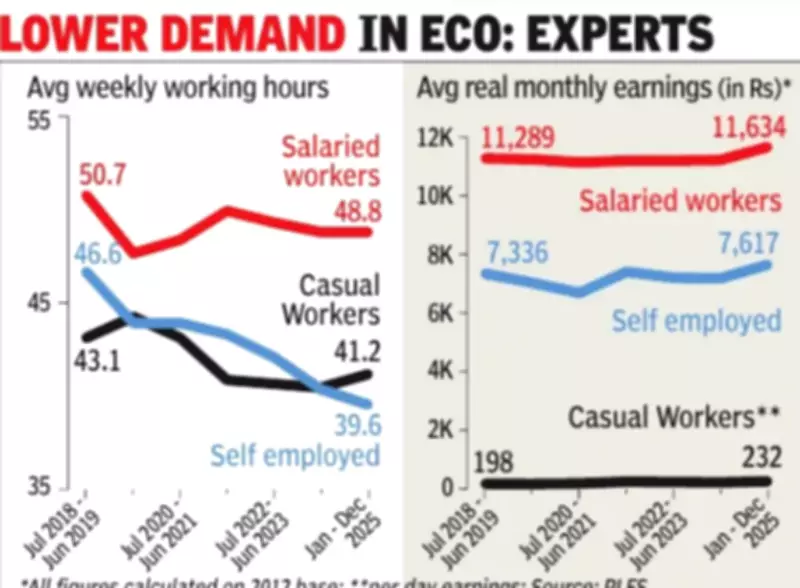
The analysis reveals that self-employed individuals, who make up nearly 56% of the workforce, have faced the most substantial reduction in working hours. Their weekly hours fell to 39.6 in January 2025–December 2025 from 46.6 hours in July 2018–June 2019. Casual and salaried workers also saw declines, with hours dropping to 41.2 and 48.8 from 43.1 and 50.2, respectively.
Experts Point to Lower Aggregate Demand and Economic Imbalances
Economists attribute this decline to reduced aggregate demand in the economy following the pandemic. Amit Basole, a professor at Azim Premji University, explained that many own-account enterprises have suffered from diminished demand, leading to lower earnings and less incentive to work longer hours. "It's a self-feeding loop. Casual workers are also struggling to find sufficient work, indicating that the labour market recovery is not as robust as headline unemployment rates suggest," he noted.

Real Earnings Show Modest Increases Amidst Hour Reductions
Despite the drop in working hours, real monthly earnings have seen slight upticks. Self-employed individuals earned Rs 7,617 in 2025, up from Rs 7,336 in 2018–19. Salaried workers' earnings rose to Rs 11,634 from Rs 11,289, while daily real earnings for casual workers increased to Rs 232 from Rs 198.
Gender and Rural Disparities Highlighted in Working Hour Trends
Disaggregated data shows that both men and women have experienced declines in weekly working hours. Men worked 45.9 hours in 2025, down from 48.9 hours in 2018–19, while women worked 34.1 hours, reduced from 39.4 hours. Women in rural areas saw the highest decline, with hours falling to 32.6 in 2025 from 38.2 in 2018–19.
Rise in Female Labour Force Participation Driven by Distress Employment
Interestingly, the labour force participation rate (LFPR) for women has nearly doubled to 34.6% in 2025 from 18.2% in July 2017–June 2018. Labour economist Santosh Mehrotra suggests this increase is primarily due to engagement in agriculture, reflecting distress-led employment. "Women are being forced to work to supplement household income rather than finding jobs that match their skills," he stated, underscoring the complex dynamics in the post-pandemic labour landscape.