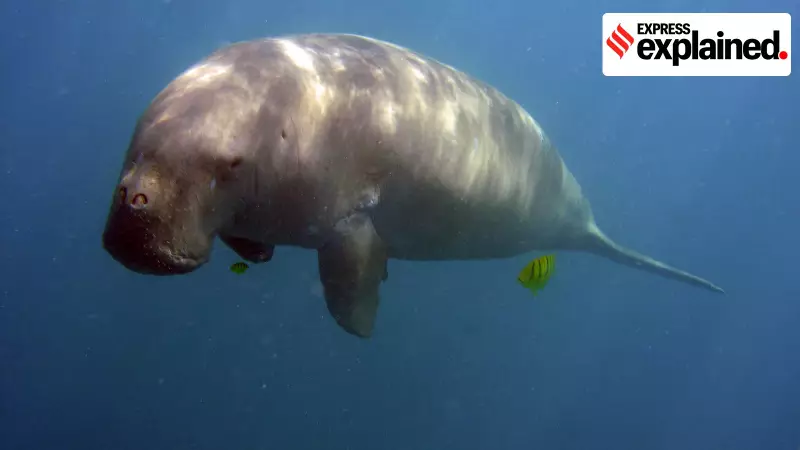
India's gentle marine giants, the dugongs or sea cows, are facing an alarming threat to their survival according to a recent international report. These majestic creatures, once believed to have inspired ancient mermaid legends, now stand on the brink of extinction in Indian waters due to relentless human activities and coastal habitat destruction.
The Grim Reality: Dugong Population Status in India
A comprehensive report titled 'A global assessment of dugong status and conservation needs' presented at the International Union for Conservation of Nature (IUCN) Conservation Congress in Abu Dhabi last month has revealed disturbing trends. The assessment indicates that the long-term survival of dugongs in the Gulf of Kutch is "highly uncertain" while their future in the Andaman and Nicobar Islands appears "challenging". Even in the Gulf of Mannar-Palk Bay region, their population has declined significantly compared to recent years.
Current estimates paint a worrying picture. While a 2012 government report indicated approximately 200 dugongs nationwide, current assessments vary. Professor K Sivakumar from Pondicherry University suggests between 400 and 450 individuals remain, though other experts believe the number is actually below 250. Anant Pande of WWF-India provides a more detailed breakdown: 150-200 dugongs in the Palk Bay-Gulf of Mannar region, less than 50 in Andaman and Nicobar Islands, and a mere under 20 individuals in the Gulf of Kutch.

Understanding India's Marine Gentle Giants
Dugongs (Dugong dugon) are remarkable marine mammals that can grow up to 10 feet in length and weigh approximately 420 kilograms. Their gentle nature and unique appearance - featuring a plump body similar to manatees but with a dolphin-like tail - likely inspired ancient seafaring tales of mermaids. These creatures are exclusively herbivorous, feeding primarily on seagrass, which explains their "sea cow" nickname.
"Dugongs inhabit shallow, warm coastal waters, often seen grazing in calm sheltered bays, lagoons, and estuaries less than 10 meters deep," explains Anant Pande. "An individual dugong requires about 30-40 kg of seagrass daily" to sustain itself, highlighting their crucial dependence on healthy seagrass ecosystems.
Ecological Significance and Economic Value
The importance of dugongs extends far beyond their charismatic presence. These marine mammals play a vital role in maintaining seagrass meadow health. Their grazing behavior acts as natural mowing, pruning leaves and uprooting old shoots. This process prevents overgrowth, stimulates carbon storage in sediments, and maintains the productivity of these crucial ecosystems.
Professor Sivakumar reveals the substantial economic value dugongs bring to coastal communities. Seagrass habitats where dugongs are present provide "a minimum of Rs 2 crore per year worth of additional fish production." He emphasizes that fish production is significantly lower in seagrass beds lacking dugong populations, demonstrating their critical role in supporting commercial fisheries.
Multiple Threats Converge on Dugong Survival
The decline of India's dugong population stems from several interconnected threats. Accidental entanglement in fishing nets represents the most immediate danger, causing numerous dugong fatalities annually. The challenges vary by region: high turbidity, pollution and fishing threaten dugongs in the Gulf of Kutch; fisheries bycatch and pollution are major concerns in Tamil Nadu; while fisheries-related mortality is particularly high in the Andamans.
A groundbreaking study published in Marine Pollution Bulletin has uncovered another serious threat: toxic metal contamination. Research led by Sivakumar, Pande, and Wildlife Institute of India scientists found arsenic, cadmium, chromium, mercury, and lead in tissues of 46 stranded dugongs. "This was the first global assessment of trace metal and metalloid concentrations in vital organs of dugongs," notes Pande, highlighting how industrial discharge, agricultural runoff, and untreated wastewater eventually contaminate the seagrass these animals consume.

Compounding these threats is the dugong's naturally slow reproductive rate. Females give birth only once every several years, making population recovery extremely challenging when facing multiple human-induced pressures.
Conservation Efforts and Future Challenges
Indian authorities have initiated several conservation measures over the years. The Environment Ministry constituted a 'Task Force for Conservation of Dugongs' in 2010, followed by a national dugong recovery program in partnership with Tamil Nadu, Gujarat, and Andaman and Nicobar Islands. A significant achievement came in 2022 when Tamil Nadu established the 448-square-kilometre Dugong Conservation Reserve in Palk Bay to protect crucial seagrass habitats.
However, conservationists stress that more needs to be done. Pande emphasizes that while these actions have helped, "enforcement of regulations in protected dugong habitats, reduction of threats, especially bycatch in fisheries and monitoring need to be strengthened." The lack of affordable alternatives to harmful fishing gear and insufficient incentive-based models to reduce fishing pressure continue to hinder conservation progress.
With dugongs listed under Schedule I of India's Wild Life (Protection) Act, 1972, and classified as vulnerable to extinction by IUCN, the urgency for comprehensive, effective conservation strategies has never been greater. The survival of India's sea cows depends on addressing the complex interplay of fishing pressures, pollution, and habitat degradation that threatens their existence in Indian coastal waters.