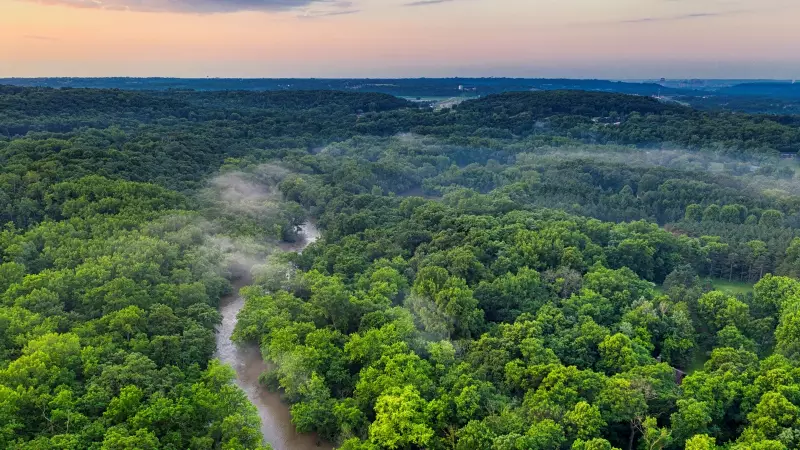
India's ambitious climate strategy faces an unexpected challenge as new scientific evidence reveals the country's natural carbon sinks are weakening under intense heat stress. This development threatens to undermine the arithmetic of India's net-zero by 2070 pathway, according to recent studies.
The Fraying Safety Net
When climate policymakers calculate national progress, they typically balance emissions against the carbon captured by forests, wetlands, and coastal ecosystems - nature's built-in "negative emissions" system. The conventional wisdom has been straightforward: plant more trees to lock away more carbon and buy valuable time for the clean energy transition. However, this environmental ledger is now showing alarming red flags.
A global multi-method study published in Nature Ecology & Evolution has uncovered a critical divergence in how carbon sinks function during extreme weather. The research demonstrates that terrestrial carbon sequestration weakens significantly during intense warm periods because plants' photosynthesis declines faster than their respiration rates.

While the mechanics might sound technical, the implication is starkly simple: heat waves, prolonged high vapour-pressure deficits, and drying soils reduce the amount of carbon plants can absorb, sometimes causing abrupt declines in carbon fixation capacity.
India's Greening Paradox
India's specific situation adds another layer of complexity to this global pattern. According to the Global Forest Resources Assessment 2025 (GFRA, 2025) by the FAO, India ranks as the world's fifth-largest carbon sink. The assessment notes that between 2021 and 2025, India's forests and tree cover absorbed approximately 150 million tonnes of CO₂ annually.
These impressive figures reflect the success of the country's afforestation programs and sustained attention to expanding tree cover. Satellite imagery confirms that India is visibly greening. However, the crucial question remains whether the functional capacity of this expanded green cover to absorb carbon is sustainable over the long term.
Recent research by IIT Kharagpur substantiates these concerns, finding that forests' photosynthetic efficiency - the physiological ability of plants to convert sunlight and CO₂ into biomass - has declined in several key regions. Heat stress, drought conditions, shifting precipitation patterns, and forest fragmentation mean that a hectare of forest today often sequesters less carbon than it did two decades ago.
The problem is compounded by India's current carbon accounting methods, which primarily measure forest area rather than actual carbon output, creating risk by conflating the two measurements.
Overlooked Assets and Policy Blind Spots
Another critical dimension being overlooked involves wetlands and coastal "blue carbon" ecosystems. Recent fieldwork in Assam and studies from India's mangrove belts and seagrass meadows document substantial, concentrated soil carbon stocks. Some wetlands store tens of thousands of kilograms of carbon per hectare in their soils.
Despite this significant potential, these ecosystems are routinely excluded from mainstream climate accounting, remain under-monitored, and receive insufficient funding. Institutional gaps further limit India's ability to translate this natural potential into reliable mitigation credits.
For a country targeting Net Zero by 2070, these findings represent more than just a footnote. Treating natural carbon sinks as a stable backstop risks mispricing mitigation efforts, misallocating scarce financial resources, and under-protecting livelihoods that depend on resilient ecosystems.
Building a Resilient Climate Strategy
Experts recommend a fundamental shift in India's climate policy approach. Rather than focusing solely on "more planting," the country needs a comprehensive three-part ARM framework:
Avoid: Protect and manage existing high-integrity forests from further degradation.
Restore: Repair degraded ecosystems with interventions that build long-term resilience.
Measure: Develop rigorous monitoring and reporting systems to track actual carbon uptake rather than just land area.

Additionally, India should operationalize instruments like payments for ecosystem services and ensure that climate-proofed restoration funding reflects the risk of carbon sink reversal rather than simply rewarding one-off plantation counts.
The country must also elevate the importance of wetlands and blue carbon in national climate policy. Carbon stored in mangroves, seagrasses, and wetland soils represents real, often durable storage, yet markets and policy frameworks rarely reflect their true value.
As natural sinks show signs of weakening, India should simultaneously diversify its mitigation portfolio. Feasible technological removals - such as direct air capture pilots and enhanced weathering research and development - should be accelerated, while nature-based solutions remain central for their co-benefits including biodiversity conservation, water regulation, and livelihood support.
Finally, India's economic policy must treat forests and coasts as living infrastructure requiring recurrent budgets. Trees are not a one-time capital expense; they need wildlife corridors, fire management systems, water security, and community incentives. This necessitates shifting some climate finance from headline plantation targets toward long-term maintenance, monitoring, and adaptive management.
The emerging scientific consensus indicates that nature has bought humanity valuable time in the climate fight, but it was never an unlimited credit line. For India's climate policy community and economists building models to inform decision-makers, key steps include embedding sink-degradation risk into scenario design, expanding land-use modules to account for non-linear sink behavior, and conducting sensitivity analyses to determine how much additional mitigation or investment becomes necessary if nature's carbon removal capacity continues to decline.