Gurgaon's Diesel Generator Pollution Crisis: Data Gaps and Compliance Challenges
In a startling revelation, diesel generator (DG) sets have been identified as the single largest source of local pollution in Gurgaon. However, the Haryana State Pollution Control Board (HSPCB) has admitted a critical oversight: it lacks comprehensive data on how many of these machines are equipped with mandatory emission-control devices.
Regulatory Framework and Current Numbers
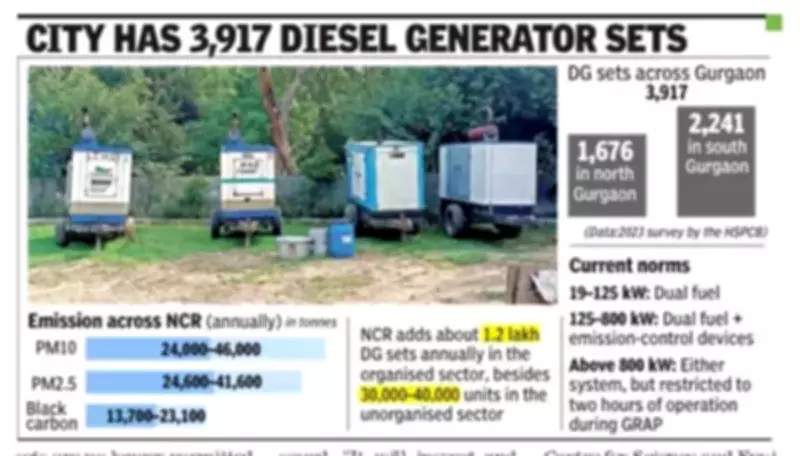
Under directives from the Commission for Air Quality Management (CAQM), only DG sets fitted with retrofitted emission-control devices (RECD) or dual-fuel kits are permitted to operate in the National Capital Region (NCR). A 2023 HSPCB survey revealed that north Gurgaon alone hosts 1,676 DG sets, while south Gurgaon has 2,241 units.
According to Central Pollution Control Board data, the organised sector in NCR adds approximately 1.2 lakh DG sets annually, with an additional 30,000 to 40,000 units purchased each year by the unorganised sector.

Compliance Norms and Operational Restrictions
Current regulations stipulate that DG sets between 19 kW and 125 kW must operate on dual fuel. Units ranging from 125 kW to 800 kW require both dual-fuel systems and emission-control devices. For generators above 800 kW, installation of either system is mandatory, but operation is restricted to two hours during the Graded Response Action Plan (GRAP) period. Notably, fifteen-year-old DG sets are completely banned in NCR.
Tracking Challenges and Enforcement Plans
HSPCB officials highlighted significant tracking difficulties, as a substantial number of generators in the city are rented, second-hand, or unregistered. The absence of a central registry makes routine verification of emission-control installations nearly impossible.
"Many DG sets are mobile or hired temporarily for construction sites, events, or commercial establishments. Without proper registration details, identifying and inspecting each unit becomes a challenge," explained an HSPCB official.
To address these gaps, the board plans to deploy a flying squad dedicated to inspecting and surveying DG sets. "It will inspect and carry out surveys on DG sets," confirmed HSPCB regional officer Akansha Tanwar. This initiative aims to map operating generators and verify compliance with approved emission-control standards.
Manufacturing Standards and Expert Insights
New generators are subject to stricter manufacturing criteria. For instance, particulate emission limits for DG sets up to 19 kW have been reduced from 0.3 g/kW-hr to 0.03 g/kW-hr.
Experts emphasize that reducing reliance on DG sets ultimately depends on improving grid reliability. Anumita Roy Chowdhury, executive director (research and advocacy) at the Centre for Science and Environment, stated, "Unless power supply stabilises and infrastructure improves, housing societies, commercial buildings and industries will continue falling back on diesel generators, locking NCR into a cycle of avoidable pollution."
CAQM Directives and Industry Concerns
On June 28, 2023, CAQM mandated that retrofitting must be completed by September 30, 2023, failing which diesel generators would be prohibited from operating anywhere in NCR, including for essential services. DG sets above 19 kilowatts are only allowed to run if fitted with emission-control devices or dual-fuel systems, a rule applicable even when GRAP is not enforced.
CAQM noted in its order, "By far, major residential, commercial and industrial pockets in NCR have access to PNG infrastructure and supply. Even where dedicated supply is not feasible, gas availability through cascades and cylinders is a convenient option."
Currently, certified agencies are available for RECDs in the 125–500 kW range, with certification for 500–800 kW expected soon. CAQM also acknowledged industry concerns regarding costs, noting that for smaller DG sets, retrofitting expenses can nearly equal the price of a new machine.
Persistent Usage and Environmental Impact
Despite regulatory efforts, DG sets remain widely used in Gurgaon due to frequent localised power outages. In many townships and condominiums, generators activate when sanctioned load falls short of actual demand, leading to breakdowns and routine dependence on backup power.

Studies highlight the massive scale of emissions from DG sets in NCR. Annually, they release:
- 24,000-46,000 tonnes of PM10
- 24,600–41,600 tonnes of PM2.5
- 13,700-23,100 tonnes of black carbon
Additionally, nitrogen oxides and carbon monoxide emissions run into millions of tonnes each year.
The situation underscores the urgent need for enhanced monitoring, stricter enforcement, and improved power infrastructure to mitigate Gurgaon's air pollution crisis.